

Insight | 01.17.25
Insight | 01.14.26
Throughout the modern marketing industry’s short, dynamic history, one question has always dominated: What’s next?
Marketers spend millions each year chasing the next big thing, gambling on what’s going to hit and following trendmakers wherever they lead. But following usually leads to a huge problem: chasing doesn’t work. By the time you catch up to culture, it has already moved on.
Brands that create culture instead of chasing it are the ones that win, but those cases are rare. You either need the budget to constantly experiment until something sticks (think: funny, intriguing daily video social content), or you need a lot of luck (think: Stanley Cup’s influencer strategy). Even the smartest, funniest, most award-winning work doesn’t guarantee a place in the conversation. After all, how many people outside of advertising know who won a Cannes Lion, or even what that is?
So maybe we should stop thinking about what’s next and start talking about what matters. All this chasing, creating, and throwing things at the wall in hopes that something sticks has created an incredibly crowded space, making the ability to stand out more important than ever. And rising above in the new year is going to require taking a higher road.
By now, you may have seen a recent Wall Street Journal piece on the role of storytelling in building brand loyalty. It wasn’t about the brand-anthemy, long-form copy kind of storytelling. It was about the kind of storytelling that gives brands context. The kind that tells the world who a company is, where it fits within the competitive set, why it exists at all, and, most importantly, why anyone should care. Because in a world where AI can write a brand anthem, a “big, bold rally cry” means nothing without the substance to back it up.
In a world flooded with content, the brands that win aren’t the loudest; they’re the clearest. They’re the ones that can articulate a point of view and sustain it across channels, leadership voices, customer experiences, and culture. Audiences are tired of being targeted, optimized, segmented, and “journeyed.” They’ve developed an almost supernatural ability to sniff out content that exists solely to sell them something.
Which brings us to AI. By 2026, AI won’t be the headline anymore, it’ll be background noise. As we’ve said before, AI is a tool, and it will remain one. It will quietly power personalization, media buying, forecasting, content testing, and a hundred other things we no longer think twice about.
The mistake brands are already making is assuming that because AI can generate, it can also connect. It can’t, at least not on its own. The brands that get it right will use AI the way great teams use great tools: to move faster, spot patterns sooner, and free up time for real thinking.
At the same time, trust is becoming the real currency of marketing. Privacy changes, disappearing cookies, and growing consumer awareness have shifted the power dynamic. There’s a reason word of mouth and unpaid recommendations remain the most powerful forms of advertising: they’re among the few sources people still trust (most of the time). By 2026, ethical data practices will be a brand signal. Companies that are clear about what they collect, why they collect it, and how it benefits the customer will stand apart in a market that still struggles with transparency.
Another shift that’s impossible to ignore is the move away from one-off influencer moments toward true creator ecosystems and brand communities. Audiences don’t want to be “influenced” anymore; they want to belong. They want to see brands show up consistently, collaborate authentically, and earn their place in culture rather than rent it for a campaign cycle. Once again, it comes back to honesty and meaning.
But how will people be reached? Short-form video, live formats, and immersive experiences aren’t trends so much as the default language of modern communication. The brands that perform best aren’t necessarily producing more content; they’re producing content that understands how people actually consume it: quickly, emotionally, and often on mute.
Behind the scenes, marketing teams are changing too. Roles are blurring, with strategy, creative, data, and technology increasingly overlapping. The most effective teams heading into 2026 are built for adaptability, not perfection. They test, learn, adjust, and move on. They value judgment as much as output, and curiosity as much as efficiency.
But can brands be authentic without authenticity becoming just another marketing buzzword? That’s a blog for another time. In the meantime, marketing is still about making people feel something and then do something. The tools have changed. The pressure has intensified. The margin for error has shrunk. But the core truth hasn’t moved an inch.
For Yalo, it’s not about chasing every new platform, format, or promise. It’s about using every tool at our disposal (technology, data, creativity, and yes, AI) to help brands show up honestly and with intention. We’ll keep focusing on work that earns attention instead of demanding it, builds trust instead of gaming the system, and creates real connection instead of noise. Because the brands that win next won’t be the loudest, they’ll be the ones that know who they are, why they exist, and how to show up meaningfully in people’s lives.
Insight | 02.17.25

Ah, Crocs. Once upon a time, they were the foot-things we loved to hate. First marketed as boat shoes back in 2002, they were quickly banished to the realms of “ugliest footwear ever.” Yet here we are, decades later, watching Crocs not just survive but thrive. What on earth happened, and more importantly, what lessons should brands take from Crocs?
Let’s dive in.
From Utility to Individuality: A Lesson in Amping It Up
When Crocs first launched, they were known for their functionality. Designed for comfort and durability, they were utilitarian to a fault—practical but lacking personality. They were, essentially, the sensible shoe your middle school teacher wore to do yard work. But in 2017, under new leadership, Crocs made a radical shift. Instead of focusing on what their shoes did, Crocs began to focus on what they could mean: a symbol of joy, self-expression, and yes, even style.
The pivot required them to go beyond what was merely expected or necessary, leaning into unexpected and over-the-top moves to demand attention. The brand started to pump out partnerships with everyone from Post Malone and Justin Bieber to fast-food icons like KFC. (Yes, they made fried chicken Crocs—complete with a drumstick Jibbitz™ charm). These collaborations were fun, unexpected, and just the right amount of outrageous, amplifying Crocs from “comfort wear” to a bold, if still questionable fashion statement.
This is a textbook example of what we at Digital Yalo like to call “Amping It Up to 11.” Crocs didn’t stop at merely shaking their old, practical reputation; they cranked up the individuality and let loose with wild collaborations and off-beat charm accessories. And frankly, anything less would likely have been insufficient.
A Visionary Journey: Embracing the Tour
To be clear, this resurgence didn’t happen overnight, and it certainly wasn’t a straight shot. By 2008, Crocs was practically on life support, hemorrhaging $185 million and cutting thousands of jobs. The stock had plunged, the business was in shambles, and it would’ve been easy to simply refocus on what was safe and comfortable. But rather than retreat, Crocs doubled down on a long-term strategy rooted in self-expression and individuality.
They knew where they wanted to go—they just had to be patient enough to make the journey.
This is what we at Digital Yalo like to call “Embrace the Tour.” Crocs had a vision of where they wanted to be, and they weren’t deterred by short-term losses or missteps. They didn’t panic when the seas got rough; instead, they leaned into the tour, adapting their strategy and committing to a path that was uniquely their own. Today, they’re forecasted to hit $5 billion in sales by 2026. That’s what happens when you stay true to your destination and weather the obstacles along the way.
Inclusion and Authenticity: A Genre for Everyone
One of the key ingredients in Crocs’ recipe for success is their unapologetic embrace of individuality—something we value here at Digital Yalo as “We Are All Genres.”
By positioning themselves as a blank canvas for self-expression, Crocs tapped into a universal truth: people want to feel included and authentic, no matter how quirky or niche their tastes. Crocs let people be a little bit extra (or a lot extra) and celebrate it, whether it’s with a mini ranch bottle charm or a platform heel so chunky it doubles as an ankle workout. In the world of Crocs, there’s a shoe for everyone, and everyone is welcome.
The takeaway? Crocs didn’t merely follow a trend—they made one. By going big on the unexpected and embracing the long haul, they’ve turned a former fashion faux pas into a cult favorite. It’s a reminder that true brand success isn’t just about filling a need. It’s about connecting with people in ways that matter to them, leaning into bold ideas, and staying committed to a vision.
So, next time you’re looking to Amp it Up or Embrace the Tour, take a page from Crocs’ playbook: make it memorable, make it bold, and never shy away from a little fun along the way.
Insight | 12.27.23

In the dynamic world of marketing, staying ahead of the curve is not just a competitive advantage—it’s a necessity. As we step into 2024, the marketing landscape is set to evolve yet again, presenting exciting opportunities for businesses to thrive in an ever-changing digital ecosystem. Today we’ll delve into the marketing trends that will shape the industry in 2024 and provide invaluable insights for marketers aiming to stay at the forefront of innovation.
As we navigate the complexities of the marketing landscape in 2024, embracing these emerging trends will be crucial for staying competitive and driving meaningful engagement with consumers. By harnessing the power of AI-driven personalization, voice search optimization, augmented reality experiences, purpose-driven marketing, and authentic influencer partnerships, brands can forge stronger connections, foster loyalty, and achieve sustainable growth in the years to come.
So, gear up for an exciting year ahead and let Yalo help you embrace these trends to propel your marketing efforts to new heights in 2024!
Insight | 06.07.23

Summer is here, and it’s the perfect time to kick back, relax, and catch up on some reading. Whether you’re an aspiring entrepreneur, a seasoned business professional, or simply someone interested in learning more about the world of commerce, there are plenty of captivating business books to dive into this summer. Here are a few of our favorites:

“The Lean Startup” by Eric Ries:
If you’re an entrepreneur or planning to start your own business, “The Lean Startup” is a must-read. Eric Ries introduces the concept of validated learning and provides a framework for building successful companies in an uncertain environment. Learn how to iterate quickly, test assumptions, and create a sustainable business model based on customer feedback.

“Range: Why Generalists Triumph in a Specialized World” by David Epstein:
In a world that often values specialization, “Range” challenges conventional wisdom by advocating for the power of broad thinking. David Epstein explores the benefits of diverse experiences and skill sets and how they can lead to breakthroughs and innovation. Discover the advantages of being a generalist in a rapidly changing business landscape and embrace the potential of interdisciplinary knowledge.

“The Infinite Game” by Simon Sinek:
Simon Sinek’s “The Infinite Game” encourages a long-term perspective in business, emphasizing the importance of purpose and sustainability. By contrasting finite and infinite games, Sinek explores strategies for building resilient organizations that can adapt and thrive in an ever-evolving market. Gain insights on leadership, organizational culture, and the power of a compelling vision to inspire and motivate teams.

“Thinking, Fast and Slow” by Daniel Kahneman:
Nobel laureate Daniel Kahneman takes readers on a fascinating journey through the mind, exploring the two systems that drive our decision-making processes. “Thinking, Fast and Slow” helps you understand the cognitive biases and heuristics that influence our choices, both as individuals and in business. This book will sharpen your critical thinking skills and help you make more informed and rational decisions.

“Never Split the Difference” by Chris Voss:
Effective negotiation skills are essential in the world of business. In “Never Split the Difference,” former FBI negotiator Chris Voss shares his experiences and techniques for successful negotiations. Drawing from real-life scenarios, Voss provides practical tips on building rapport, active listening, and finding mutually beneficial solutions. Master the art of negotiation and enhance your communication skills.

For those interested in the world of startups and rapid growth, “Blitzscaling” offers valuable insights. Reid Hoffman, co-founder of LinkedIn, and Chris Yeh present a roadmap for scaling companies at breakneck speed. Learn about the strategies, risks, and cultural shifts required to build and sustain hyper-growth organizations. This book is a treasure trove of knowledge for entrepreneurs and business leaders aiming for exponential success.
Make the most of your summer by immersing yourself in these thought-provoking business books. From entrepreneurial principles to negotiation tactics and innovative thinking, each recommendation offers unique perspectives to help you thrive in today’s dynamic business landscape. Whether you’re an aspiring entrepreneur, an established professional, or simply someone looking to expand your business acumen, these books will equip you with the knowledge and inspiration you need to succeed!
While you’re here and reading our suggestions for great content to enjoy this summer, you should consider Yalo’s own content marketing services for building better brands. From customer communications and social campaigns with honed messaging to thought leadership strategy that helps position your brand as an A-list player, our strategic content creation deliverables make your business an informed and productive voice in the marketplace of ideas.
Insight | 05.23.23

In today’s world, consumers are bombarded by countless advertisements on a daily basis. Consumers are now looking for more out of these advertisements than just sale prices. The younger generation, ages 18-25, are also interested to see if a brand supports diversity and inclusion. Because of this, brands are also increasing their focus on diversity, equity, and inclusion (DEI) as well.
Consumers today want to support brands that represent them as well as their values. Many organizations that have made DEI efforts a core priority also recognize that it’s just as important to feature representation in front of the camera as it is behind the scenes.
There are several ways companies can accomplish this.
One way is to ensure your teams and suppliers reflect your market. Teams—both internal and external—that closely reflect the markets they serve can reduce the cultural and demographic distance between the brand and the consumers they aspire to reach.
Companies can also utilize diverse voices for the organization. As companies are often continually researching their changing customer base, they should use those findings to continuously monitor and bring the needs of underrepresented communities to their organization—and feature those voices and faces in campaigns.
Most importantly, ensure your commitments are measurable. Often times, organizational leaders state that improving diversity is a goal that they are working towards – and a year or more goes by and they have made no progress. There should be specific goals companies are trying to reach including representation at all levels of the organization. Ultimately, no amount of messaging can help a brand overcome the hurdle of being labeled disingenuous. One way to solve for this is to make sure your DEI goals are not just checking a box but creating real, measurable outcomes including leadership representation.
I will leave you with an interesting statistic that helps validate the impact of diversity in marketing. According to the Deloitte 2022 Marketing Trends Report, high-growth brands (defined as those with annual revenue increase of 10% or more) are more frequently establishing key performance metrics for DEI objectives than their lower-growth competitors. How are your DEI actions measuring up?
————
Brandon Bradford makes sense here, doesn’t he? At Digital Yalo, we’re working hard to reflect the culture and demographics we live within, and enjoying the journey along the way. Would you like to work with us? Yalo has open positions from time to time and we’re looking for talented, capable, forward-thinking individuals.
We’re also striving to deliver the best customer service, ideas and deliverables when it comes to our clients and our branding and marketing services. Would you like us to work for you? We feel that our work speaks volumes about our capabilities – take a look at some of our recent samples, and then reach-out to us at the bottom of this page or via our simple Contact form. We look forward to hearing from you.
Insight | 05.09.23
Our UX Design teams in Atlanta and Cleveland are always looking for ways to speed-up our workflow. Here are 5 of the Chrome extensions we’ve been putting to good use regularly at Yalo.
Loom
This plugin is billed as video messaging for work and while I’m sure it fulfills that overarching goal, we primarily use it to quickly record UX and UI work that benefits from a video walkthrough.
Whether that’s demonstrating animations and interactions within a design that can’t be captured with normal prototyping or including our design thinking and context with a given design, this tool gives us an easy way to add video and voice to our work.

As a designer, if you often find yourself on a site and wonder about the typography they have in place, this is the tool for you. Simply hover over the fonts in question and get an immediate identification. Your days of going down the “inspect code” rabbit hole are over.
It will also detect the services being employed for delivering the fonts to the site such as Adobe and Google Fonts.

Responsive design is here to stay and this simple tool allows you to quickly see your site at many different viewports. When you’re designing on a giant monitor, a tool to see how most users will be interacting with your site comes in handy.
Choose from the most common presets or set custom sizes if you are targeting a specific device.

This beautiful color palette-generating website also has a handy Chrome extension. While the plugin isn’t very robust (new tabs give you new palletes), the site is so useful and a quick way of getting there that it’s enough to make our list.

How’d they do that? This plugin will return a detailed profile of any site you visit, outlining all the technologies they’ve employed to make it happen.
Depending on your scenario, this could serve as a handy guide in your own project plans.

Need more UX Design tips and tricks? Are you ready for a UX refresh? Let us know, we will be happy to help with our team of UI/UX design and development experts!
Insight | 01.17.23
At one point or another you’ve probably asked yourself: “How can I improve my marketing skills?” Maybe not in those exact words (that’s kinda weird), but you’ve definitely wondered if you could be working harder or smarter to build your brand.
The answer is yes, of course. Everyone could. And a good way to start is by learning which marketing strategies to avoid. Sounds complicated? Just bear with us.
There’s a reason Socrates, Plato, and Descartes aren’t well known for their social posts, email campaigns, and out-of-home work. (Besides the fact that they lived roughly a million years before electricity.) It’s because content isn’t a philosophy; it’s a tactic. Too often, when coming up with marketing strategies, these two things get confused.
While there are many viable tactics that play an important role in growing a brand, what’s really important are the philosophies behind the tactics. Here, we’re going to discuss some marketing mistakes to avoid that miss the big picture and put your brand or business in a hole from the start.
Unless you are marketing to an extremely specific, possibly magical market segment, the consumer is not a werewolf. One strategy (or silver bullet) is not going to take care of your entire problem. How many times have you seen a brand make one Instagram post a week and leave it at that? If you want to have meaningful engagement with the consumer, you need to create a constant dialogue to grow the relationship over time. Repeated interaction with a brand builds the interest and, more importantly, the trust that is required to maintain those relationships. Branch out and engage your target audience in multiple ways and continue to do so consistently over a long period of time. It won’t kill a werewolf (probably?), but it will help your business.
An outdated marketing technique that we see all the time is the idea that you just need a cool website, and the money will start rolling in. Building a website is just the tip of strategy iceberg. This points back to strategy #1—there is no silver bullet, not even parallax scroll. Unless you are constantly going out of your way to engage the consumer, they’re not going to just show up in person or virtually and give you their money. The ghost of Shoeless Joe Jackson might be powerless to avoid what you’ve built, but everyone else is going to need a little bit more from your brand. That’s a “Field of Dreams” reference, for those of you under the age of 45.
Speaking of outdated references, there’s a reason the phrase “OK Boomer” became part of the pop culture lexicon. It’s not so much about that specific generation as it is about thinking that your experience is universal—that it transcends geography and generations. Consumers are all different. They’re different from each other and different from you. Even if a 55-year-old man has been working in the same business for 25 years, that doesn’t mean he knows the best way to reach his 28-year-old female audience. There are numerous ways you can survey consumers to figure out what they want and develop a strategy that addresses those specific needs and desires. So don’t just go with your gut—do the research. OK Boomer?
“Do you make viral videos? Let’s do that.”
A viral video or any singular piece of content is a “what.” Before a brand has a “what,” it needs a “why.” It’s essential to develop a strategy as the foundation for your content. Before you can make something meaningful, you have to figure out why you’re making it in the first place. What purpose will it serve? How does it fit with the other moving parts of the brand? Foregoing strategy to just “make stuff” is like shouting into the wind. So put a purposeful strategy in place, and you won’t just be making stuff; you’ll be building something.
Imagine the owner of the Kansas City Chiefs letting his nephew start at quarterback because he’s really, really good at playing Madden on his PS5. Sounds ridiculous, but similar things happen all the time in the marketing and advertising industry. Just because your sister’s boyfriend took a Photoshop class last semester does not mean he should be handling crucial aspects of your business. Professionals—people who’ve studied advertising and marketing and put it into practice for multiple industries—have more than just the basic tools and programs to make a piece of content. They also have the experience and understanding to give meaning to the work. It’s worth investing in people who know what they’re doing when it comes to your business needs.
If you and your agency have a clear picture of your budget from the start, then you can work within that framework to create a strategy that maximizes resources and ensures all your ideas remain viable options. While it may seem freeing to have no budget, it can be a huge waste of time and resources to come up with 100 different variations of an idea only to have 99 of them dismissed because you can’t afford them. Think of it like building a sandcastle: it’s far easier to focus on getting it right if you’re working in a sandbox as opposed to running all over a huge beach. Your agency needs the sandbox.
There’s an old idiom that says, “why keep a dog and bark yourself?” And while we’re not sure why any human would bark (idioms can be weird), there’s a lot of truth in that statement when it comes to hiring marketing teams. When you pay an experienced marketing team to do what they do best, it’s a huge waste of time and effort to not delegate the work to them. Allowing the team you hired to do their jobs is an incredibly important strategy, yet work is so often undercut with “thanks, but let’s do my idea instead.” In other words: let the people you pay to do a job actually do their job. In other, other words: let the dog bark.
Welcome to the loop. Sales doesn’t know what Marketing is doing. Marketing doesn’t know what Operations is doing. Operations doesn’t know what Sales is doing. Ad infinitum. If you aren’t sharing business goals and objectives with all the departments involved with those goals and objectives, you don’t get a well-oiled machine—you get a Rube Goldberg device that leads nowhere. It’s crucial to make sure everyone can see the bigger picture; that way, each part can work toward a cohesive whole, and you’ll have a strategy to avoid a communication breakdown.
Does your business or brand spend millions of dollars a year on creative? How about hundreds of millions on marketing as a whole? Do you have a passionate, sometimes obsessive fan base that will probably support your brand no matter what? If you said yes to this, then congratulations, you are Apple. Otherwise, you’re going to have to approach things another way. Without investment in resources, you can’t get the quality, consistency, and loyalty you desire. Let’s be honest, even with all that, you still can’t be Apple. But you can take a page out of their book—when it comes to your brand’s strategy, “Think Different.”
More likely than not, you’ve already experienced a few of these “strategies.” Don’t worry, we’ve all been there at some point. But with the right agency, budget, and team behind your brand helping you build a strategy that’s right for you, success will come. Good luck out there.
Oh and by the way, Yalo has been helping companies excel and stand-out in the marketplace for a long time now. We’ve even won awards. You can consider us for your needs too. Reach us at the bottom of this page to start a conversation.
Insight | 01.04.23

As a new year begins, marketers are predicting which marketing trends will matter the most and placing their bets (and budgets) on those they believe will show the most return on investment. Here below are five tactical trends that we see adding value to the market(ing) place in 2023.
A strong brand can build customer loyalty, increase customer lifetime value, drive business growth, and increase the perceived value of your products or services, which can lead to higher prices and more profitability.
A few benefits of building a strong brand:
Full disclosure: Yalo offers our Brand Strategy Bootcamp to help fledgling as well as established brands to dip their toes in the world of brand strategy for greater awareness in the public sector. It’s a fun, informative, effective exercise our clients love to experience!
Creators are the beating heart of social media, and their endorsements can shape consumer behavior drastically. The creator economy refers to the network of people who create and share content online, often for a large and engaged audience. Brands can tap into the creator economy in a number of ways:
Overall, the key to success in the creator economy is to build authentic and mutually beneficial relationships with creators. This can help brands to reach new audiences and stay relevant in an increasingly digital world.
Artificial intelligence (AI) and automation are being increasingly used in marketing to help companies save time and resources, as well as to improve their marketing efforts. Some common applications of AI in marketing include:
Another disclosure! Yalo has been offering Sentiment Analysis services powered by AI for some time now for business intelligence for our clients.
TikTok and user-generated social media videos that organically draw in an audience or create word-of-mouth are the best bang for your buck. There are several benefits of user-generated social media videos:
Brands can leverage web3 technology and virtual influencers in a number of ways. Here are a few potential strategies:
Overall, virtual influencers and web3 technology offer brands new and innovative ways to reach and engage with their audience. By staying up-to-date on the latest trends and technologies, brands can find creative ways to leverage these tools to their advantage.
Let Yalo keep you on-trend in 2023. Subscribe to our free e-blasts below for informative, entertaining and stimulating analysis and critiques on what‘s happening in the worlds of marketing, advertising and pop culture. Scroll down to the bottom of the page if you’d like to start a conversation with us!
Insight | 12.07.22
No matter how you spend the holiday season, there’s no better way to keep spirits bright than with a magical winter cocktail.
Light up this festive time of year with a few favorites sure to have your yuletide cup overflowing with cheer!

White Christmas Margarita By: Food Network Kitchen
INGREDIENTS
1 1/2 cups frozen cranberries
1 cup tequila blanco
2/3 cup fresh lime juice (from about 6 limes), plus 4 lime slices, for serving
6 tablespoons orange-flavored liqueur, such as triple sec
3 tablespoons unsweetened coconut milk
3 tablespoons superfine sugar
1/2 cup light corn syrup
2 tablespoons extra-fine shredded unsweetened coconut
Kosher salt
DIRECTIONS

Vodka Cranberry Punch with Apple Cider Ice Cubes By Jessica Merchant
INGREDIENTS
2 cups apple cider, or more as needed
1/3 cup sugar
1/4 teaspoon ground cinnamon
3 cups cranberry juice cocktail
1 1/2 cups vodka
1/2 cup orange juice
6 cinnamon sticks
1 cup fresh cranberries
DIRECTIONS

Champagne Bourbon Cocktail By: Bobby Flay
INGREDIENTS
1/2 cup sugar
1/2 cup water
1/2 vanilla bean, split and seeds scraped
Bourbon (recommended: Woodford Reserve)
Prosecco or sparkling wine, chilled
DIRECTIONS

Gingerbread Martini By: Trisha Yearwood
INGREDIENTS
4 ounces Irish cream liqueur, such as Baileys
4 ounces vodka, such as Kettle One
2 ounces coffee liqueur, such as Kahlua
2 ounces Gingerbread Syrup, recipe follows
2 scoops vanilla ice cream, softened
Whipped cream, for topping
Small handful gingerbread cookies, crushed
DIRECTIONS
Combine the Irish cream liqueur, vodka, coffee liqueur, Gingerbread Syrup and ice cream in a cocktail shaker. Add ice and shake well. Pour into four chilled martini glasses. Top each with a generous dollop of whipped cream and a sprinkling of gingerbread cookie crumbs.
Gingerbread Syrup:
Yield: 1 1/2 cups
Add the sugar, water, cloves, cinnamon and ginger to a small saucepan. Bring to a boil over medium-high heat, stirring until the sugar has dissolved. Lower the heat and simmer for 5 minutes. Remove from the heat and let cool to room temperature before using, about 20 minutes. Cover and refrigerate for up to 2 weeks.

Peppermint White Russian By: Food Network Kitchen
INGREDIENTS
1 ounce coffee liqueur
1 ounce vodka
¾ ounce peppermint Schnapps
1 ounce heavy cream
DIRECTIONS
For each drink, combine 1 ounce each vodka and coffee liqueur and 3/4 ounce peppermint schnapps in a short glass; fill with ice. Pour in 1 ounce cold heavy cream. Serve with a peppermint stick.
If you are looking for more great ideas, please check out the Food Network’s 59 Festive Drink Recipes.
Want to see what Yalo can mix-up for your business in terms of creative branding and marketing campaigns? Shaken or stirred, we’ve got you covered. Let’s talk.
Cheers Everyone!
Insight | 10.26.22

Halloween is a great opportunity for brands to creatively connect with their customers, from Mausoleum pop-up stores to selling garlic-sauce talisman necklaces. Even celebrities such as Keke Palmer are participating in this year’s Halloween-themed campaigns.
Here’s a look at a few spooktacular strategies. ????
HEINZ
Heinz released new versions of its condiments designed for Vampire Influencers—Black Garlic Mayo and Tomato Blood Ketchup.
To promote these new variants, the brand partnered with Toby, a 280-year-old vampire influencer, who prefers to drink Tomato Blood Ketchup over human blood. Heinz will also open a store in the middle of the Boldu-Cretuleasca forest, in Romania, on Halloween, and will only be open from midnight to 1 a.m. Those who visit the store will be gifted with a sample of the Black Garlic Mayo. ????????♂️
PAPA JOHNS
Papa Johns launched a garlic sauce talisman necklace for Halloween. The campaign sees Papa Johns resurrect its ‘80s horror film parody series, “Jack!,” with the launch of its first-ever piece of jewelry—the Stranger Bling necklace is a nod to Netflix’s hit “Stranger Things“. ????
UBER EATS
Actress Keke Palmer partnered with Uber Eats to deliver a new horror short, “Don’t Run Out,” with $1 million worth of discount codes hidden in it.
The video sees a trio of friends who, on Halloween night, realize that they’re running low on candy. Palmer’s character explains how one family vanished on Halloween after the same thing happened to them, as she rushes to order more on Uber Eats. The friends all split up, each pursued by a masked figure in the shadows, later revealing itself at the end.
CHEETOS

Chester Cheetah and Cheetos are taking their antics to virtual reality this Halloween. Cheetos unveiled Chesterville, a new, digital suburban neighborhood and the first exciting venture into virtual reality for the brand.
“This is a significant moment for both the brand and the portfolio as we broaden the ways we engage with fans, inviting them to experience Cheetos in an entirely new way,” said Stacy Taffet, senior VP of marketing for Frito-Lay, the parent company of Cheetos.
The goal is to gain access to the spooky mansion atop Cheetos Hill. Once inside the mansion, fans can unlock a chance to vote for their favorite “ghost of Cheetos’ past” and help bring a no-longer-available flavor back to life in the real world. Fans will choose from one of three favorite flavors to resurrect for a limited run: Cheetos Flamin’ Hot Chipotle Ranch, Cheetos Flamin’ Hot Pepper Puffs or Cheetos Nashville Hot snacks. ????
TWIX
If Halloween had a mascot.. it would definitely be chocolate.
Since 2012, Twix has delivered ad campaigns focused on the left and right sides of their chocolate bars. ????
Features of Right Twix
Features of Left Twix
Need more spooky inspiration? Here is a compilation of 10 of the best Halloween Commercial Ads ever, including Burger King, Nike, LG, Skoda, Mars, Snickers, IKEA and Booking.com.
COMPILATION OF SOME OF THE BEST HALLOWEEN ADS
These commercials are fun and boo-tiful examples of creative branding and marketing that leverage our collective participation in a holiday experience. Have you ever considered how your brand might benefit from such an exercise at a certain time of the year? Allow Yalo to help you mine the possibilities – creative marketing campaigns are what we’re all about. Please scroll down to the page bottom and click the Contact Us button to start a conversation.
Insight | 10.24.22

Gearing up for Grammy season and you know us here at Yalo, looooooove our music. It is part of our DNA. It is part of our methodology. Maybe you’ve heard of our Soul Song creative process that helps brands identify their soul and amp up their brand presence? If not, we should talk!
Now, back to the topic of bands reppin’ brands. This started decades ago. For me, my first memories of this being a ‘thing’ was back in the early 80’s when rap music first emerged. I believe the rap music genre created and capitalized on the opportunity. Do you remember LL Cool J and the Kangol?

Run DMC and Adidas shell toe shoes and track suits were synonymous. You couldn’t hear a Run DMC song and not think Adidas.

However, for years before and after rap did it, it was considered ‘selling out’ by other bands and artists. They opposed it. Well, the rap pioneers didn’t care. I think they considered it part of the hustle. Just like selling their music mixtapes music out of their trunk and on street corners. By any means necessary.
But then, the King of Pop did it. He represented Pepsi. Who could forget his hair catching on fire while filming a commercial? Despite the hair and fire thing, he made it ok, he made it cool to put your music with a brand. Since then, many bands and brands have gotten together. These days, just about anybody’s music will show up in a commercial, even the Beatles. There are tastemakers whose sole job at major brands is to seek out the newest, coolest, hippest artists to include in their commercials. What a great job, who wouldn’t want to do that!
These tastemakers put together unlikely pairs like Motley Crue and Ally Financial using “Kick Start My Heart” in a commercial (see our blog on this). They put together trendy artists with brands that want to look cool and appeal to a younger generation. A few examples that come to mind are:
They are even taking old songs and making them cool again. How about Walmart and Gary Numan’s “Cars”?
But it doesn’t stop there. Michael Jordan pioneered athletes getting into this game too by creating the Air Jordan brand by Nike. The marriage of Jordan and Nike has turned itself into a $1B business in and of itself. Recently, the most notable athlete example is Lebron James and Beats. Not only did Lebron start reppin’ the headphones, but he also became part owner. Now that’s how you double down on yourself!
So, I ask you this. Who would you pick as your artist or band to represent your brand? Tell us by posting your choice #YaloBandnBrand. Here are some of our Yalo tribe favorites and selections.
While you’re thinking about your brand, why not allow Yalo to give you some new ideas about your public persona? Brand strategy is one of our favorite things to do to help a company interface well with the general marketplace. Contact us at the bottom of this page and let’s get something started together.
Rock on!
Insight | 09.28.22
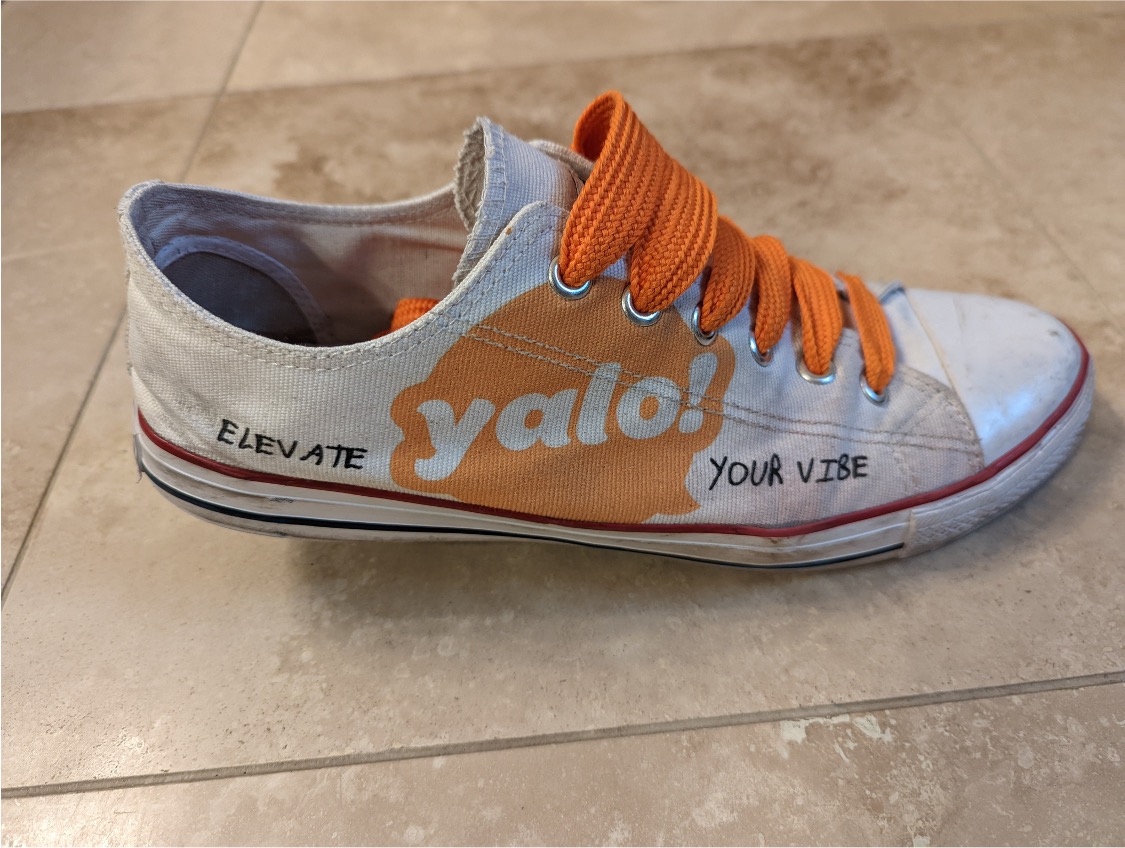
Do you ever wonder what your shoes say about you? Who would’ve guessed that the way we dress our feet could reveal so much about who we are? Well, it turns out that they do! Your shoe style can tell us a lot more than just how much time you spend at the gym or if you’re into fashion trends.
So why are shoes so meaningful? Well for starters, they can be used as an outlet for self-expression. From glittery stilettos to sneakers and everything in between—shoes can help tell others about your personality or mood depending on what kind of shoe or sandal you choose to wear on any given day.
The Yalo Tribe is known for its Soul but now let’s look at their Soles. Here are the results from our recent favorite shoe poll:

Leading the pack for the sports and outdoors category is our own CEO Arnold Huffman with his custom Yalo kicks.

Eric, Rachel, and Brian are all on the sports and outdoors train

Tim, Giselle, and Jeff… bike, skate, and jump

Nick, Kate, and Robert are kicking it up a notch

Lance, Kenny, and Brandon are brand loyalists repping Nike

Denise and EJ are our resident Business Fashionistas

So what are your favorite pair of shoes? Here is some musical inspiration to help you decide!
Blue Suede Shoes – Elvis
Dancing Shoes – Arctic Monkeys
Old Brown Shoe – The Beatles
No Shoes, No Shirt, No Problem – Kenny C
Boot Scootin’ Boogie – Brooks & Dunn
Head Over Boots – Jon Pardi
Nike’s On My feet – Mac Miller
Nikes – Frank Ocean
Just Kickin’ It – Xscape

As you can tell by how we bare our soles, we’re not the typical creative design and marketing agency. We’re full of outside-the-shoebox ideas, and we use them to make our clients more successful every day. From marketing communications and branding to website design & development and video & animation, we’re unde-feeted when it comes to design and delivery. Scroll down a bit and contact us – let’s have a conversation and rock the world together.
Insight | 08.02.22
The end of summer marks a transition into the fall season, and it’s an important time to consider the changes that come with it. In marketing, this means considering how your brand can stay relevant during such a busy time of year—and whether or not your strategy needs updating.
With that in mind, here are some top trends we expect will dominate marketing conversations as August begins.

Adapting Media Mixes To Changing Consumer Habits
In addition to demanding the content they want, where they want it, and when they want it, consumers also expect that content to be interconnected. That’s where we start to see cohesion become critical across media platforms, and media start to blend into other sectors. Adjust your media mix to adapt to massively changing consumer habits.

Personalizing Branding According to Customer Behaviors
If brands want to stay ahead of the curve, they need to get on the personalization train. The surge in online interactions since the onset of the pandemic escalated expectations—giving consumers more exposure to the personalization practices of e-commerce leaders and raising the bar for everyone else. From web to mobile and in-person interactions, consumers now view personalization as the default standard for engagement.

Aligning Brand Practices With Consumers’ Values
Today’s discerning customers have high expectations from the brands they choose to associate with and they are actively making choices based on brands’ alignment with their personal values. A purpose, rather than a promise, moves consumers to align themselves with a brand.

Telling Micro Stories
With TikTok, Instagram Reels and YouTube Shorts, everyone’s attention span is getting shorter and shorter. We need to be able to hook people in the first three seconds – helping people understand the story by fixing down its key turning points. This is the approach screenwriters have been using for decades, and it works very well.

Exploring The New Frontier Of The Metaverse
The Metaverse and Web3 are the future of the internet. This multifaceted extension of our physical reality, where gaming, social networks, unconventional presences and crypto converge to create new avenues is creating new opportunities for businesses with a curious digital mindset.
We know there are many different marketing strategies to choose from and we want to help you find what works best for your business. By understanding what your audience wants and how they consume content, we can ensure that your brand will grow successfully. Yalo knows brands, and we work tirelessly to build marketing campaigns that help our clients to rock in their perspective industries.
Want to find out what we can do for your brand? Let’s have an intro conversation and then take over the world together. Contact us at the bottom of this page, or via our simple online form. Don’t forget to sign-up for our emails directly below – you wouldn’t want to miss our consultative and cultural commentaries on Pop Culture, would you?
Insight | 06.30.22

Everyone is inundated with and providing ever growing quantities of structured and unstructured data. The opportunity is getting relevant information from this tsunami data. Information yielding resulting in strategies that create operational improvements, increase business value and a sustainable competitive advantage. Sentiment analysis identifies opportunities across industries.
At Yalo we have created a thoughtful method to sentiment analysis for our social media messaging. This has supported achieving the following analytics’ metrics performance:
A sentiment analysis engine and a lexicon modeled for our industry enabled managing our social messaging at the word level. Yielding the following sentiment analysis results:
The bottom line, Words Make the Difference.
How much social media success (contacts to customer) attributed to skill, chance and/or environment elements beyond our control, is difficult to measure. Thoughtful application of sentiment analysis in creating content, supports influencing, driving a share of the outcome. But our experience indicates that sentiment analysis:
Other Industries – Sentiment Analysis and Social Media
Banking – Analysis of social media campaigns to understand the meaning of comments for improving customer acquisition and identification and prioritization of causes of customer churn. Improved and extend equity investing research considering more unstructured resources (research data, news media, social media) for more companies in more markets. Unstructured data analysis provides insights on specific bonds or commercial paper and establish correlations between news events and securities performance in credit markets.
Healthcare – Locating disfunctions and gaps through analyzing patient feedback, surveys, and social media. Improving communications between providers and patients. It identifies patients’ challenges when interacting with providers and structures a scoring mechanism for departmental performance.
Consumer Brands – Collecting online and offline unstructured data to determine what people are saying about you.
“Your brand is what other people say about you when you’re not in the room.”
Monitoring and maintaining your brand requires careful use of key words in messaging, showing your customers that you care by asking and actin on feedback and keeping your messaging evergreen.
Sentiment Analysis Insights
The sentiment analysis insights are consistent across industries. The value is in bringing appropriate rate of change in reimagining business. Every industry should apply sentiment analysis for strategic measures relevant for their business for:
Sentiment Analysis Benefit Streams
Monitoring the strategics measures generates benefits in four significant areas:
How can Yalo help you achieve success in these areas by applying our proven social media best practices?Allow us to show you first-hand! Contact us at the very bottom of this page to get started, or use our easy form and then we’ll contact you. While you’re here, drop us your email address directly below and we’ll send you more informative and marketing-based blog posts to keep you in-the-know and firmly standing on the leading edge of the marketing world. It’s what we do!
Insight | 06.16.22
For many of us, summertime is synonymous with vacation—whether it’s a week at the beach or an hour on the porch. It’s also a time for reading and catching up on books you’ve been meaning to read but haven’t had the time. If you’re looking for a book that will help you grow as a person in addition to helping pass the time, consider Yalo’s Ultimate Summer Reading List for 2022. We’ve taken the guesswork out of what books are actually worth your time by compiling this list of titles that can impact your life while they entertain you.
Dave Grohl ‘Storyteller’
Great story about focus, effort and persistence that results in tremendous success not only as a musician but his life has been enriched by putting himself in the right place at the right time meeting rock icons like Elton, Joan Jett, Lemmy, McCartney, and so many more. Not to mention being a part of not just 1 HoF band but 2! He is manically hard working and loves every minute of it.

James Nestor “Breath”
Modern research is showing us that making even slight adjustments to the way we inhale and exhale can jump-start athletic performance; rejuvenate internal organs; halt snoring, asthma, and autoimmune disease; and even straighten scoliotic spines. None of this should be possible, and yet it is.

Robert Carson “Shadow Divers”
Sunken WWII wolfpack submarine 70 miles off of New Jersey, dangerous 230 foot depths, narcosis depths, government coverups and rewriting history, what is not to like??? This is a riveting true adventure in which two weekend scuba divers risk everything to solve a great historical mystery–and make history themselves.

Haruki Murakami “The Wind Up Bird”
In a Tokyo suburb, a young man named Toru Okada searches for his wife’s missing cat—and then for his wife as well—in a netherworld beneath the city’s placid surface. As these searches intersect, he encounters a bizarre group of allies and antagonists. Gripping, prophetic, and suffused with comedy and menace, this is one of Haruki Murakami’s most acclaimed and beloved novels.

Walter Isaacson “The Code Breaker: Jennifer Doudna, Gene Editing, and the Future of the Human Race”
Driven by a passion to understand how nature works and to turn discoveries into inventions, Jennifer Doudna would help to make the most important biological advance since the codiscovery of the structure of DNA. She and her collaborators turned a curiosity of nature into an invention that will transform the human race: an easy-to-use tool that can edit DNA. Known as CRISPR, it opened a brave new world of medical miracles and moral questions.

Douglas Adams “The Hitchhiker’s Guide to the Galaxy”
Douglas Adams’s mega-selling pop-culture classic sends logic into orbit, plays havoc with both time and physics, offers up pithy commentary on such things as ballpoint pens, potted plants, and digital watches . . . and, most important, reveals the ultimate answer to life, the universe, and everything.
Now, if you could only figure out the question.

Madeline Miller “The Song of Achilles”
A tale of gods, kings, immortal fame, and the human heart, The Song of Achilles is a dazzling literary feat that brilliantly reimagines Homer’s enduring masterwork, The Iliad. An action-packed adventure and a marvelously conceived and executed page-turner.

In this entertaining and wise book, Kyle reflects on what he discovered about freeing ourselves from the pain of the past. “This story involves multiple Viking funerals, thousands of square feet of cardboard, and enough hot glue to supply your mother-in-law’s craft night for the rest of time,” he writes. “But it also involves regret, self-doubt, insecurity, and ultimately, redemption. So buckle up. It’s about to get bumpy.”

Uma Naidoo, MD “This Is Your Brain On Food”
In This Is Your Brain on Food, Dr. Naidoo draws on cutting-edge research to explain the many ways in which food contributes to our mental health, and shows how a sound diet can help treat and prevent a wide range of psychological and cognitive health issues. Packed with fascinating science, actionable nutritional recommendations, and 40 delicious, brain-healthy recipes, This Is Your Brain on Food is the go-to guide to optimizing your mental health with food.

Stacy Willingham “A Flicker In The Dark”
When Chloe Davis was twelve, six teenage girls went missing in her small Louisiana town. By the end of the summer, her own father had confessed to the crimes and was put away for life, leaving Chloe and the rest of her family to grapple with the truth and try to move forward while dealing with the aftermath.

BJ Fogg, PhD “Tiny Habits: The Small Changes That Change Everything”
BJ FOGG is here to change your life—and revolutionize how we think about human behavior. Based on twenty years of research and Fogg’s experience coaching more than 40,000 people, Tiny Habits cracks the code of habit formation. With breakthrough discoveries in every chapter, you’ll learn the simplest proven ways to transform your life. Fogg shows you how to feel good about your successes instead of bad about your failures.

Now that we have listed all of our favorite books, it is time to get reading! If you think you don’t have enough time for a full book, pick up a short story or article online. You can find anything from a meditation on life to a guide on how to be an effective leader in your industry. The summer is the perfect opportunity to relax and enjoy yourself while learning something new—so be sure to make the most out of it with our recommendations!
Would you like to comment on our reviews above, or tell us what you thought about the book you read from the selections by our Yalo team? Tell us on our Facebook page, or leave a message using our Contact Us form easily. Thanks for reading, and for Reading too!
Insight | 05.25.22

The Metaverse’s potential is considerable across Financial Services, Healthcare and Consumer Products. Currently, the most significant implementation progress is in providing user- generated games, groups, and other entertainment experiences. Pioneers in each of these segments have made notable inroads extending on the initial successes in entertainment and gaming. Financial Services is pursuing the Metaverse for converging a new market for value-added service with enhanced delivery for existing services. Healthcare’s Metaverse approach has focused on training and virtual delivery of medical services and access to expertise. Consumer products have used the Metaverse concepts as an extension of eCommerce to promote and extend brand loyalty.
Manufacturing operates by necessity in three physical dimensions. Dimensions are defined by the strategies to meet customer expectations. These expectations are based on how long a customer will wait to have an order filled and how long it takes to get materials, produce, and deliver the product. Product – customer combinations define the following strategies when considering product customization, production speed, inventory costs, labor costs and overhead.
Dimensions implementations combine product designs, production processes, and production/ transportation lead times.
The supply chain is the key concept that defines a network for delivering products at the required level of customer service. Manufacturing is no longer an island with supplying vendors and deliver-to customers, it is a node in a network. A network of suppliers, supplier’s suppliers and customers and their customers. A network of nodes with each having a lead time and transportation links with their lead times dependent on mode selection. Each product has its own network defining the physical world that it operates in.

Digitizing the Physical World
With so many products and vendors, managing each network path and network node is challenging. So long before the Healthcare sector was thinking about a “digital twin,” the supply chain was digitizing operations to reduce lead times and cost while increasing customer service. This included Computer Aided Design to digitize both machining processes and factory flow to improve production speed. Before IoT, Internet of Things, manufacturing execution systems uploaded production quantities and quality control measurements and downloaded process setpoints and product formulations to/from business process. Supply chain management software controls and improves speed network flow reducing overall lead time and increasing customer service while being thoughtful on inventory investments to deal with potential disruptions. The end game is to provide greater visibility to the customer on supply chain operations and optimize supply chain operations across the entire network.
Entering the Metaverse
Digitization of the supply chain and manufacturing has focused on the physical aspects of operations. A Metaverse goal is to create a digital space that is persistent and can interface with the physical world.
Digital Supply Chain: Through IoT, the supply chain digitization will accelerate and provide a comprehensive digital twin in the Metaverse with visibility for all stakeholders.
Product Development: With a shared virtual space, customers, vendors, and manufacturers will share collaborate on a 3D model, speeding new production introduction and support an explosion in new production introductions.
Process Design: The digital twin will support simulation of potential production process alternatives specifying the ways that work can be completed with efficiency and safety.
Customer Intimacy: Virtual design spaces can include customers in the rapid product design process. Upfront collaboration will increase product acceptance and reduce downstream quality issues.
Manufacturing: Virtual services will empower the customer in delivering mass customization. Simulation of product and process design will establish priorities for asset utilization and investments.
Purchasing: Supporting vendor collaboration for value creation across the entire network and transparency in cost negotiations.
Supply Chain Transparency: ESG initiatives have all stakeholders demanding a clearer understanding material sourcing, and who and how product inputs are made. Through immersive experiences 3D representations, this will provide visibility on product creation, manufacturing, and distribution.
Metaverse will converge offered virtual services with will supply chain’s physical flow of vendor, producer, distributor, and customer. Will this reduce the importance of the supply chain? Or will it complement it through a “digital twin,” exponentially improving effectiveness and efficiency, reducing lead time and cost, and improving customer transparency? The evolution of manufacturing in the Metaverse will introduce new priorities for virtual services and resolve how the virtual and physical worlds will converge.
Next
Achieving the Metaverse hype will require continued development in the ability to capture and digitize supply chain operations. Data collection from business processes and integration across the supply chain will support the interoperability and immersive features of the Metaverse. The prize being the ability to design, evaluate, and confirm manufacturing and economic feasibility before any changes are made the physical supply chain. The feasibility confirmed through the collaboration of all stakeholders: customers, vendors, product designers, and manufacturing. Processes will be reconfigured or designed quickly delivering improved customer service, controlling costs, and reducing lead times.
Ready to continue with this conversation about the Metaverse and its possibilities? Please scroll down – there are related posts to read about Blockchain, healthcare in the Metaverse and more. Ready to engage with Yalo on marketing technology to give your brand a boost in the marketplace of ideas? Please scroll to the bottom of this page and click the Contact Us button to get the conversation started.
Insight | 04.27.22

How we have lived and worked through COVID has prepared us for the next internet release, Web 3.0. The accelerated acceptance of new behaviors catapulted eCommerce growth of 25.7% in 2021. With consumers accustomed to digital shopping and socializing, brand managers are seeking new opportunities to expand their omnichannel approach for products and services.
There are consumer brands that are building their Metaverse presence. Early adopters are establishing a presence which boosts the likelihood of the Metaverse having decentralized control and interoperability. These companies shaping their virtual presence are taking advantage of the beachheads established in the gaming and entertainment industries. Their success creates opportunities for branded experiences becoming virtual and immersive sponsorships.

Pioneers
Companies pioneering in the virtual world are using strategies taking advantage of new techniques afforded by the Metaverse. Strategies which extend brand loyalty through unique and creative virtual experiences.
Facebook – Rebranding for the Future: making the image breaking effort of a new vision to bring the Metaverse to life with rebranding and new a $150 million investment in a new developer platform.
Nike – Maintaining Top Retailer Relevancy: capitalized on a Metaverse opportunity with an immersive experience linking their clothing, entertainment, and gaming with a future of selling branded sneakers.
Coca-Cola – Leveraging Brand Power for Charity; launched an NFT auction that demonstrated the power of digital assets raising $575,000 in 72 hours with $500,000 going to charity.
Wendy’s – Changing the Rules of the Game: gaming in Fortnite competing in, Food Fight event Wendy built their winning strategy on their marketing slogan, “fresh, never frozen,” boosting brand mentions by 119%.
Samsung – Brand Dance Party: 837x Metaverse experience with exclusive NFT’s and live mixed reality dance party promoting brand and experiences their products can unlock.
Gucci – Selling Digital and Physical Bags: sponsoring a virtual event on Roblox giving advertising campaign insights, purchasing digital clothing and bags in a limited time window with crypto virtual bag prices exceeding the real world bags.
Louis Vuitton – Happy Birthday: gaming celebrating the founder’s birthday, sharing fashion house legacy, innovation and NFT art while retaining collectibles during the game attracting new customers and solidifying brand loyalty.
Burberry – Two Can Play the Game: gaming with a memorable experience while showing fashions and the human/nature relationship.
Balenciaga – Clothes Make the Avatar: Fortnite collaboration with new digital apparel highlighted in the game with the debut limited time launch of a matching apparel line offered at premier Balenciaga stores and their B2C channel.
Zara – Virtual/Physical Product Line Launch; utilized NFT’s to simultaneously launch an identically priced line (Zepeto) in their physical stores and Metaverse virtual shops.
Hyundai – Mobility Adventure: first automotive company to enter the Metaverse with a virtual experience focused on younger consumers with avatar customization, focus on gaining awareness of existing and future mobility solutions.

Wal-Mart – All In
The greater the traction that commercial brands get using Metaverse features and capabilities, the sooner it will attain credibility as the next big thing.
Wal-Mart has benefited from Web 2.0 more than any other brand, except Amazon. Their success has changed who they are and grown their brand offerings. With a January 2022 filing, Wal-Mart made their commitment to the Metaverse. They made extensive trademark filings indicating what they were going to make/sell for virtual goods, offering virtual currency and selling NFT’s. This included a downloadable application offering financial services for digital currency and digital token value for member use on a global computer network.
“Continually exploring how emerging technologies may share future shopping experiences.”
-Wal-Mart
The specific wording of the filings indicates that this is much more than a “me-too.” There appears to be significant planning for approaches addressing the Metaverse, cryptocurrency, and the virtual world. With a global brand of this magnitude making this commitment, all brands must pause and consider how they can protect their digital investments.
Next?
A Metaverse presence gives marketers another channel to introduce both Gen-X and Millennials to their brands and products. Brand participation in staking their claim in virtual worlds, is proof positive that there is commitment to defining the virtual worlds and augmented reality. This is consistent with the omnichannel strategy for reaching the consumer. By collaborating with gaming, there are opportunities for in-game purchases of avatar outfits and accessories. The optimism is reinforced by what we hear from the pioneers:
“…the same iconic and optimistic experiences they are used to in real life in the digital world.” – Oana Vlad, Sr. Director Coca-Cola Global Strategy
“The collaboration is indeed a step forward to how fashion and gaming can emerge to attract and maintain clients.” – Josie Zhang, President Burberry China
“2021 1WorldSync research found that nearly 7 out of 10 shoppers say a brand’s online presence compels them to seek out products when shopping in-store.” – 1 WorldSync
Fast followers may give away an unsurmountable advantage to the leaders. The leaders will have a significant following and fast followers must consider risk/reward determining what, how and when for the Metaverse entrée. Sustained presence in the Metaverse will require quality product and content when interacting with the consumer. Because 81% of consumers value product quality over brand image.
Are you ready to build your brand? Learn how the future of retail brands will exist in the Metaverse with our Blockchain 101 blog. Learn about our Brand Strategy Bootcamp as a present-day solution for weak brands that need boosted and emboldened. Ready to discuss details? Please scroll to the bottom of this page and use the Contact Us button to get a conversation started.
Insight | 03.24.22

The State of the Game
The Gaming industry provides some important foundational concepts and traits that are emerging as “must have’s” in the Metaverse. — This includes assuming personas with custom avatars and virtual “wearables”, ecosystems that support cryptocurrency-based transactions using NFTs and custom utility tokens, and even hosting and facilitating live events, gallery showings, concerts, and mixed reality experiences. Virtual worlds, quite different from how we appreciate the “real” world. We are now seeing businesses accessing the projected full Metaverse capabilities with connections in virtual worlds. Connections supporting both personal and professional interactions and conducting commerce in real and virtual worlds.
Variations in Metaverse implementations range from simple to complex. From digitizing an image of the real world to converging the physical and virtual worlds. PwC projects the Metaverse market opportunity to go from $45.5 billion in 2019 to $1.5 trillion in 2030. This market offers potential for the financial services industry:
Still to be determined is whether financial services can take advantage of virtual opportunities engaging customers beyond a brick and mortar and/or smartphone experience.

Pioneers
Financial services pioneers have been using AR/VR to gain a foothold and understanding of the value proposition afforded by the Metaverse.
Early Adopters
Visionaries and Fintech companies have pursued Metaverse opportunities:
When polled in the Fall of 2021, financial institution leaders see 1 out of 5 using AR/VR for completing daily transactions, going beyond gaming.

What’s Next
The future holds a two-fold challenge. First, how to use Metaverse capabilities to enhance the customer experience for existing financial services and find the right level of convergence between the “real” world and virtual worlds. Second, based on Metaverse’s evolution, financial services providers are positioning for supporting novel payment systems and other ancillary services totally within the Metaverse.

Extending What We Know:
Virtual Services in Virtual Worlds
Success
Traditional banking business models’ disruption is occurring due to blockchain, cryptocurrency, and crypto assets decentralized finance protocols. Add to this Goldman Sachs projecting digital economy transitioning to the Metaverse with growth estimated at $8.0 trillion. We could ponder how soon this is going to happen and consider that it took 20 years and a pandemic for eCommerce to become 20% of retail sales. Regardless of which forecast one uses, the numbers are of sufficient magnitude that even if they are 50% correct, the Metaverse warrants thoughtful consideration in any financial services business strategy.
Achieving these forecasted market projections, will rely on Metaverse delivering its promise on:

The end game being balancing the roles of existing services, Metaverse enhanced services, and Metaverse specific services for virtual worlds. Early Metaverse acceptance can be fueled by using virtual world capabilities to enhance existing services with thoughtful extension into the Metaverse. As with any new, new thing, success will depend on the impact on business outcomes.
Are you game? Yalo has over 20 years of experience with financial services marketing, and top-notch interactive & IT development and virtual reality skills as well. Allow us to help your financial institution stay up-to-date with user experiences and the joys of banking in the Digital Age. Start a conversation with us below!
Insight | 03.16.22

When you hear the word, “metaverse,” what is your vision? One shared vision was:
The metaverse is a shared virtual space composed of virtual spaces united into one or more virtual worlds. Each with their own unique attributes for economy, currency, digital assets, and avatars. Users may enter a space to interact with other users, attend events, play games, and even transact with businesses and other individuals. Each virtual space supports types of motion (walking, flying, teleporting) and form of user-to-user communication (text chat, audio chat, video chat) within the space.
Technologies essential to the metaverse are cryptocurrency, blockchain, and non-fungible tokens (NFTs). An alternative metaverse vision is:
“What is the Metaverse? The immersive NFT-powered future internet.”
-Andrew Hayward Decrypt.co
This vision is bold, intriguing, and instructive, and presents NFT knowledge as the next step in increasing our metaverse awareness.

NFT Definition
An NFT is digital item is viewed and accessed on a public digital ledger called a blockchain. Metadata explains NFT contents which may cover ownership rights, use and resale. A Smart Contract is computer code which governs all the NFT’s contents. NFT’s are bought and sold on public marketplaces or in peer-to-peer transactions facilitated through use of blockchain and cryptocurrency technology. NFT applications continue to grow:
The programmable power within the Smart Contract and blockchain presents a host of supported business relationships:
NFT’s, as digital assets, created for scarcity by programming, fit nicely, in the metaverse for tracking virtual assets like access, digital apparel, play-to-earn games, created content and plots of land.

NFT Creation
NFT value is in its uniqueness and scarcity. NFT creation requires determining features such as scarcity (versions and copies) upfront because post NFT creation modification is not possible. Taking a digital item and creating a NFT on a blockchain is called minting. Once minted, the digital assets are secured and represented by the NFT. The NFT are bought, sold, and traded with all transaction history tracking supported by the blockchain. NFT creation involves the following:
These are just the basics and look deceptively simple. The technology is evolving, and you need to do your research and get appropriate help if you are a novice.

NFT Value
NFT’s future depends on their ability to differentiate from other business approaches. They must maximize the advantages they have in identity and scarcity of digital ownership. A community that shares in excitement of the NFT’s and has vibrancy and activity is critical for NFT value. Every NFT project should seek ways to provide easy access to membership in the community. Finally, the NFT value based on cryptocurrency exposes it to value fluctuation and financial regulations.

NFT Futures
Make no mistake, it is the wild West out there with this new and emerging technology. Progress and significant profits with NFT’s are being made in art, animation, collectibles, and music. Several sources are making forecasting significant opportunity, with Bloomberg estimating the metaverse market at $400 million by 2024 and Grayscale sees the future potential of a $1 trillion market. NFT’s play a critical role in these valuations, because they are a digital asset that affords the opportunity to simultaneously be an investor, club member, brand shareholder and profit from loyalty programs.
Are you ready to get Meta? Let Yalo help you with your first NFT and enjoy the sensation of cutting-edge Cool before all the other kids on your business block join in the fun. Start a conversation with us below and we’ll answer your questions and provide guidance from start to finish. NFT Design and development services too!
Insight | 02.16.22

It was great watching the Foo Fighters concert on my couch in VR Sunday night after the big game! While there were a few glitches getting into the event, users were treated to a front row concert experience with the ability to interact with others watching the show. I decided to mute other attendees to focus on the music, but could see that being fun, especially if a group of friends were also there. The setting reminded me of the first time I saw Foo Fighters live at the Masquerade in Atlanta, GA when they first started touring in the 90s, minus the moshing.
This particular show was filmed in 180 degrees versus 360, which means half of the venue was streaming video and the other was filled with a 3D venue environment that one could move around in and move up-and-down between balconies to get the best view. There were also several cameras setup, so the viewpoint of the band would change throughout the show to keep it interesting for viewers.

The video played back well and the sound was great. Dave Grohl and team rocked out a 45 minute set, which was above-and-beyond for a free concert!
Not only featured in Meta’s Horizon Venues in the Quest 2 VR headset, the concert was also live streamed on Facebook and Instagram. This is a great strategy as the VR user base grows to reach the greatest number of fans.
Overall, had a great time and am looking forward to more immersive concerts from the comfort of home.
Didn’t make the show? Not to worry—you’ll be able to catch the replay over the next month via an Always On room in Venues or on Oculus TV.
Interested in learning more about how you can leverage the Metaverse, and all things AR/VR? We can help! Yalo offers virtual reality design and implementation services as part of our marketing and branding expertise in Atlanta, Cleveland and across America. Reach us below and let’s talk about how to get your VR campaign rock and rolling.