

Insight | 01.17.25
Insight | 02.02.22

Understanding the Metaverse and why it matters.
The metaverse is a shared virtual space composed of user-created virtual spaces united into a virtual universe. The spaces own unique attributes for economies, currency, digital assets, and avatars. Each space requires a user to enter it, to experience it, and exists whether a user enters or not. The space exists and operates independent of the outside world and other virtual spaces. Each virtual space supports interaction for users within the space.
“Metaverse is a working term for cyberspace that enables users to “live” within a digital universe with the help of next-gen technologies.” (“A Beginner’s Guide to the Metaverse | HackerNoon”)
Metaverse interactions enable in-person connection and communication anytime, anywhere, virtually. The vision is that metaverse will service and support a virtual space’s economy. An economy that will be selective on supporting business building, commerce and virtual networking for work, training, and family events. Picture entering the International Bazaar (virtual space) to get outfitted for a return to fitness running. You (your avatar) connect with your personal assistant (avatar) who knows your health history and preferences and has prioritized which brands within the Bazaar you should try. With your digital twin you try on different shoe models and gear and take them for a test run checking fit. The personal assistant confirms your choice and enters your orders. This stresses a key point, the metaverse is more than gamification.
“Even though it was initially marketed as a new kind of massively multi-player online game the OASIS quickly evolved into a new way of life” Ready Player One.
This new way of life will afford the opportunity of bridging the physical and virtual worlds for entertainment, travel, working, and business creation.
The companies that are leading in creating a metaverse solution are consistent in the stack of services for delivering a solution. Even with the metaverse being in its infancy, the service stack has emerged with seven layers.

Next-Gen technologies chosen by layer will deliver the capabilities necessary to meet metaverse expectations.
Metaverse is in its infancy. Metaverse maturity level can be assessed by the building tool set availability and the sophistication of current metaverse offerings.
Acknowledged building toolsets:
Metaverses offerings that exist:
Is It for Real?
If the following is only 50% accurate, Metaverse progress and use has to be taken seriously.
Matthew Ball, CEO of Venture Capital firm Epyllion, believes that the metaverse economy could value between $10-30 trillion in the next decade
Ready to get Meta?
Yalo can help. Our Web development and app development services and virtual reality offerings can transport your business firmly into 21st century spaces. Reach out to us below to have a trenchant conversation!
Insight | 01.19.22

Catching the Wave
We have calmed most of the concern of artificial intelligence replacing workers. Today, artificial intelligence is part of the fabric of our lives (Alexa, Siri) and an important part of business strategy. A strategy fast-tracked by COVID to deliver efficient and remote business processes. Businesses have dealt with worker shortages, supply chain change and inflation which have accelerated the introduction of the Internet of Things, 5G and artificial intelligence. Validating Sundar Pichai’s, CEO of Google Inc. claim that artificial intelligence will have a far greater impact than fire and electricity on humanity.
Another indicator of artificial intelligence’s impact is where are the best minds in technology going in industry and academia. The most recent Taulbee Survey 2020 by Computer Research Association indicates where the information technology PhD awardees are applying their expertise in academia and in industry. With the data from the report, in academia 17% are pursuing research and teaching appointments in artificial intelligence and machine learning.

At 20% we see similar trends for those PhD. awardees taking an industry career path.
So, when thinking about futures in technology for 2022 it makes sense to start with artificial intelligence/machine learning to identify emerging trends.
Examining the trends, one must explore the potential within artificial intelligence and the change it will generate.

Considering todays’ artificial intelligence progress, we are experiencing the benefits of enterprise operational efficiency. The following trends will enable progression to the crest of the wave.
Augment
Enterprise implementations of artificial intelligence has help overcome the fear of the intelligent machine. For now, instead of machines replacing the workforce, machines analyze data and create information relevant for the workforce. Artificial intelligence augmenting the workforce is present in many professional fields including:
Expanded artificial intelligence use extends the need for data creation and growing AI literacy. This environment will develop more user-friendly tool sets which sort through the data isolating the value creating information for task completion.
Literacy
Language modeling is an artificial intelligence discipline that is significantly impacting our daily lives. With language modeling, machines and humans can interact and understand with a language that people can understand. Natural language processing (NLP) takes language and converts into computer code that runs programs and applications. In addition to use in intelligent voice assistants (Google, Siri, Alexa) NLP applied to:
The recent Open AI release of GPT3 is the most advanced language model to date, approaching the ability to conduct a conversation with users, moving toward literacy. NLP facilitating the human-machine interface will accelerate the democratization of technology in general and the acceptance of artificial intelligence.
Safety
With growth of knowledge and machines involved in business operations and our daily lives, there is an increased cybercrime risk. More human interaction and machine additions to the network create more points of failure. Artificial intelligence’s smart algorithms will manage network complexity, detect patterns, and network traffic call attention to dubious activities. Artificial intelligence’s smart algorithms will address cybersecurity by:
Through surveillance and antivirus software design, artificial intelligence will serve an ever-increasing cybersecurity role.
Metaverse
Metaverse is defined as a digital environment where multiple users can work and play together. This virtual world concept received a significant boost with the Mark Zuckerberg announcement of creating a metaverse combining virtual technology and Facebook. Users constructing these environments will be able to engage and expanding their creativity. Experiences in the metaverse will involve interacting with AI bots for relaxation and potentially as virtual assistants in selecting products and services. AI will play a significant role in creating and maintaining these virtual environments.
Simple As Possible
With increasing demand for the application of artificial intelligence, organizations are facing an artificial intelligence and engineering shortage in creating new tools and algorithms. This is a huge barrier in adopting the technology at the rate of change. Delivering artificial intelligence and machine language tools requires a sophisticated and evolving set of skills implementing this technology. Addressing this challenge with a set of tools to simplify the creations process will be a priority, but it is important to heed Albert Einstein’s caution:
Make everything as simple as possible, but not simpler.
The artificial intelligence No Code solutions are emulating web designing solutions where users drag and drop modules/features from a library to build a website ready page. No-Code artificial intelligence systems will create smart solutions by combining pre-created modules and supplying solution specific data through intuitive user interfaces.
Contact Yalo’s resident Data Scientist Rich Krahn for more great insights as part of our data analytics services. Contact Yalo below to get started on a conversation about our many design and development services that can help your business to thrive digitally.
Insight | 07.20.21

Social Media Returns
Anticipation is high for the payback on social marketing investments. The verdict is out for capturing any quantifiable results. A recent CMO poll cosponsored by Duke Business School and Deloite Touche indicates that even with an average of 13% of marketing dollars being spent on social marketing, only 30% of the respondents indicate that they have shown quantifiable value. Pressure will increase significantly to show value, with social marketing estimated to grow to 21.5 % of the marketing budget over the next five years.

Social Media Value – Lagging Indicators
To achieve quantifiable benefit, social media must deliver outcomes with business value. Social media must facilitate the journey through the marketing funnel, for users, customers, and clients. For eCommerce, the outcome is a loaded shopping cart and commitment to buy. For concerns, offering services and/or building brand image, it is attracting eyeballs “from the wild,” and migrating from reach/impressions to followers. Using tools like, Google Analytics, progress is tracked using lagging indicators. The intent is to determine what was an effective post, but resorts instead, to just comparing summary statistics for a given time period. This can show that the process is directionally correct but:
Even sentiment analysis has focused on what has happened. It is used to sense public opinion from social media posts or internal customer issue tracking or product feature feedback. Companies use sentiment analysis to gain insights so they can provide differentiated services, valued product designs, frictionless user experiences and refined business processes. Sentiment analysis is used to determine the predilection or opinions of the author. But again, this is something that has already happen, which is like, “trying to drive a car by looking in the rear-view mirror.”

Sentiment Analysis – Influencing Outcomes
Sentiment analysis can be performed using several approaches. They tend to fall either in the supervised learning or lexicon (bag of words) approaches. Supervised learning, large amount of unlabeled text is fed into algorithms. These algorithms use embedded words learn based on the coming text and develop a model which establishes the sentiment (positive, negative, or neutral) analyzing text sources including social media. Getting large amounts of text and defining the parameters for embedding terms for teaching the model are two of the challenges using this approach.
Bag of Words uses a pre-defined lexicon. There is significant effort to build a lexicon, especially if a crowd sourcing (sending out surveys, online tools) is used. This builds a lexicon with each word being assigned a positive or negative score. The scored words with rules for addressing context and syntax define a sentiment score at the sentence and paragraph levels. This gives an overall score plus insights how the chosen words effected the sentence and or paragraph sentiment score.
Using tools when creating all content influences the reader to continue reading, become a follower, or act. Applying sentimental analysis cannot address all the variability for social media outcomes, it is a part of the variability that you can control. Using a lexicon and consistent approach to content development will influence the audience because, the words make a difference. They make a difference because research has shown that social media with higher positive content
The Lexicon Challenge
Having the “right” lexicon is the challenge when taking the supervised approach using a lexicon. How do you manage the effort of creating the “right lexicon,” by audience but not introduce bias? How do you get unbiased word scoring? How often should it be updated? Is a general one-size fits all lexicon the answer or is something specific needed for each audience? What choices exist in developing or collecting public domain lexicons and developing audience-specific lexicons?
Heady marketing subject matter but as the title of this post states it, words make the difference. At Yalo, we’re in the business of making your words more relevant and more impactful – whatever medium and purpose you are intending. Sentiment analysis and marketing communications services help to accomplish those goals. What word-smithery can we accomplish for you?
Insight | 07.07.21

When it comes to lead generation on your website, it all starts with one page; the homepage.
Not only does your homepage set the tone for a good (or poor) user experience, it can also mean the difference between a lead and zilch.
As you know, a good homepage should include a strong CTA and be tested with a few different elements.

Here are 4 tactics to consider to optimize your homepage.
Let Yalo help you optimize your website and create impactful returns. We offer a wide array of creative services from our offices in Atlanta & Cleveland – interactive & development, design system managers, marketing communications and more – that can come into play to make your homepage (and the rest of your website) sparkle like a lead-gen jewel.
Insight | 07.07.21

Magic of 3
A question often heard these days is, “What is your deepest fear?” This quote was made famous in the movie Coach Carter. Artificial intelligence has created fears on many levels. Three fears are emerging as our “deepest fears.” Since there is something magical about the number three, we will focus on these “deepest fears,” and how they can become opportunities.

Opportunity 1: Bias = Discrimination
Unsupervised artificial intelligence models are composed of learning model data, outcomes and constraints, each present bias risk when being defined. Learning model data can be biased based by intent, omission, or improper analysis. Even with diligence in these areas, learned algorithms can reconstruct bias and or prejudice. The risk being that unsupervised models are “black box,” in the nature on how learned models are derived.
Examples of artificial intelligence models viewed as has having some bias:
Opportunity 2: Explainability
A model trained to differentiate between wolves and dogs in testing demonstrated a high degree of accuracy. When put in operation it experienced a significantly higher error rate. Investigation determined that training data used images with wolves using a background of snow and dogs with spring and summer like backgrounds. A wolf with the summer-like background was being identified as a dog. The model based on the training environment established an algorithm based on the background not the animal.
It is important upfront that the predictors from the objectives are clearly understood. The understanding should be based on what actions should be taken based on model outcomes and can be understood by humans using the model. These insights increase transparency, transforming mistrust/distrust to trust.
This is the crux of explainability. Model definitions should be clear and concise. Source data used for the learning environment should be explained and vetted. The data input and output relationships should be outlined. Finally, clear procedures should be identified and how they will be implemented for verifying and maintaining model operations. Clear and concise model definitions will build trust, starting with what the model is intended to accomplish. Even more trust will be built by identifying unusual circumstances where control should be passed back to a human or when the model is challenged by situations that it cannot handle. This last point could have addressed the critical moment in 2001 Space Odyssey, where HAL denies making errors and does not want to cede control.
Opportunity 3: Knowledge Transfer
Knowledge transfer should be viewed as a two-way street. Supervised learning guides model development with labelled data having known relationships between data inputs and outputs. The higher order learning of supervised learning takes embedding and considers thousands of inputs and potential relationships which human experts, in total, cannot comprehend. The abstractions that power unsupervised models are the very things that people fear. There is no transfer of knowledge back to humans, no explanation of how the model works.
The risk increases as models share data, create data, and interact with other models. Risk management processes need to be in place to see relationships beyond that data resulting in tenuous correlations and learn behaviors that were not properly constrained during development. This lack of transparency and knowledge transfer will keep artificial intelligence models under surveillance for explainability and operating with humans and other models. Ultimately answering the question for each model, “At what point should humans intercede and when stopping the model is the best course of action?”

Hope for the Future
Thoughtfulness is needed to address these opportunities with Artificial Intelligence. Emerging AI tools are providing a structured approach in addressing these concerns. One proposed approach for documenting models is Model Cards, which require the following:
Another proposed documentation approach for data sets is Data Sheets. These will aid creators and users of data by capturing:
Together these tools and tools addressing similar purposes will provide transparency and accountability. They will be important inputs for determining the appropriate levels of risk management and regulation, which for now, seem inevitable.
While all of this new computer science is unfolding before our very eyes, Yalo is already engaging in this bold new frontier. We now feature sentiment analysis tools & services powered by AI, to help us serve our clients better as we collaboratively build better brands. We’re excited about what this future will bring.
Insight | 06.23.21
Summer is here and everyone gets excited about a road trip! This had us thinking, how does the road trip compare to your customer journey? Whether you’re driving across the country, or just to warmer weather – there’s always an attraction or scenic overlook along the way to capture the perfect road trip selfie. These pit stops add to the memories and the journey along the way. As marketers, we like to add to the journey (even the pit stop selfie) to make a brand impression, conversion or create a loyal follower.
I recently spoke at the WPEngine summit on creating a digital experience platform and making the most of your digital presence. Much like a road trip, your customers make stops along the way before they reach their destination! With new tools and technologies emerging every day, I’ve rounded up 4 of my favorite tools to use to enhance your customer’s experience and learn from their journeys:


Have another tool or tip that adds to the journey? Drop us a line, we’d love to hear about it! Did we mention that Yalo offers FullStory for digital experience intelligence that leads to deeper engagement and conversion? We just did!
Insight | 05.12.21

You are pretty much guaranteed to impress your audience when you immerse them into a 360° panoramic video experience. But if you are putting forth the effort to produce one of these wow-factor video presentations, you want it to be a home-run with bases loaded and not just a base hit, right?
Here’s a few small things that you should be doing that will make a huge impact on your audience’s overall video experience. Let’s knock it out of the ballpark!
1. Add Background Music
If your video doesn’t include natural sounds or narration (we will get to that in a second), then we highly recommend that you at least add some sort of instrumental background music or maybe a song that ties in with your brand or message. Watching videos with no audio are much more boring and you are more likely to lose the interest of your viewer much quicker.

2. Voiceover/Narration
Videos which include a professionally recorded voiceover that goes along with what the viewer is actually seeing has a much greater impact. Don’t just show people, get as many of the senses involved as possible – tell them what they are looking at too! But give them just enough information to convince them to come to your doorstep for the full in-person experience.

3. Lights, Camera, ACTION!
There’s such a huge difference in watching a video of an empty space versus one buzzing with activity! Sometimes, an empty space makes more sense but for the most part – showing people what an area looks like with action is much more captivating and makes it easier for them to envision themselves within your space which is the ultimate goal – to get them there. So, don’t show them a boring version of your area – show them with action.

4. The Talent
And it’s not a bad idea to “stage” the video shoot with people who are great at following direction, natural on camera and are very animated (yet not over the top). If you can hire “extras” for the day to be your “talent” – this is the best way to go to get the most out of your production. Professionals make it more professional, it’s that simple.

5. Smooth Operator
If you have a camera operator who isn’t steady with your camera with smooth and fluid movement through a space, it is not going to be nearly as impressive as one that does. Watching videos that are not professionally produced can even make you a bit dizzy. Of course, at times a more raw feel to the shooting style makes sense for an authentic experience, for example in extreme sports. But overall, a smooth camera operator can up the production value and overall the end user experience exponentially.

At Digital Yalo, we specialize in creating compelling 360° video panoramic experiences. Contact us today to strategize with our team for your own dynamic project. Let us help you bring a larger audience to your doorstep!
Insight | 05.11.21
Is Your Social Media Messaging Good Enough?
Does it make a difference what and how you post on social media? Don’t you just need to maintain a presence? Or if you do not have a presence, then how do you know the right message is getting out there to your target audience? In reality, it’s all about emotion, quantity and speed. Your company’s social messages Do make a difference, because business social media is exploding.
The Social Media Explosion
How fast are social networks growing?
Across age groups, where are the commercial uses for social networks:
Simultaneous to audience growth, information being added to the Internet will grow from 4.4 billion GB per day in 2016 to 463 billion GB per day in 2025 (IDC estimate). With exploding users and content projected to grow a 100-fold per day, how do you differentiate your messaging to gain, maintain and grow followers, engagement and sales? How do you make sure your content influences and accelerates through the Internet, so you get your “share of eyeballs?”
Social Media Diffusion
Information diffusion is how fast data is moving through a network. It has been studied extensively in social, physical and computational sciences. Research in word of mouth and viral marketing has been documented in business literature. With the emergence of social media, new communication techniques have been explored such as: SMS, weblogs, picture-sharing portals and online communities. The following research considers the variables that effect the diffusion on information on social networks.
Sentiment and Social Media Quantity and Speed
Steiglitz and Xuan conducted research on the effect of emotion on political tweets. This research analyzed 64,432 tweets posted one week before two German state parliament elections. They proved the following hypotheses:
Using supervised learning (regression) the study considered:
Dependent variables
Independent variables
The regression models’ coefficients indicated that for every unit increase in negative words there was a 6% increase in retweets(pg. 238). Likewise, for every unit increase in positive words there was a 4% increase in retweets. An important hypothesis they were not able to prove:
Sentiment and Social Media Predictability
Ashan and Kumari researched 20,000 tweets on the 2016 U.S. presidential election. The analysis considered the impact of sentiment along with the following environmental factors in predicting information diffusion:
Using two different regression approaches, analysis was completed determining the independent variables that provided the best model predictability. As seen below, in each model sentiment content was included and provided a significant increase in predictability.


Including the sentiment content significantly improves the predictability of social media performance and is enhanced with the ability to consider hashtags.
Sentiment and Positivity
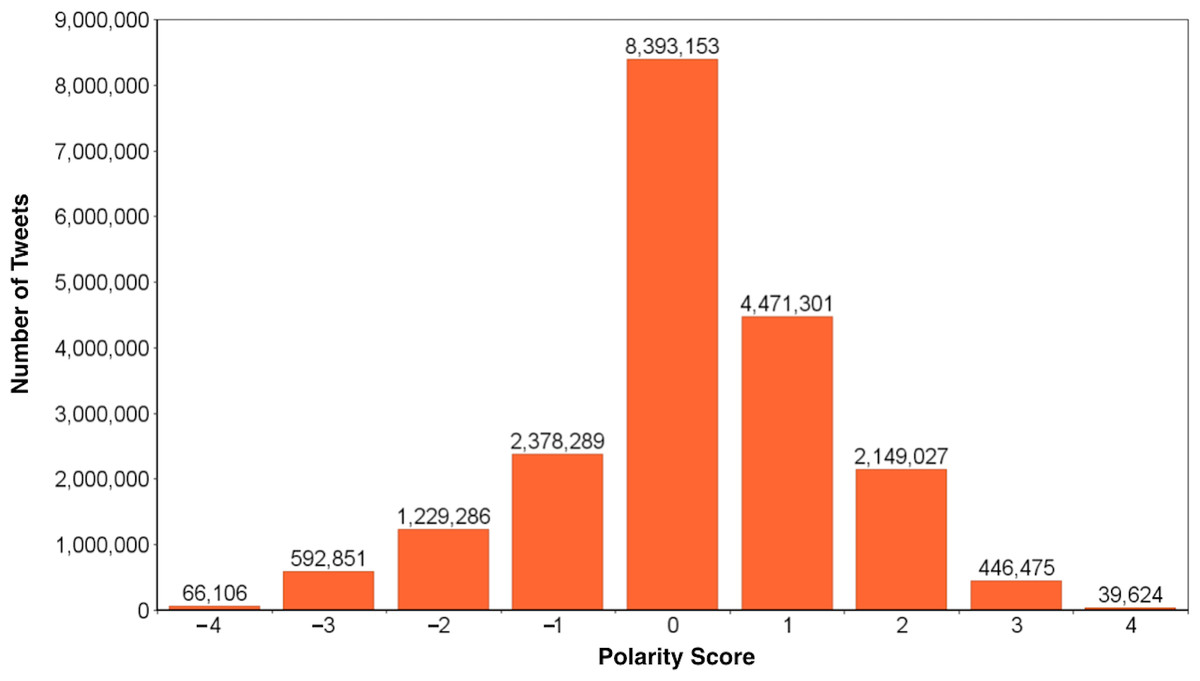
Ferrara and Yang conducted a study of 19 million tweets with the following distribution:

Their findings indicated that positive tweets reach a larger audience and are shared more often. As tweet score becomes more positive, the number of retweets, favorites and seconds to first retweet increases at an accelerated rate.

Just how much of a difference does positivity make:
So What? – Words Make a Difference
These are the key findings on sentiment content:
At Yalo, we feel that your words really make a difference. There are many environmental factors that also need to be considered. With these environmental factors we have varied levels of control; however it comes to how we share content we have complete control. Control of what we share and also how we share it! Sentiment analysis from Yalo is the tool to tune content delivery for influencing followers and customers, as well as for analyzing social media traffic that reflects and responds to brand image.
Interested in this fascinating new Yalo marketing-communications and analytics service? Curious how it could be applied towards your business goals? Let’s have a conversation for nuanced understanding.
Insight | 05.04.21
Natural Language Processing and text analysis are AI techniques for isolating, selecting and measuring the effective nature of unstructured information. With these techniques, sentiment analysis is applied for understanding customer feedback (reviews, surveys), analyzing social media traffic, creating website content and shaping marketing campaign messaging.
A scored word list is a supervised learning technique for completing sentiment analysis. The scored list or lexicon contains words with scores from most negative to most positive. Numbers assigned depend on the lexicon being used, for example AFINN scores range from -4 to +4. Text is decomposed into its individual words. The individual words are matched against the lexicon, summed and divided by the number of words to get an average score. Lexicons can be developed using surveys and adjusted to address specific domains. This approach can be enhanced with a rules base to address other language features, such as context, multipolarity and negation resulting in a compound calculated score for a piece of text. The power of this approach is in understanding the effect of each word and then being able to adjust the rules.
Using clustering, unsupervised learning can also be used for sentiment analysis. Like any unsupervised technique data is fed into the model, in this case, text – and in real time the model returns the overall results of positive, neutral or negative. To build the module, representative embeddings must be isolated and scored. Clustering is then completed on the data. The relative location of words in a cluster determines their positive or negative value. Then each word is considered for how unique it is in each sentence. This along with the sentiment scores are used to complete sentence scoring.
Some applications of sentiment analysis tools include:
Content Creation – confirming intended sentiment for social media and website content
Customer Feedback – analyzing market sentiment towards products and/or services
Product Review – capturing the most valued product features
Brand Image – monitoring social media by segment for sentiments on brand
Stock Market – real time assessment of investor sentiment on stocks, influencing long/short positions
Regulatory Compliance – identify, extract and understand regulatory, legal and medical documents that traditional data analytics techniques can’t handle
Competitor Intelligence – comparing sentiment on social media against competitors

Sentimental Analysis Tools Value
Sentiment analysis confirms the intent of communications: emails, website content and social media postings. This contributes to the reach, impressions and engagement of these communications. With studies indicating positive emotions increase the speed and reach of social messages, sentiment analysis has significant value. In addition to social media applications, sentiment analysis tools also provide value in tracking customer service feedback and product reviews.
Learn about Yalo’s own Sentiment Analysis services for our clients. Contact us please for any general inquiries, here.
Insight | 04.27.21
Many historical perspectives identify the genesis of Natural Language Processing with Alan Turing’s efforts during World War II cracking the Nazi’s Enigma code machine. By any measure, his Ultra intelligence and Turing machine saved millions of lives and shortened the war by multiple years.

NLP Evolution
After World War II, Turing’s direction involved establishing the foundation of NLP in his article, “Computing Machinery and Intelligence.” This ground-breaking article is viewed as the first treatise on artificial intelligence. He proposed the “Turing test,” (see below) for addressing the question,” can machines think?” He supported his position by rebutting nine arguments against intelligent machines. The nutshell result -thinking machines do not just isolate the words; they identify what the words mean in context.
“A computer would deserve to be called intelligent if it could deceive a human into believing that it was human.” – Alan Turing
NLP Components
Building on this foundation, language translation, language theory, probabilistic and data driven models have yielded what we know of as NLP today. Using NLP, computers dissect, absorb and draw meaning from language in context by:
NLP Applications
It is surprising how many everyday situations benefit from the application of NLP. Some of them include:
NLP and Sentiment Analysis
Natural Language Processing as part of the artificial intelligence discipline is the foundation for sentiment analysis. Both supervised and unsupervised learning techniques can be applied to complete sentiment analysis. The approach being used relies on the input word, sentiment values definition, and the level of control desired in understanding, modifying and acting on the results.
NLP Strengths
Natural Language Processing’s power is derived by its ability to understand and manipulate the human language. This ability delivers exact answers to questions without extraneous information. In addition, NLP can provide structure and sequence to ambiguous information. Yalo utilizes these functions as part of our new Sentiment Analysis services for expanded social media success for our clients.
Insight | 04.20.21
AI is here and in the words of PF Sloane, many think we are on the “the eve of destruction.” But it is not that dire, it always feels this way when we are on “the eve of disruption.” For example:

Challenges of AI
The artificial intelligence disruption is rolling in and protesting or lamenting the risks will not hold it back. In these situations, big opportunities come commensurate with risks and responsibilities. Minimizing the challenges confronting this generation presents significant leadership moments. So, we have been here before, the next wave is approaching, and “disaster” is just around the corner. What is different this time is the reach of artificial intelligence in a Now-Digital, Now-IT based world.
The artificial intelligence wave is here, perhaps not cresting yet and what are some of the most frequently presented concerns?
These are some of the challenges with artificial intelligence, but not a complete list.
Opportunities for AI
The challenges are plentiful but the opportunities are significant. They include:
It is hard to imagine a discipline where artificial analysis has greater impact than marketing. Areas affected include:
With all the avenues for delivery business value, it is little wonder that artificial intelligence is projected to deliver additional global output of $13 trillion dollars.
Where We Go From Here
The value proposition is extensive, while at the same time the risk profile can be viewed as daunting. Where do we go from here?
Managing the introduction of artificial intelligence must address risk areas mentioned earlier. The risk/reward relationship has all of the elements associated with introducing any new technology. Artificial intelligence intensifies the risk/rewards because we are replacing routine human tasks and/or introducing data relationships and business tasks not easily grasped or described.
Not understanding all the outcomes after AI implementation impacts the ability to have a sense of risk profiles for each potential application. Prevention and second order thinking becomes critical in assessing unintended consequences. This starts with the technology used to implement solutions powered by artificial intelligence. Isolating, cleansing and using appropriate unstructured data from a variety of sources is an emerging challenge. This must be accomplished in a secure manner, without revealing sensitive and personal information, and still achieve the business value of the algorithm/model. The delivery of the right data at the right time along with the uptime of the infrastructure of the solution is also key when artificial intelligence is applied to a mission-critical function, like customer service. Additionally, when utilizing what appears like non-sensitive information in building the artificial intelligence solution, the appropriate security levels must be established so that bad actors are prevented from building false identities for hacking and data-theft activities.
If an artificial intelligence solution could be compared to an automobile, the above elements would be similar to the frame, body, and tires/brakes. The real “engine” is the algorithm. In building and maintaining the algorithm, constant vigilance is required to ensure that recommended outcomes are consistent with regulations, social norms, and brand image. Managing the supplied data and supervising the algorithm includes addressing concerns over bias, underrepresented populations, and outcomes where there is no recourse (outcomes where it is unknown how to change the recommendation). Outcomes and response also require consideration on how the AI solution interacts with humans. When and how do humans interact with solutions when the solutions are slow to react to or are generating safety issues. This is not straightforward because they must also address situations where human judgment may be incorrect.
When implementing artificial intelligence, the following quote comes to mind:
“Where there is great power there is great responsibility,” Winston Churchill 1906
In meeting the challenges that artificial intelligence presents, a structured enterprise approach that isolates the most critical risks, controls for the development/implementation of solutions, and strategizes to prioritize risks based on model transparency, complexity, and the nature of the human interface, is whole-heartedly advised in order to achieve success.
Yalo has begun our journey with artificial intelligence by offering our Sentiment Analysis services for AI for social media. Please learn more here about this exciting service.
Insight | 04.12.21

Unsupervised Learning Defined
In unsupervised learning the model works independently discovering patterns and information that were not previously defined. This learning technique works predominantly with unlabeled data (no defined relationship between inputs and outputs). Using this technique affords the opportunity to address more complex processing tasks vs. supervised learning.
Unsupervised Learning Techniques
An important unsupervised learning technique is clustering. Cluster algorithms find groups within the input data. Clustering allows the user to define the number of clusters that should be identified. The number of clusters determines the specificity of each cluster (e.g. the more clusters the more specific the data within a cluster). Unsupervised learning cluster types include:
Clustering techniques include:
Another unsupervised learning technique is association. In this technique, rules are used to establish associations among objects in large data bases. An application of this technique experienced every day is shopping groups based on eCommerce searches and purchases.

Unsupervised Learning Applications
Customer Segmentation – understanding customer groups for building business strategies and marketing campaigns
Genetics – grouping DNA patterns to study evolutionary biology.
Predictive Maintenance – detecting defective mechanical parts
Dimensionality Reduction – problem simplification by reducing random variables resulting in better data visualization
Ecology – comparison of audio recording of regions for comparison of species population for biodiversity
Delivery Routes – optimize delivery efficiency by determining the optimal number of regional locations and efficient truck routes.
Crime Zones – crime data by specific location including area and category for defining crime concentration locations within a city.
System Alert Management – operations alert messages from IT system components prioritized based on mean time to repair, downstream impact and failure predictions.
Unsupervised Learning Advantages & Disadvantages
Plus
Minus
One Application Plus that Yalo is investing in for our clients is our new sentiment analysis service – capable of several insightful deliverables that can boost your marketing & branding campaign successes. Contact us today to learn how our new tools powered by AI can be a boon for your 21st century business.
Insight | 04.05.21

Supervised Learning Defined
Supervised learning for machine learning occurs independent of the process. A supervisor is available while a machine learns how to complete tasks. After training completion, the expectation is that for new data sets the machine will be able to arrive at correct outcomes. As the number of practices on training data increase, outcome accuracy is expected to increase.
Supervised Learning Techniques
This approach is used when we have enough known data (labeled data) for outcomes that a model is attempting to predict. The learning designs an algorithm which maps inputs to outputs. The supervisory learning uses two techniques. The classification technique is appropriate when inputs can be segregated into categories. A real-world application is where the algorithm categorizes financial transactions as fraudulent or non-fraudulent. The regression technique takes inputs and predicts a single outcome for either continuous or real variables. A real world application would be using baseball Sabermetrics to predict how many games a MLB team will win.

Applications of Supervised Learning
Home Pricing – input data on square footage, number of rooms/bathrooms, yard size for predicting price
Face Recognition – input image to identify matches in surveillance footage
Weather Forecasting – current/historical data for predicting weather and precipitation
Customer satisfaction – sentiment analysis for classifying satisfied/dissatisfied customers
Recycling – robots sorting removing non-recyclable items from a conveyor waste stream
Television Viewing – recommending new viewing alternatives/degree of match based on past viewing
Customer Lifetime Value – determines net business profit of a specific customer over time
Marketing – scheduling, customizing and personalizing content for more effective marketing campaigns
Yalo’s new Sentiment Analysis tools can be a huge help for the marketing tasks described above. Find out more by visiting this page.
Supervisory Learning Advantages & Disadvantages
Plus
Minus
While we submit that this is heady material you might not expect to encounter with a creative marketing agency, Yalo is not your typical agency so welcome to our world! We leave no stone unturned as we look for new and innovative methods & tools to give our clients a leg-up advantage in their pursuit of success. One does not need AI to know that this is a smart way to do business. Contact Us below, see examples of our recent work on this page.
Insight | 03.24.21

AI has two approaches in programming intelligent machines: supervised learning and unsupervised learning. Supervised learning requires data with defined input/output relationships (labeled data). The comparison being taught by a supervisor or teacher. The resulting supervised learning algorithm uses the learning to predict outcomes from new input data. Over time the model must be maintained to ensure that the labeled data is both current and complete.
Unsupervised machine learning requires no supervision. Using this approach, the model works on its own to infer information from unlabeled data. There is no information on the outputs, the model identifies patterns from the data. This approach supports more complex processing tasks when compared to supervised learning. Unsupervised learning can be more unpredictable when compared to other learning methods.

Supervised Learning Advantages
Supervised learning takes advantage of collecting/developing data from existing experiences. This provides an approach for optimizing a model’s performance. Supervised learning is valuable in addressing computational problems.
Unsupervised Learning Advantages
Unsupervised learning is adept at discovering unknown patterns in data. The identification of the patterns occurs in real-time and labeling is completed in the presence of the learners. Using unlabeled data, unsupervised learning does not require the data labeling effort.
Supervised Learning in Action
Supervised learning trains the machine to complete a task. Suppose you wanted to predict how many games a pitcher will win in an upcoming season using prior year performance. The process requires the collection of a data set of pitching performance by pitcher. Example data could be:

These inputs for a particular pitcher would be collected and the model determine the output, number of games won.
The labeled data defines a training data set used as an input for training the model. The model may conclude that more strikes and less walks are desirable. Similarly, more ground balls and fewer flyballs. The learning process takes this training data, isolates attributes and develops an algorithm(s) which become the model.
Unsupervised Learning in Action
Unsupervised learning uses data with no labels. An example for unsupervised learning would be if you went to a baseball game and had no idea how the game is played, you would watch and make observations to develop an understanding of how the game is played. You would notice
You would be learning baseball without any assistance. The learning would have occurred by identifying patterns that were not previously known.
Summary – Supervised vs. Unsupervised Learning
The learning methods differ on how data is used. Input data is labeled for supervised learning and unlabeled for unsupervised learning. Supervised learning uses the output data to learn and outputs to new inputs. Unsupervised learning does not use output data. Supervised learning is a simpler method with learning performed offline versus unsupervised learning being computationally more complex and occurring in real time.
The major unsupervised learning drawback is that without labels, complete information on data grouping and output data is not available. Supervised learning requires the classification of the data. Supervised learning is considered a trusted process with accurate results, whereas, unsupervised learning in more unpredictable.
Both of these processes and more contribute to the fascinating power of artificial intelligence. In the workplace, Yalo is using our new sentiment analysis services to leverage AI for social media monitoring and actionable insights for our clients. Request a demo in order to understand how these amazing tools can help to build and boost your brand.
Insight | 03.18.21

What is Intelligence
First, some agreement on what constitutes intelligence is necessary. Depending on the discipline different attributes are valued and therefore constitute intelligence.
A person’s intelligence within a discipline would be recognized by their mastery of the discipline’s attributes. An argument can be made that a machine can be intelligent by mastering one set or multiple sets of attributes.
Elements of Intelligence
When evaluating something as intangible as intelligence, what elements should be considered? It starts with reasoning processes that support extending observable facts/events to general beliefs and/or take general beliefs consider alternatives in coming to specific conclusions. For a baseball player it is baseball IQ; the musician it is a sense of timing or beat; physicist the thought experiment in visualizing the abstract. It includes learning by training, observing and experience which expands the understanding of the discipline.
Depending on the discipline, listening, recalling experiences, duplicating physical activities and drawing conclusions by relating environmental cues are all techniques for expanding knowledge. These techniques make a decision or choose a process which resolves an issue. They must also consider their surroundings, sensing valid inputs and providing structure. Generating value and knowledge, machines must also have communications skills to understand inputs and document results.

Humans rely on recognizing patterns in applying their intelligence. Each pattern, learned or experienced, has its information and heuristics for a situation. Familiar or stressful situations are facilitated by quick thinking in applying the most familiar pattern. New or complex situations require more thoughtful thinking in perceiving differences, altering existing or developing new patterns.
Machine intelligence is programmed with attributes focused on a specific discipline. This intelligence relies on taking general beliefs, considering alternatives and arriving at conclusions. This can include understanding that a mistake has been made and avoiding it in the future.

Intelligent machines evaluate inputs as data by applying sets of rules. While humans search for patterns, machines learning relies on rules/algorithms. Two different techniques are used to develop learning in machines. Supervised learning uses sample data with matched outputs (labelled data) to teach machines to approximate outcomes for new inputs. Unsupervised learning does not rely on labeled outputs – the learning occurs by inferring the natural structure of a set of data points. A differentiator between machine intelligence and human intelligence is in situations with incomplete or distorted inputs – humans can still determine outcomes where intelligent machines can have inconsistent results.
Yalo is embracing machine intelligence/AI with the arrival of our new sentiment analysis services that can recognize language patterns in order to determine social media feedback and popularity for a brand, amongst several other tasks. We are bringing AI to bear on the Web 2.0 world in our relentless pursuit of excellence for our customers. AI rocks!
Insight | 03.03.21

Sonic branding (also sometimes called audio branding, or sound branding) is the strategic use of sounds and music to reinforce brand identities, just as you would with certain colors or words.
In an age of information overload, consumers are demanding a break from screens. A recent report into Gen Z and millennials by Spotify found that 56% believe that audio can serve as a welcome break from too much visual stimulation. We can see this in the explosion of podcasting, audiobooks and voice assistants. You can simply look at the meteoric rise of Clubhouse to see how audio is making an impact.
Adding sound or music to your brand brings another dimension to your brand experience as it produces additional layers of emotional response that images cannot reproduce. It breaks through the rational part of your brain and resonates on a more emotional level.

Startups and small businesses with limited resources are often overshadowed by competition from big companies with larger financial resources. These businesses are now incorporating affordable yet effective sound marketing solutions such as jingles, tones, music on hold, background music, podcasts, and announcements to promote brand awareness, communications, and customer satisfaction.
Just like any other form of marketing, sound branding needs to be unique. As audio becomes a more crucial part of marketing, a personalized brand voice is incredibly valuable to your business. Before anything, think about the kind of sound that best represents your company because, beyond your visual logo, a consistent tone of voice is what helps to drive familiarity with your customers.
Hear them here: Top 10 Most Recognizable Brand Audio Logos.
Developing an audio logo may be the next logical step for companies looking to take their brand to the next level. Doesn’t this sound like a great idea? According to DesignRush, Yalo is one of the Top Atlanta Digital Marketing Agencies. So, let Yalo turn up the volume on your brand.
So, let Yalo turn up the volume on your brand. Make some noise in our direction and we’ll get right back to you.
Insight | 02.17.21

The world is fast evolving, with Artificial intelligence (AI) at the forefront in changing the world and the way we live. AI is everywhere — at our workplace, in our homes, cars, in our phones and laptops — in short, in the things that have become integral in our lives. Moreover, AI devices know what kind of TV shows and movies we like, what we buy, and how we operate. Let’s explore this world a little deeper…
AI By Definition
It is the ability of a computer to imitate how we think. It is accomplished by learning from previous experience, object identification, language mastery, decision making and problem resolution. These and other capabilities can be combined to perform functions that would be performed by a human. Like a human, with AI, machines can combine input from multiple sources (sensors, digital), analyze information and act on analysis results. Designed by humans, these machines are expected to reach conclusions based on real-time analysis.
AI Explained
Today AI applications are not “artificial,” but focused and contained in functions and features we experience daily such as: word completion while typing, travel directions, eCommerce buying, and television watching recommendations. Although the value of these AI applications is taken for granted, there’s some degree of confusion on terminology. Key terminology that is used includes:
AI runs the gamut of specific task completion to duplication of human activities by choosing and solving multiple problems without human intervention. The former we experience daily with new applications enabling humans to complete tasks with ever increasing efficiency and accuracy. The latter is currently theoretical and exists only in the realm of the TV series Next.
AI Applied
AI has found its way into our daily living. Some great examples include:
These use cases depend on machine learning and data analytics combined to deliver intelligent decisions. To remain relevant, they learn from and adapt to information changes in their environment.
What’s Next
Imagination is the only limitation where AI can improve lives but many questions remain.. What is machine intelligence? What tools are most appropriate for different AI use cases? What is the right balance of replacing humans performing tasks vs. supporting them? Want to know what comes next and how to balance the future of machine learning?
Let us help you navigate your business with AI-driven solutions. Yalo uses AI with our new Sentiment Analysis services to help your brand build content, segment customers, and leverage social media more successfully across the board. You don’t need a computer to know a smart idea when you hear one.
Insight | 01.29.21

Over 39% of the top ranked websites on the Internet run WordPress1. Our Corporate website runs on WordPress. We host our Virtual Events platform on WordPress. Many of our client websites are built on top of WordPress. Yalo has multiple clients hosting their brand websites and corporate websites on WordPress in WP Engine, currently over 50 websites.
There are MANY hosting options to consider when setting up a new WordPress site. We chose WP Engine as our Preferred Partner for hosting WordPress sites for a number of reasons.

WP Engine provides an unprecedented level of checks and balances to ensure that customers’ WordPress environments are secure with multiple layers of security and redundancy built in. With automated daily site backups, extensive QA testing prior to releasing WordPress Core and plugin updates, and a well established backup and recovery process, WP Engine provides a robust and flexible platform for WordPress hosting.
The Global Edge Security functionality provides an additional layer of security, stability, and performance leveraging an integrated suite of Cloudflare services. This provides optimal performance tuning capabilities, protects against malware, Denial-of-service attacks, spam, and general attempts at hacking or compromising a WordPress site.

When I first joined Yalo in December 2019, I had never heard of WP Engine. I’ve been a long time user of WordPress and primarily hosted my own sites on various LAMP environments and know all too well the routine “tasks” that are required to properly maintain a secure and performant WordPress site. I have to admit I was skeptical of the “hosted WordPress” option. Nonetheless, I learned we had an existing customer on WP Engine that I was asked to help manage/maintain, so I jumped right in to assist.
They happened to already be on WP Engine, so that was my first exposure to the WP Engine Administration User Interface. With an intuitive and easy to navigate UI, I was able to quickly ramp up do everything needed to properly manage and maintain our client’s WordPress site .
A few months later I got a text in the late afternoon from our CEO, Arnold Huffman, informing me he had just received a phone call from a customer whose site had been hacked/compromised in a Zero-day WordPress exploit – that I would later come to find out – had literally just hit the Internet that same day.
Needless to say, I was super nervous and dropped everything to focus on getting our client’s site back up. After confirming the site was indeed down and unavailable, I logged into the WP Engine Administration UI and fired up my first Web support chat session.
I was BLOWN AWAY by the level of support I received from the WP Engine support team. In a matter of minutes, the support representative had confirmed the site issue, inspected the user and access logs, verified that we had backups in place to restore from, and identified the questionable plug-ins that were the attack vector.
The support rep quickly restored the last known backup of the site, updated the vulnerable plug-in, and in less than 20 minutes after first hearing about the issue, had our client site back up and running. WOW! I was so pleased to be able to call Arnold back and let him know we were good to go and that he could call the customer back with the good news! I thanked the WP Engine support rep profusely and went back to whatever I was working on prior to this “firedrill”.
In all my years working in IT/tech sector, I’ve never had that level of support from a software vendor. This was prior to our signing a partnership with WP Engine, and when our next client came on board and needed a hosting solution, based on the experience I described with our client above, WP Engine was (and is) my #1 recommendation.
Since then, I’ve put their support team through the motions, firing up support chats whenever I have an issue or need to help address a customer request or concern. We continue to grow and expand our footprint with WP Engine and have a growing list of clients and sites that benefit from our partnership with WP Engine.
It gives me peace of mind knowing that WP Engine Support is there 24/7/365 to meet our clients’ ongoing needs.
Sending MANY thanks to the entire WP Engine Support Team!
Yalo is a strategic agency partner of WP Engine, reach out to our team to learn more.

Insight | 07.20.20

Is this the second wave? Or is this a reeeeally long first wave? Or a vast conspiracy? Whatever your particular flavor of the truth is these days, it doesn’t matter. The unavoidable truth is that many of us aren’t going back to an office anytime soon. I used to be excited that my personal “grid” wasn’t more than a few square miles–now I’d be thrilled if it extended beyond my refrigerator.
Back when this all started, I had been reading about what businesses could be doing in their “downtime.” It may have felt like the downtime had passed (Yay! Back to normal), but I think we’re all going to need to get used to a little more (sad trombone). And, maybe you’re resetting your own plans. Trying to figure out the best strategy to bring your design team out of this on the other side, in a better place than where you started.
Based on my conversations with our friends at InVision, one way a lot of design teams are “sharpening their saw,” as Dr. Steven Covey puts it, is by investing their time now in a Design System. Design Systems are a collection of reusable atomic design components, guided by clear standards, that can be assembled together to build any number of websites or applications. Think of “design LEGO blocks” if you will. A design system manager is the “dashboard” and tools per se for using the design system – think WordPress CMS for a system that’s akin to InVision DSM. Design systems can shorten time to market and increase collaboration and consistency across your teams. Now is the perfect time to build it.
But how do you sell it to your team and your organization?
We recently implemented a Design System for a global brand company that has grown to sell in more than 175 countries. Here are four key takeaways you can steal for your own company:
Why implement a Design System?
Don’t be intimidated by the work a new Design System Manager may appear to be. It will totally be worth it in the end. There are a lot of fantastic resources out there to help you get started and to guide you along the way. And, Yalo is here to help or to talk through ideas. Reach out to us anytime!
Insight | 06.10.20
Enabling a new way to engage with an ordinary household item. This augmented reality app created for Kimberly-Clark, allows users to explore design patterns and boxes allowing sales reps and consumers to take the guess work out of their purchase.



Yalo created the Augmented Product Visualizer for Kimberly-Clark as a custom tool for their special needs, and we can do the same for your business. We also partner with InVision – creators of the fabulous InVision DSM design system manager – and implement and support this remarkably cohesive branding system tool when a totally custom app isn’t what’s needed next on your drawing board. Give us a shout today to learn more about InVision DSM. Discuss InVision DSM directly with resident expert Eric Cantini at 216-533-0712.