

Insight | 01.17.25
Insight | 03.05.25

Meet Chris Dawson: Yalo’s Hot Dog Man and Tech Innovator
Welcome to Digital Yalo’s monthly employee spotlight. This space is held to shine a light on the talented thinkers and makers behind the scenes who make Digital Yalo the award-winning agency it is.
Our team boasts a diverse group of talented, smart, and dynamic professionals. And each spotlight will showcase and celebrate their unique contributions and impressive work.
So, without further ado, let’s meet this month’s star and discover the stories, skills, and obsessions that make Digital Yalo the hub of innovative thinking that it is.
Today, we’re excited to introduce Chris Dawson, a Senior Developer who’s been with Yalo for what feels like forever—and for good reason. Chris’s impact on the tribe and our clients is undeniable, and his expertise, leadership, and unique personality are key to his success.


Chris isn’t just a developer—he’s the driving force behind the success of the Primrose project, working closely with a contractor, Andrew, to turn the project around. Together, they optimized site speeds and tackled all other tasks necessary to bring Primrose to a great place. Thanks to their leadership and technical expertise, Primrose has become a strong success, with the client continuing to return for more. Chris’s problem-solving skills and ability to think outside the box have made him a standout figure within Yalo and with clients alike.
Chris’s contributions go beyond code. As a mentor, he’s helped shape the next generation of developers at Yalo. Whether he’s guiding interns or supporting junior developers, Chris has a knack for making complex concepts simple while also pushing his team to grow and improve. His leadership isn’t just about teaching; it’s about empowering those around him to become better versions of themselves.
Outside of work, Chris enjoys a mix of unique and entertaining interests. From baking and cooking to hitting the golf course or spending time at the range, Chris knows how to make the most of his time away from the computer. (He’s also known for asking the age-old question: Is a hot dog a sandwich? Feel free to debate that one with him!)

Living in North Carolina, Chris balances his love for tech with his love for the outdoors, which probably helps keep him sharp for the next big project.
Chris Dawson is more than just a Senior Developer at Yalo—he’s a mentor, a problem solver, and the backbone of many of our most successful projects. His leadership and innovative thinking keep Yalo at the cutting edge, and we’re lucky to have him on the team. Here’s to Chris and the amazing work he continues to do!

Insight | 01.31.24

In the ever changing business world, staying ahead of the competition requires more than just a keen eye for opportunities – it demands a strategic embrace of cutting-edge technology. The right tools can revolutionize the way you manage and analyze your business, paving the way for unprecedented growth and efficiency. Today, we’ll explore the myriad benefits of leveraging technology to propel your business forward.
In the age of information, data is the new currency. Technology equips businesses with powerful tools to collect, process, and analyze vast amounts of data in real-time. With accurate insights at your fingertips, decision-makers can make informed choices, mitigate risks, and identify lucrative opportunities swiftly.
Streamlining operations is at the heart of every successful business, and technology is the catalyst for achieving unparalleled efficiency. Automated workflows, project management tools, and cloud-based solutions empower teams to collaborate seamlessly, reducing time spent on mundane tasks and allowing employees to focus on high-value activities.
The right technology enables businesses to deliver personalized and immersive customer experiences. From advanced CRM systems to AI-driven chatbots, companies can engage with their audience in real-time, addressing queries promptly and tailoring products or services to individual preferences.
As businesses evolve, so do their needs. Technology provides the scalability and adaptability necessary to accommodate growth and changing market dynamics. Cloud computing, for instance, allows businesses to scale their infrastructure effortlessly, ensuring that technological capabilities grow in tandem with the organization.
In a hyper-competitive market, staying ahead requires innovation. Businesses that harness the latest technologies gain a competitive edge, whether it’s through predictive analytics, artificial intelligence, or Internet of Things (IoT) devices. Early adopters often find themselves leading the pack, setting industry standards and trends.
The benefits of utilizing the right technology to manage and analyze your business are vast and transformative. Embracing these tools is not merely an option but a strategic imperative for those aspiring to thrive in today’s dynamic business landscape. By investing in technology, you’re not just adapting to change – you’re shaping the future success of your business. So, let Yalo help you equip your enterprise with the tools it deserves and embark on a journey of innovation and unparalleled growth.
Insight | 01.04.23

As a new year begins, marketers are predicting which marketing trends will matter the most and placing their bets (and budgets) on those they believe will show the most return on investment. Here below are five tactical trends that we see adding value to the market(ing) place in 2023.
A strong brand can build customer loyalty, increase customer lifetime value, drive business growth, and increase the perceived value of your products or services, which can lead to higher prices and more profitability.
A few benefits of building a strong brand:
Full disclosure: Yalo offers our Brand Strategy Bootcamp to help fledgling as well as established brands to dip their toes in the world of brand strategy for greater awareness in the public sector. It’s a fun, informative, effective exercise our clients love to experience!
Creators are the beating heart of social media, and their endorsements can shape consumer behavior drastically. The creator economy refers to the network of people who create and share content online, often for a large and engaged audience. Brands can tap into the creator economy in a number of ways:
Overall, the key to success in the creator economy is to build authentic and mutually beneficial relationships with creators. This can help brands to reach new audiences and stay relevant in an increasingly digital world.
Artificial intelligence (AI) and automation are being increasingly used in marketing to help companies save time and resources, as well as to improve their marketing efforts. Some common applications of AI in marketing include:
Another disclosure! Yalo has been offering Sentiment Analysis services powered by AI for some time now for business intelligence for our clients.
TikTok and user-generated social media videos that organically draw in an audience or create word-of-mouth are the best bang for your buck. There are several benefits of user-generated social media videos:
Brands can leverage web3 technology and virtual influencers in a number of ways. Here are a few potential strategies:
Overall, virtual influencers and web3 technology offer brands new and innovative ways to reach and engage with their audience. By staying up-to-date on the latest trends and technologies, brands can find creative ways to leverage these tools to their advantage.
Let Yalo keep you on-trend in 2023. Subscribe to our free e-blasts below for informative, entertaining and stimulating analysis and critiques on what‘s happening in the worlds of marketing, advertising and pop culture. Scroll down to the bottom of the page if you’d like to start a conversation with us!
Insight | 06.23.21

In today’s frenetic, fast-paced B2B sales environment, it can be hard to ensure that your sales team is having the right conversations with their prospects to deliver value and drive deals forward. The biggest impediment seems easy, but in reality is a complex problem to solve: equipping sales with the right content based on their unique prospects and specific selling situation.
Odds are, your organization already has some form of sales enablement in place, as 80% of organizations with sales teams bigger than ten people currently use sales enablement tools and practices, according to research from Highspot. But are you getting the best results from your efforts?
Here are 5 ways to shore up your sales enablement:
1. Reduce the Time Sales Spends on Non-Selling Activities
This seems a little straightforward, but most organizations have multiple portals or tools where sales reps are supposed to go to find what they need, and reps are spending between four to eight hours a week just searching for the right marketing content to send their prospects. The Sales Enablement Lab podcast is a great place to listen and learn how focusing sales on revenue producing activities and allowing marketing to gain better insight into content usage and impact.
2. Map Sales Enablement to the Customer Journey
We operate in industries with long buying cycles, this is just a fact of life. For example, the average lifespan for an ERP system is between 5-10 years and the buying cycle can be 12-18 months long, this timescale will not shorten in the foreseeable future. These solutions come at a great cost to an organization, and when you are making a decision that will affect the company for 5-10 years you will be dealing with highly informed buyers.
By mapping out the sales enablement strategy to mirror the customer journey you can arm your sales representatives with the content they need to match the customer’s current life cycle stage. Using automation you can drip feed information to your awareness stage prospects until they are sales ready, allowing your sales team to focus their efforts on closing decision stage prospects, without letting any leads go cold.
3. Give Your Team Easy Access to Content
The fact is, 90% of content goes unused by sales, according to the American Marketing Association. This is largely because sales simply can’t find it. Is your sales enablement system flexible? Can your content be organized in a meaningful way for your sales team in one centralized library? Flexible content organization and content recommendations based on performance, informed by your marketing automation platform, help keep conversations on point and accelerate conversions.
4. Integrate Sales Enablement Across the Company
Sales enablement requires input from multiple teams, not just the sales department. Throughout the entirety of your customer’s life cycle, it is inevitable that they will come in contact with many departments, much more than just the sales and marketing teams. This means that in order to create long-lasting relationships with happy customers and to secure repeat purchase it becomes essential to deliver a consistent customer experience across all contact points.
By implementing a consistent sales enablement program business wide you can ensure that everyone in the organization has been empowered to support the core sales team with the ability to align the right resources to the right prospect. Each department understands their role in ensuring the right information, tools and subject matter can be delivered in a way which is relevant to each selling situation.
When sales and marketing teams work together harmoniously, companies typically see 36% higher customer retention and 38% higher close rates.
5. Use Technology to Accelerate Success
Many sales departments don’t have the time or resources to evaluate and implement new technology. And yet, the right technology solution can help them be more effective in hitting their numbers and closing deals. This is an area where marketing can step in and help. As you’re vetting, deploying, and implementing best-of-breed solutions, consider what applications, features, or solutions can help sales prioritize leads and work more efficiently and effectively, driving results across the entire organization.
Having a platform in place that enables data-driven analysis of what content, strategies, and processes are most effective in various situations lifts the performance of the entire sales team. This applies to them sharing insights with your marketing team as well.
Learn more about how you can empower your sales team by contacting Yalo – we have a whole team of technologists, business analysts and salespeople who can help you win more business within which industry you compete.
Insight | 05.11.21
Is Your Social Media Messaging Good Enough?
Does it make a difference what and how you post on social media? Don’t you just need to maintain a presence? Or if you do not have a presence, then how do you know the right message is getting out there to your target audience? In reality, it’s all about emotion, quantity and speed. Your company’s social messages Do make a difference, because business social media is exploding.
The Social Media Explosion
How fast are social networks growing?
Across age groups, where are the commercial uses for social networks:
Simultaneous to audience growth, information being added to the Internet will grow from 4.4 billion GB per day in 2016 to 463 billion GB per day in 2025 (IDC estimate). With exploding users and content projected to grow a 100-fold per day, how do you differentiate your messaging to gain, maintain and grow followers, engagement and sales? How do you make sure your content influences and accelerates through the Internet, so you get your “share of eyeballs?”
Social Media Diffusion
Information diffusion is how fast data is moving through a network. It has been studied extensively in social, physical and computational sciences. Research in word of mouth and viral marketing has been documented in business literature. With the emergence of social media, new communication techniques have been explored such as: SMS, weblogs, picture-sharing portals and online communities. The following research considers the variables that effect the diffusion on information on social networks.
Sentiment and Social Media Quantity and Speed
Steiglitz and Xuan conducted research on the effect of emotion on political tweets. This research analyzed 64,432 tweets posted one week before two German state parliament elections. They proved the following hypotheses:
Using supervised learning (regression) the study considered:
Dependent variables
Independent variables
The regression models’ coefficients indicated that for every unit increase in negative words there was a 6% increase in retweets(pg. 238). Likewise, for every unit increase in positive words there was a 4% increase in retweets. An important hypothesis they were not able to prove:
Sentiment and Social Media Predictability
Ashan and Kumari researched 20,000 tweets on the 2016 U.S. presidential election. The analysis considered the impact of sentiment along with the following environmental factors in predicting information diffusion:
Using two different regression approaches, analysis was completed determining the independent variables that provided the best model predictability. As seen below, in each model sentiment content was included and provided a significant increase in predictability.


Including the sentiment content significantly improves the predictability of social media performance and is enhanced with the ability to consider hashtags.
Sentiment and Positivity
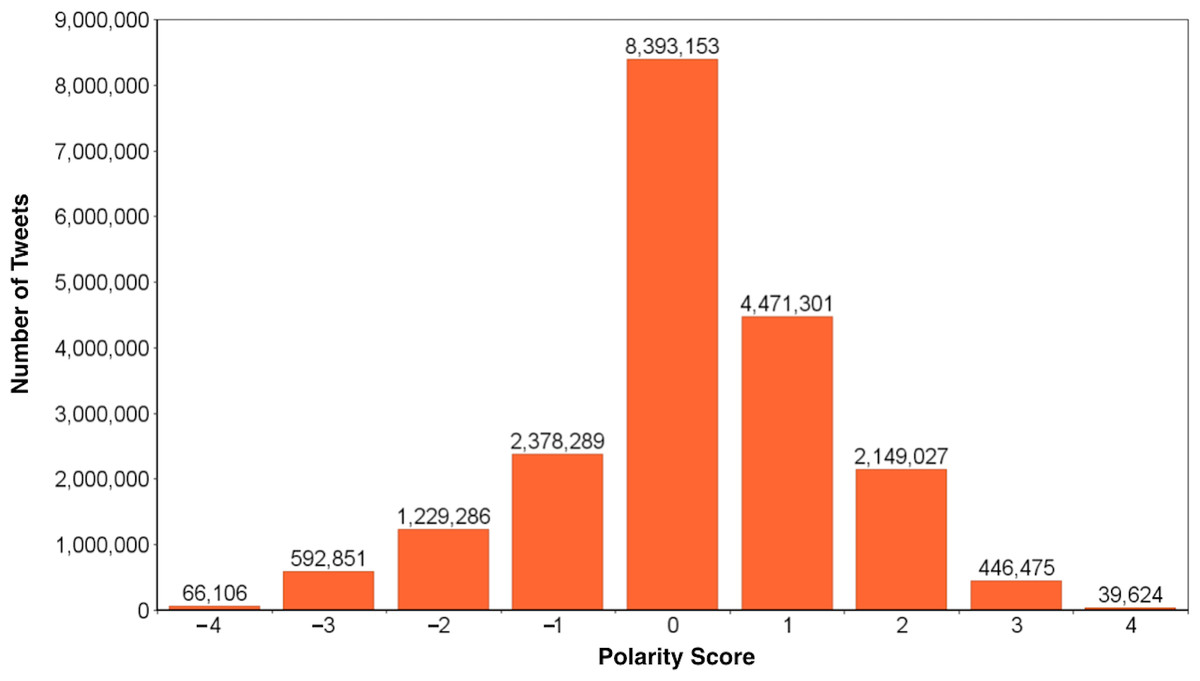
Ferrara and Yang conducted a study of 19 million tweets with the following distribution:

Their findings indicated that positive tweets reach a larger audience and are shared more often. As tweet score becomes more positive, the number of retweets, favorites and seconds to first retweet increases at an accelerated rate.

Just how much of a difference does positivity make:
So What? – Words Make a Difference
These are the key findings on sentiment content:
At Yalo, we feel that your words really make a difference. There are many environmental factors that also need to be considered. With these environmental factors we have varied levels of control; however it comes to how we share content we have complete control. Control of what we share and also how we share it! Sentiment analysis from Yalo is the tool to tune content delivery for influencing followers and customers, as well as for analyzing social media traffic that reflects and responds to brand image.
Interested in this fascinating new Yalo marketing-communications and analytics service? Curious how it could be applied towards your business goals? Let’s have a conversation for nuanced understanding.
Insight | 05.04.21
Natural Language Processing and text analysis are AI techniques for isolating, selecting and measuring the effective nature of unstructured information. With these techniques, sentiment analysis is applied for understanding customer feedback (reviews, surveys), analyzing social media traffic, creating website content and shaping marketing campaign messaging.
A scored word list is a supervised learning technique for completing sentiment analysis. The scored list or lexicon contains words with scores from most negative to most positive. Numbers assigned depend on the lexicon being used, for example AFINN scores range from -4 to +4. Text is decomposed into its individual words. The individual words are matched against the lexicon, summed and divided by the number of words to get an average score. Lexicons can be developed using surveys and adjusted to address specific domains. This approach can be enhanced with a rules base to address other language features, such as context, multipolarity and negation resulting in a compound calculated score for a piece of text. The power of this approach is in understanding the effect of each word and then being able to adjust the rules.
Using clustering, unsupervised learning can also be used for sentiment analysis. Like any unsupervised technique data is fed into the model, in this case, text – and in real time the model returns the overall results of positive, neutral or negative. To build the module, representative embeddings must be isolated and scored. Clustering is then completed on the data. The relative location of words in a cluster determines their positive or negative value. Then each word is considered for how unique it is in each sentence. This along with the sentiment scores are used to complete sentence scoring.
Some applications of sentiment analysis tools include:
Content Creation – confirming intended sentiment for social media and website content
Customer Feedback – analyzing market sentiment towards products and/or services
Product Review – capturing the most valued product features
Brand Image – monitoring social media by segment for sentiments on brand
Stock Market – real time assessment of investor sentiment on stocks, influencing long/short positions
Regulatory Compliance – identify, extract and understand regulatory, legal and medical documents that traditional data analytics techniques can’t handle
Competitor Intelligence – comparing sentiment on social media against competitors

Sentimental Analysis Tools Value
Sentiment analysis confirms the intent of communications: emails, website content and social media postings. This contributes to the reach, impressions and engagement of these communications. With studies indicating positive emotions increase the speed and reach of social messages, sentiment analysis has significant value. In addition to social media applications, sentiment analysis tools also provide value in tracking customer service feedback and product reviews.
Learn about Yalo’s own Sentiment Analysis services for our clients. Contact us please for any general inquiries, here.
Insight | 04.27.21
Many historical perspectives identify the genesis of Natural Language Processing with Alan Turing’s efforts during World War II cracking the Nazi’s Enigma code machine. By any measure, his Ultra intelligence and Turing machine saved millions of lives and shortened the war by multiple years.

NLP Evolution
After World War II, Turing’s direction involved establishing the foundation of NLP in his article, “Computing Machinery and Intelligence.” This ground-breaking article is viewed as the first treatise on artificial intelligence. He proposed the “Turing test,” (see below) for addressing the question,” can machines think?” He supported his position by rebutting nine arguments against intelligent machines. The nutshell result -thinking machines do not just isolate the words; they identify what the words mean in context.
“A computer would deserve to be called intelligent if it could deceive a human into believing that it was human.” – Alan Turing
NLP Components
Building on this foundation, language translation, language theory, probabilistic and data driven models have yielded what we know of as NLP today. Using NLP, computers dissect, absorb and draw meaning from language in context by:
NLP Applications
It is surprising how many everyday situations benefit from the application of NLP. Some of them include:
NLP and Sentiment Analysis
Natural Language Processing as part of the artificial intelligence discipline is the foundation for sentiment analysis. Both supervised and unsupervised learning techniques can be applied to complete sentiment analysis. The approach being used relies on the input word, sentiment values definition, and the level of control desired in understanding, modifying and acting on the results.
NLP Strengths
Natural Language Processing’s power is derived by its ability to understand and manipulate the human language. This ability delivers exact answers to questions without extraneous information. In addition, NLP can provide structure and sequence to ambiguous information. Yalo utilizes these functions as part of our new Sentiment Analysis services for expanded social media success for our clients.
Insight | 04.05.21

Supervised Learning Defined
Supervised learning for machine learning occurs independent of the process. A supervisor is available while a machine learns how to complete tasks. After training completion, the expectation is that for new data sets the machine will be able to arrive at correct outcomes. As the number of practices on training data increase, outcome accuracy is expected to increase.
Supervised Learning Techniques
This approach is used when we have enough known data (labeled data) for outcomes that a model is attempting to predict. The learning designs an algorithm which maps inputs to outputs. The supervisory learning uses two techniques. The classification technique is appropriate when inputs can be segregated into categories. A real-world application is where the algorithm categorizes financial transactions as fraudulent or non-fraudulent. The regression technique takes inputs and predicts a single outcome for either continuous or real variables. A real world application would be using baseball Sabermetrics to predict how many games a MLB team will win.

Applications of Supervised Learning
Home Pricing – input data on square footage, number of rooms/bathrooms, yard size for predicting price
Face Recognition – input image to identify matches in surveillance footage
Weather Forecasting – current/historical data for predicting weather and precipitation
Customer satisfaction – sentiment analysis for classifying satisfied/dissatisfied customers
Recycling – robots sorting removing non-recyclable items from a conveyor waste stream
Television Viewing – recommending new viewing alternatives/degree of match based on past viewing
Customer Lifetime Value – determines net business profit of a specific customer over time
Marketing – scheduling, customizing and personalizing content for more effective marketing campaigns
Yalo’s new Sentiment Analysis tools can be a huge help for the marketing tasks described above. Find out more by visiting this page.
Supervisory Learning Advantages & Disadvantages
Plus
Minus
While we submit that this is heady material you might not expect to encounter with a creative marketing agency, Yalo is not your typical agency so welcome to our world! We leave no stone unturned as we look for new and innovative methods & tools to give our clients a leg-up advantage in their pursuit of success. One does not need AI to know that this is a smart way to do business. Contact Us below, see examples of our recent work on this page.
Insight | 02.17.21

The world is fast evolving, with Artificial intelligence (AI) at the forefront in changing the world and the way we live. AI is everywhere — at our workplace, in our homes, cars, in our phones and laptops — in short, in the things that have become integral in our lives. Moreover, AI devices know what kind of TV shows and movies we like, what we buy, and how we operate. Let’s explore this world a little deeper…
AI By Definition
It is the ability of a computer to imitate how we think. It is accomplished by learning from previous experience, object identification, language mastery, decision making and problem resolution. These and other capabilities can be combined to perform functions that would be performed by a human. Like a human, with AI, machines can combine input from multiple sources (sensors, digital), analyze information and act on analysis results. Designed by humans, these machines are expected to reach conclusions based on real-time analysis.
AI Explained
Today AI applications are not “artificial,” but focused and contained in functions and features we experience daily such as: word completion while typing, travel directions, eCommerce buying, and television watching recommendations. Although the value of these AI applications is taken for granted, there’s some degree of confusion on terminology. Key terminology that is used includes:
AI runs the gamut of specific task completion to duplication of human activities by choosing and solving multiple problems without human intervention. The former we experience daily with new applications enabling humans to complete tasks with ever increasing efficiency and accuracy. The latter is currently theoretical and exists only in the realm of the TV series Next.
AI Applied
AI has found its way into our daily living. Some great examples include:
These use cases depend on machine learning and data analytics combined to deliver intelligent decisions. To remain relevant, they learn from and adapt to information changes in their environment.
What’s Next
Imagination is the only limitation where AI can improve lives but many questions remain.. What is machine intelligence? What tools are most appropriate for different AI use cases? What is the right balance of replacing humans performing tasks vs. supporting them? Want to know what comes next and how to balance the future of machine learning?
Let us help you navigate your business with AI-driven solutions. Yalo uses AI with our new Sentiment Analysis services to help your brand build content, segment customers, and leverage social media more successfully across the board. You don’t need a computer to know a smart idea when you hear one.