

Insight | 01.17.25
Insight | 05.11.21
Is Your Social Media Messaging Good Enough?
Does it make a difference what and how you post on social media? Don’t you just need to maintain a presence? Or if you do not have a presence, then how do you know the right message is getting out there to your target audience? In reality, it’s all about emotion, quantity and speed. Your company’s social messages Do make a difference, because business social media is exploding.
The Social Media Explosion
How fast are social networks growing?
Across age groups, where are the commercial uses for social networks:
Simultaneous to audience growth, information being added to the Internet will grow from 4.4 billion GB per day in 2016 to 463 billion GB per day in 2025 (IDC estimate). With exploding users and content projected to grow a 100-fold per day, how do you differentiate your messaging to gain, maintain and grow followers, engagement and sales? How do you make sure your content influences and accelerates through the Internet, so you get your “share of eyeballs?”
Social Media Diffusion
Information diffusion is how fast data is moving through a network. It has been studied extensively in social, physical and computational sciences. Research in word of mouth and viral marketing has been documented in business literature. With the emergence of social media, new communication techniques have been explored such as: SMS, weblogs, picture-sharing portals and online communities. The following research considers the variables that effect the diffusion on information on social networks.
Sentiment and Social Media Quantity and Speed
Steiglitz and Xuan conducted research on the effect of emotion on political tweets. This research analyzed 64,432 tweets posted one week before two German state parliament elections. They proved the following hypotheses:
Using supervised learning (regression) the study considered:
Dependent variables
Independent variables
The regression models’ coefficients indicated that for every unit increase in negative words there was a 6% increase in retweets(pg. 238). Likewise, for every unit increase in positive words there was a 4% increase in retweets. An important hypothesis they were not able to prove:
Sentiment and Social Media Predictability
Ashan and Kumari researched 20,000 tweets on the 2016 U.S. presidential election. The analysis considered the impact of sentiment along with the following environmental factors in predicting information diffusion:
Using two different regression approaches, analysis was completed determining the independent variables that provided the best model predictability. As seen below, in each model sentiment content was included and provided a significant increase in predictability.


Including the sentiment content significantly improves the predictability of social media performance and is enhanced with the ability to consider hashtags.
Sentiment and Positivity
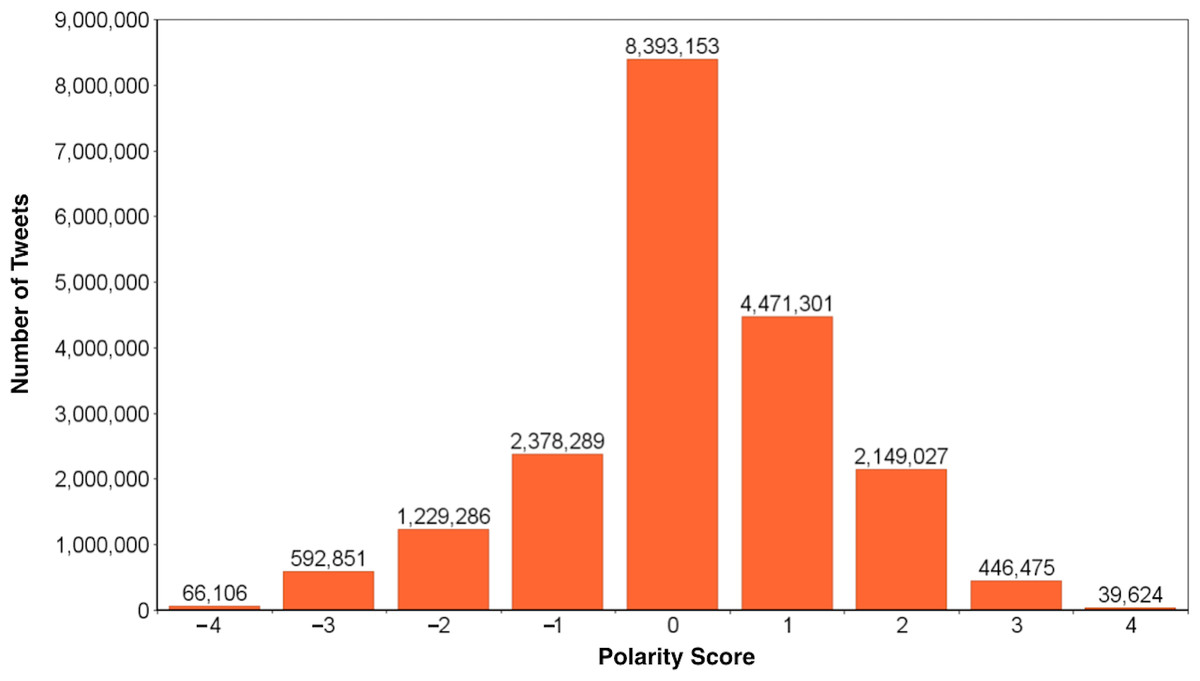
Ferrara and Yang conducted a study of 19 million tweets with the following distribution:

Their findings indicated that positive tweets reach a larger audience and are shared more often. As tweet score becomes more positive, the number of retweets, favorites and seconds to first retweet increases at an accelerated rate.

Just how much of a difference does positivity make:
So What? – Words Make a Difference
These are the key findings on sentiment content:
At Yalo, we feel that your words really make a difference. There are many environmental factors that also need to be considered. With these environmental factors we have varied levels of control; however it comes to how we share content we have complete control. Control of what we share and also how we share it! Sentiment analysis from Yalo is the tool to tune content delivery for influencing followers and customers, as well as for analyzing social media traffic that reflects and responds to brand image.
Interested in this fascinating new Yalo marketing-communications and analytics service? Curious how it could be applied towards your business goals? Let’s have a conversation for nuanced understanding.
Insight | 05.04.21
Natural Language Processing and text analysis are AI techniques for isolating, selecting and measuring the effective nature of unstructured information. With these techniques, sentiment analysis is applied for understanding customer feedback (reviews, surveys), analyzing social media traffic, creating website content and shaping marketing campaign messaging.
A scored word list is a supervised learning technique for completing sentiment analysis. The scored list or lexicon contains words with scores from most negative to most positive. Numbers assigned depend on the lexicon being used, for example AFINN scores range from -4 to +4. Text is decomposed into its individual words. The individual words are matched against the lexicon, summed and divided by the number of words to get an average score. Lexicons can be developed using surveys and adjusted to address specific domains. This approach can be enhanced with a rules base to address other language features, such as context, multipolarity and negation resulting in a compound calculated score for a piece of text. The power of this approach is in understanding the effect of each word and then being able to adjust the rules.
Using clustering, unsupervised learning can also be used for sentiment analysis. Like any unsupervised technique data is fed into the model, in this case, text – and in real time the model returns the overall results of positive, neutral or negative. To build the module, representative embeddings must be isolated and scored. Clustering is then completed on the data. The relative location of words in a cluster determines their positive or negative value. Then each word is considered for how unique it is in each sentence. This along with the sentiment scores are used to complete sentence scoring.
Some applications of sentiment analysis tools include:
Content Creation – confirming intended sentiment for social media and website content
Customer Feedback – analyzing market sentiment towards products and/or services
Product Review – capturing the most valued product features
Brand Image – monitoring social media by segment for sentiments on brand
Stock Market – real time assessment of investor sentiment on stocks, influencing long/short positions
Regulatory Compliance – identify, extract and understand regulatory, legal and medical documents that traditional data analytics techniques can’t handle
Competitor Intelligence – comparing sentiment on social media against competitors

Sentimental Analysis Tools Value
Sentiment analysis confirms the intent of communications: emails, website content and social media postings. This contributes to the reach, impressions and engagement of these communications. With studies indicating positive emotions increase the speed and reach of social messages, sentiment analysis has significant value. In addition to social media applications, sentiment analysis tools also provide value in tracking customer service feedback and product reviews.
Learn about Yalo’s own Sentiment Analysis services for our clients. Contact us please for any general inquiries, here.
Insight | 04.27.21
Many historical perspectives identify the genesis of Natural Language Processing with Alan Turing’s efforts during World War II cracking the Nazi’s Enigma code machine. By any measure, his Ultra intelligence and Turing machine saved millions of lives and shortened the war by multiple years.

NLP Evolution
After World War II, Turing’s direction involved establishing the foundation of NLP in his article, “Computing Machinery and Intelligence.” This ground-breaking article is viewed as the first treatise on artificial intelligence. He proposed the “Turing test,” (see below) for addressing the question,” can machines think?” He supported his position by rebutting nine arguments against intelligent machines. The nutshell result -thinking machines do not just isolate the words; they identify what the words mean in context.
“A computer would deserve to be called intelligent if it could deceive a human into believing that it was human.” – Alan Turing
NLP Components
Building on this foundation, language translation, language theory, probabilistic and data driven models have yielded what we know of as NLP today. Using NLP, computers dissect, absorb and draw meaning from language in context by:
NLP Applications
It is surprising how many everyday situations benefit from the application of NLP. Some of them include:
NLP and Sentiment Analysis
Natural Language Processing as part of the artificial intelligence discipline is the foundation for sentiment analysis. Both supervised and unsupervised learning techniques can be applied to complete sentiment analysis. The approach being used relies on the input word, sentiment values definition, and the level of control desired in understanding, modifying and acting on the results.
NLP Strengths
Natural Language Processing’s power is derived by its ability to understand and manipulate the human language. This ability delivers exact answers to questions without extraneous information. In addition, NLP can provide structure and sequence to ambiguous information. Yalo utilizes these functions as part of our new Sentiment Analysis services for expanded social media success for our clients.