

Insight | 01.17.25
Insight | 07.02.25

When a client asks, “What’s the ROI of [insert ad channel here]?” what they’re really asking is, “Which magic button can I press to make results appear?”
We get it. Attribution is intoxicating. ROAS feels like truth. And with the rise of AI-powered buying tools, real-time dashboards, and third-party data integrations, it’s never been easier to see results.
But here’s the kicker: the numbers you can track are only part of the story. The rest? That’s where we come in.
At Yalo, our media team is built differently, with the knowledge that data is a critical tool, but it’s not the whole tool belt.
We’re full-funnel, full-service, and fully fluent in the nuances of both digital and traditional channels. And yes, when to trust ROAS metrics, and when to be a healthy skeptic. From CTV and podcasts to SEM, print, programmatic, and beyond—we’re not here to rack up views, we’re here to make them count.
How? We use in-platform and third-party AI tools not just to chase efficiency, but to ensure impact.
Whether it’s uploading a CRM list through LiveRamp, creating historical geotargeting audiences via third-party partners, or running brand lift studies across healthcare or general market categories, we’re not guessing—we’re pinpointing.
Our planning process is powered by research partners like MRI Simmons and Comscore.
Our buying is enriched with purchase-level data from credit bureaus and intent signals. And our reporting? Custom dashboards that are live, accessible, and actually usable, so clients aren’t stuck staring at a spreadsheet asking ‘so what?’
But tech alone won’t win the war.
You still need great creative. An integrated media mix. A message that lands. And yes, that includes a team that understands your business well enough to challenge your assumptions.
While it’s tempting to chase short-term wins with last-click logic, the truth is: 91% of people who buy your product saw your ads and didn’t click them (Nielsen). 80% bounce between devices before purchase. And 40% use more than one screen to complete a transaction (eMarketer).
So, what’s the ROI of that?
Truth is, the most impactful plans don’t just ask, “What channel will convert?” They ask:
That’s what we do.
Our tribe connects the dots between strategy, storytelling, and sales. Between the art and the algorithm. Between “what you’re doing” and “why it’s working.”
There’s no magic button. Just media done right. And that’s the Yalo way.
Insight | 01.17.25
They say all the world’s a stage, but when you’re running media for a historic theatre like The Strand, the real performance happens behind the scenes—in dashboards, data, and media spend optimizations. Our task? Drive ticket sales for a lineup of wildly different shows, from classic films to live concerts, all while ensuring our client got the best bang for their advertising buck. Enter AI, the ultimate understudy that helped us steal the show in media performance.
The first challenge was figuring out exactly who we needed to have sitting in the proverbial front row: our target customer. But with such a diverse lineup of performances, that audience was a varied one. AI helped us break it down by analyzing Meta’s audience data at scale and identifying patterns in who was engaging, who was buying tickets to which types of shows, and (more importantly) who wasn’t.
Engaging them on their terms added another layer to our efforts. Rather than relying on assumptions, AI helped us tailor our messaging and audience targeting to match the unique vibe of each show.
Once we had our audiences locked in, we made sure our ad dollars were putting on a Tony-winning performance. We wielded AI by continuously analyzing which channels and creative assets were hitting the right notes at the moment of transaction.
This real-time, data-driven decision-making kept us from wasting budget on underperforming tactics and ensured we doubled down on what worked. Think of it as a media strategy that constantly fine-tuned itself, like a sound engineer tweaking the mix to get the perfect balance.
A great show builds momentum; our campaigns did too. Thanks to our team’s prowess in deploying AI to parse analytics at scale, we didn’t just see good performance, we saw better performance month over month.
By the time the final curtain fell, The Strand Theatre had maximized its media spend while continuously improving ROI. The result? More ticket sales, smarter budget allocation, and a digital media strategy that played to a standing ovation.
We didn’t use AI to replace our expertise, we used it to enhance it. It helped us make smarter, faster, and more data-driven decisions, allowing us to move budget with precision and drive higher returns. In the world of media strategy, it was a box-office smash.
And with AI in the mix? Let’s just say we’re already looking forward to several encores.
Insight | 05.11.21
Is Your Social Media Messaging Good Enough?
Does it make a difference what and how you post on social media? Don’t you just need to maintain a presence? Or if you do not have a presence, then how do you know the right message is getting out there to your target audience? In reality, it’s all about emotion, quantity and speed. Your company’s social messages Do make a difference, because business social media is exploding.
The Social Media Explosion
How fast are social networks growing?
Across age groups, where are the commercial uses for social networks:
Simultaneous to audience growth, information being added to the Internet will grow from 4.4 billion GB per day in 2016 to 463 billion GB per day in 2025 (IDC estimate). With exploding users and content projected to grow a 100-fold per day, how do you differentiate your messaging to gain, maintain and grow followers, engagement and sales? How do you make sure your content influences and accelerates through the Internet, so you get your “share of eyeballs?”
Social Media Diffusion
Information diffusion is how fast data is moving through a network. It has been studied extensively in social, physical and computational sciences. Research in word of mouth and viral marketing has been documented in business literature. With the emergence of social media, new communication techniques have been explored such as: SMS, weblogs, picture-sharing portals and online communities. The following research considers the variables that effect the diffusion on information on social networks.
Sentiment and Social Media Quantity and Speed
Steiglitz and Xuan conducted research on the effect of emotion on political tweets. This research analyzed 64,432 tweets posted one week before two German state parliament elections. They proved the following hypotheses:
Using supervised learning (regression) the study considered:
Dependent variables
Independent variables
The regression models’ coefficients indicated that for every unit increase in negative words there was a 6% increase in retweets(pg. 238). Likewise, for every unit increase in positive words there was a 4% increase in retweets. An important hypothesis they were not able to prove:
Sentiment and Social Media Predictability
Ashan and Kumari researched 20,000 tweets on the 2016 U.S. presidential election. The analysis considered the impact of sentiment along with the following environmental factors in predicting information diffusion:
Using two different regression approaches, analysis was completed determining the independent variables that provided the best model predictability. As seen below, in each model sentiment content was included and provided a significant increase in predictability.


Including the sentiment content significantly improves the predictability of social media performance and is enhanced with the ability to consider hashtags.
Sentiment and Positivity
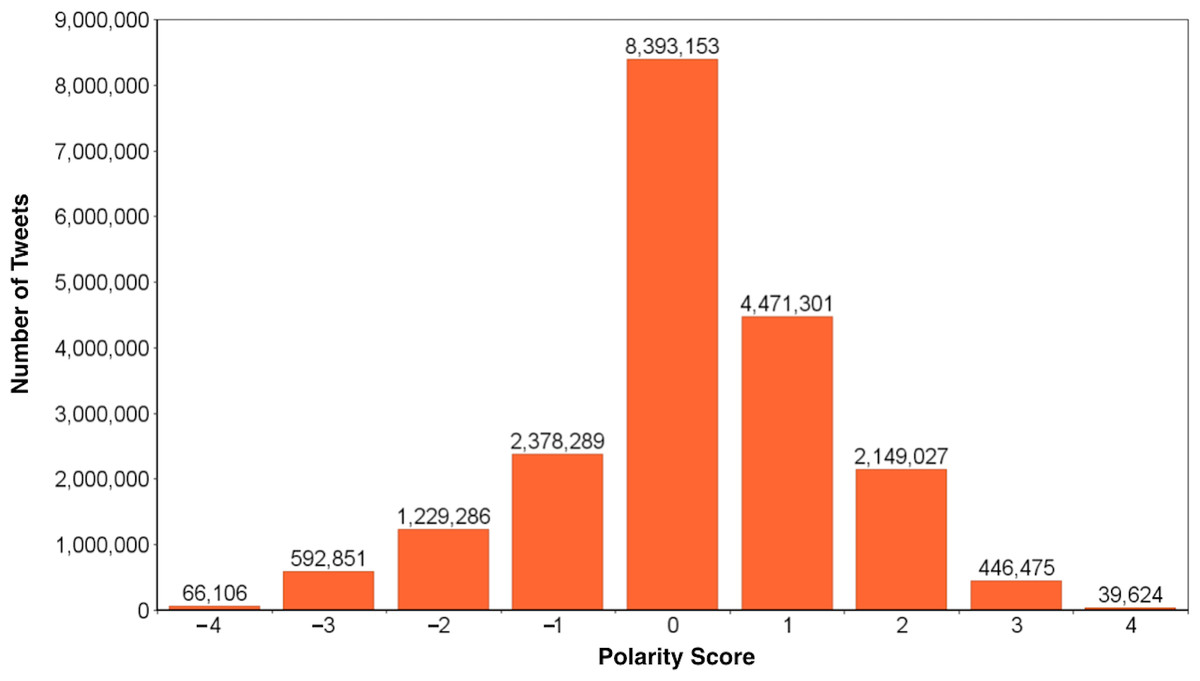
Ferrara and Yang conducted a study of 19 million tweets with the following distribution:

Their findings indicated that positive tweets reach a larger audience and are shared more often. As tweet score becomes more positive, the number of retweets, favorites and seconds to first retweet increases at an accelerated rate.

Just how much of a difference does positivity make:
So What? – Words Make a Difference
These are the key findings on sentiment content:
At Yalo, we feel that your words really make a difference. There are many environmental factors that also need to be considered. With these environmental factors we have varied levels of control; however it comes to how we share content we have complete control. Control of what we share and also how we share it! Sentiment analysis from Yalo is the tool to tune content delivery for influencing followers and customers, as well as for analyzing social media traffic that reflects and responds to brand image.
Interested in this fascinating new Yalo marketing-communications and analytics service? Curious how it could be applied towards your business goals? Let’s have a conversation for nuanced understanding.