

Insight | 01.17.25

Encore! How AI Helped The Strand Theatre Steal the Show in Media Performance

They say all the world’s a stage, but when you’re running media for a historic theatre like The Strand, the real performance happens behind the scenes—in dashboards, data, and media spend optimizations. Our task? Drive ticket sales for a lineup of wildly different shows, from classic films to live concerts, all while ensuring our client got the best bang for their advertising buck. Enter AI, the ultimate understudy that helped us steal the show in media performance.

Act One: Understanding Our Audience with AI

The first challenge was figuring out exactly who we needed to have sitting in the proverbial front row: our target customer. But with such a diverse lineup of performances, that audience was a varied one. AI helped us break it down by analyzing Meta’s audience data at scale and identifying patterns in who was engaging, who was buying tickets to which types of shows, and (more importantly) who wasn’t.

  • For classic movie nights, we saw higher engagement from an older demographic that responded well to nostalgic content.
  • For concerts, AI pinpointed younger audiences that skewed towards certain music genres based on their social interactions.
  • Theatre performances? A mix of local patrons and die-hard fans, depending on the production.

Engaging them on their terms added another layer to our efforts. Rather than relying on assumptions, AI helped us tailor our messaging and audience targeting to match the unique vibe of each show.

Act Two: Optimizing Spend Like a Broadway Producer

Once we had our audiences locked in, we made sure our ad dollars were putting on a Tony-winning performance. We wielded AI by continuously analyzing which channels and creative assets were hitting the right notes at the moment of transaction.

  • If carousel ads were outperforming static images, AI flagged it.
  • If video ads were getting stronger engagement, AI shifted more budget their way.
  • If a particular behavioral subset was buying more tickets, AI made sure we prioritized their feeds (and in the process, we learned that behaviors trumped demographics when it came to driving sales).

This real-time, data-driven decision-making kept us from wasting budget on underperforming tactics and ensured we doubled down on what worked. Think of it as a media strategy that constantly fine-tuned itself, like a sound engineer tweaking the mix to get the perfect balance.

Act Three: ROI That Kept Getting Better

A great show builds momentum; our campaigns did too. Thanks to our team’s prowess in deploying AI to parse analytics at scale, we didn’t just see good performance, we saw better performance month over month.

  • We refined audience segments based on actual purchase behavior, not just interest-based assumptions.
  • We kept shifting budget dynamically to high-performing content types.
  • We analyzed ad fatigue in real time, swapping out creative before engagement dipped.

By the time the final curtain fell, The Strand Theatre had maximized its media spend while continuously improving ROI. The result? More ticket sales, smarter budget allocation, and a digital media strategy that played to a standing ovation.

The Takeaway: AI is the Ultimate Tech Crew

We didn’t use AI to replace our expertise, we used it to enhance it. It helped us make smarter, faster, and more data-driven decisions, allowing us to move budget with precision and drive higher returns. In the world of media strategy, it was a box-office smash.

And with AI in the mix? Let’s just say we’re already looking forward to several encores. 

Insights & News
Insights & News 
Insights & News 
Insights & News 

Insight | 05.29.24

The Power of Paid Media: How Brands Leverage Metrics for Success

In the dynamic world of digital marketing, brands are constantly seeking effective strategies to reach their target audiences and drive engagement.

In the dynamic world of digital marketing, brands are constantly seeking effective strategies to reach their target audiences and drive engagement. Among the myriad of options available, paid media has emerged as a powerful tool. When combined with the intelligent use of metrics, paid media not only amplifies a brand’s presence but also provides invaluable insights into consumer behavior. Let’s explore the significance of paid media and how brands can harness metrics to maximize their return on investment (ROI).

Understanding Paid Media

Paid media refers to any form of advertising that a brand pays for to promote its content or products. This includes various channels such as:

  • Pay-Per-Click (PPC) Advertising: Ads displayed on search engines or other platforms where advertisers pay each time their ad is clicked.
  • Social Media Ads: Sponsored posts on platforms like Facebook, Instagram, Twitter, LinkedIn, and TikTok.
  • Display Ads: Banner ads displayed on websites within a network like Google Display Network.
  • Influencer Partnerships: Collaborations with influencers who promote a brand to their followers for a fee.
  • Native Advertising: Ads that blend seamlessly with the content of the platform they appear on, such as sponsored articles or videos.

The Role of Metrics in Paid Media

Metrics are the backbone of any successful paid media campaign. They provide a quantitative basis for evaluating the effectiveness of advertising efforts and inform strategic decisions. Here are some key metrics that brands should focus on:

  • Click-Through Rate (CTR): This measures the percentage of people who click on an ad after seeing it. A higher CTR indicates that the ad is engaging and relevant to the audience.
  • Conversion Rate: This metric tracks the percentage of users who complete a desired action (e.g., making a purchase, signing up for a newsletter) after clicking on an ad. It helps brands understand the effectiveness of their ad in driving sales or leads.
  • Cost Per Click (CPC): This measures the amount a brand pays each time an ad is clicked. Monitoring CPC helps in managing the budget and optimizing the ad spend.
  • Return on Ad Spend (ROAS): This is the revenue generated for every dollar spent on advertising. A higher ROAS indicates a more profitable campaign.
  • Impressions: The number of times an ad is displayed. While impressions don’t guarantee engagement, they are important for brand visibility and awareness.
  • Engagement Rate: This metric tracks interactions with the ad, such as likes, comments, shares, and saves. High engagement rates suggest that the content resonates well with the audience.

Strategies for Leveraging Metrics

To effectively leverage metrics, brands need to adopt a strategic approach. Here are some tips:

  • Set Clear Objectives: Define what success looks like for your campaign. Whether it’s increasing brand awareness, driving website traffic, or boosting sales, having clear objectives will guide your metric tracking.
  • A/B Testing: Experiment with different versions of your ads to see which performs better. This helps in understanding what resonates with your audience and optimizes ad performance.
  • Monitor and Adjust: Regularly review your metrics and be prepared to make adjustments. If a campaign isn’t performing as expected, tweak your strategy or reallocate your budget to better-performing ads.
  • Audience Targeting: Use metrics to refine your audience targeting. Analyze demographic and behavioral data to ensure your ads are reaching the right people.
  • Utilize Analytics Tools: Invest in robust analytics tools to track and analyze your metrics. Platforms like Google Analytics, Facebook Ads Manager, and others provide detailed insights into your campaign performance.

Let Yalo help you unleash the power of paid media. Contact us today for a strategic assessment of your marketing needs.

Insights & News
Insights & News 
Insights & News 

Insights & News 

Insight | 04.10.24

From Data to Dollars: How Marketing Analytics Drives ROI

In today's rapidly evolving business landscape, the importance of data cannot be overstated.

In today’s rapidly evolving business landscape, the importance of data cannot be overstated. Every decision, every strategy, and every move a company makes can be enhanced and optimized through the power of analytics. It’s no longer enough to rely on gut instinct or past experiences; businesses that thrive in the digital age harness the potential of data analytics to gain invaluable insights and drive success. Let’s explore the myriad of benefits of utilizing analytics for business growth and how it can be a game-changer for companies.

Empowering Informed Decision-Making

In the dynamic realm of marketing, decisions made in the dark can lead to missed opportunities and wasted resources. Marketing analytics shines a light on the path forward, enabling businesses to make informed decisions backed by solid data. From identifying the most lucrative customer segments to optimizing advertising spend, every move is strategically guided by insights gleaned from analytics.

Precision Targeting and Personalization

Gone are the days of generic, one-size-fits-all marketing campaigns. Today’s consumers crave personalized experiences tailored to their preferences and needs. Marketing analytics equips businesses with the tools to deliver just that. By segmenting audiences based on demographics, behavior, and psychographics, marketers can craft hyper-targeted campaigns that resonate with individual consumers on a deeper level.

Maximizing ROI and Efficiency

In the world of business, every dollar spent must yield a return. Marketing analytics serves as a compass, guiding investments towards the most lucrative channels and strategies. By tracking key performance indicators (KPIs) such as conversion rates, customer acquisition costs, and lifetime value, businesses can optimize their marketing efforts for maximum ROI. Furthermore, analytics highlights areas of inefficiency, allowing organizations to streamline processes and allocate resources more effectively.

Staying Ahead of the Competition

In today’s hyper-competitive landscape, staying ahead of the curve is imperative for business survival. Marketing analytics provides the competitive edge needed to outmaneuver rivals and capture market share. By monitoring competitor activities, analyzing industry trends, and identifying emerging opportunities, businesses can proactively adapt their strategies to maintain a competitive advantage.

Driving Continuous Improvement

The journey towards success is a never-ending pursuit of improvement and innovation. Marketing analytics serves as a compass, guiding investments towards the most lucrative channels and strategies. By tracking key performance indicators (KPIs) such as conversion rates, customer acquisition costs, and lifetime value, businesses can optimize their marketing efforts for maximum ROI. Furthermore, analytics highlights areas of inefficiency, allowing organizations to streamline processes and allocate resources more effectively.

Embracing the Future of Marketing

As technology continues to evolve and consumer expectations evolve, the role of marketing analytics will only become more pivotal. By harnessing the power of data-driven insights, businesses can unlock a world of possibilities and propel themselves towards unparalleled success. From precision targeting to continuous improvement, marketing analytics is the cornerstone of modern marketing strategy, empowering businesses to thrive in an ever-changing landscape.

Analytics is no longer a nice-to-have; it’s a strategic imperative for businesses looking to thrive in today’s data-driven world. By harnessing the power of analytics, businesses can make smarter decisions, improve efficiency, enhance customer experiences, gain a competitive advantage, mitigate risks, and drive revenue growth. In a world where data is king, analytics is the key to unlocking untapped potential and charting a course towards business success. Let Yalo help you create the right metrics to propel your business to the next level.

Insights & News
Insights & News 
Insights & News 

Insights & News 

Insight | 09.12.22

Baseball, Apple Pie and… Analytics?

What could be more dependable than Baseball, Apple Pie and .. Analytics? Mom’s apple pie never disappoints. Baseball, there is always Opening Day next year, when hope springs eternal for participating in the Fall Classic. Okay, it was in doubt in 2020 because billionaires were squabbling with millionaires, being selfish, not For the Love of the Game. But they came around and saved the season. As for analytics and baseball (Sabermetrics), there are terabytes of data that are applied to influence and drive many facets of baseball operations. 

Using these tools and relying on lagging indicators has become pervasive in baseball. Our Opening Day blog projected Atlanta winning the division in 2020. This year sources (CBS, The Lines and SI) all predict an Atlanta repeat at 91.5 wins, followed by the Mets, Nationals, Phillies and Marlins at 89, 88, 82 and 71 wins, respectively. You will recall this analysis starts with collecting key data for each player and through proven analytics build a forecast of  individual player performance. Using player performance forecasts and building a team roster, the team’s schedule is simulated enough times to achieve projected season performance with the desired level of confidence. Every team is projecting how many wins it will take to get to playoffs and building a team within budget to get there. This process is represented well in a 4 minutes scene in the movie Moneyball.

Oakland, Boston and Tampa Bay pioneered managing by the numbers and continue to manage to their 2021 payrolls of $107M, $77M and $45M respectively. Other teams have been fast followers, applying analytics that have largely leveled the playing field for what were misconceptions in what it takes to win baseball games and what makes a player valuable. Capitalizing on the power of analytics, Major League Baseball has gone beyond roster strategy into additional areas of baseball operations, including:

  • Advance scouting
  • Minor League player development
  • Major League draft analysis
  • Player/coach game preparation
  • International arbitration
  • Financial modeling and budgeting
  • Marketing 
  • Community Outreach

Businesses are also expanding the use of analytics. There is a thoughtful expansion of analytics use from descriptive/inferential statistics and trailing indicators to supervised/unsupervised learning and natural language processing for:

  • Personalization: promotions and notifications tailored to specific customers
  • Forecasting Services: anticipating demand for properly staffing customer service centers
  • Predictive Modeling: accelerating research and development for new products
  • Preventive Health: maintenance strategies based on anonymous patient histories
  • Health Delivery: supporting voice transcription of doctor-patient interactions

These result in modern business models which:

  • Launch new product offerings
  • Create new revenue streams
  • Automate manual processing prioritizing higher value-added tasks
  • Improve customer, business partner and employee relationships

All businesses need to evaluate the power of the total analytical tool set in isolating the imperfections in their business models and capitalizing on the imperfections in their competitors’ business models.

How about dependability? Even if it is close, you need to go with Mom’s apple pie, because in the end she is one of the few people who will always love you for who you are. In baseball, the next collective bargaining agreement looms on the horizon and we will need to monitor the owners’ and players’ stewardship of the game. Analytics in baseball has to be applied with judgment. With the right data and a sufficiently large data set it has its appropriate applications. But we need to keep in mind the ’02 Oakland A’s, recent LA Dodger playoff futility (until 2020) and game 6 of the 2020 World Series and taking Blake Snell out of the game. In the postseason, the sample size becomes too small for season-long trends to be significant and it becomes a different ballgame.

In each instance, as in business, historical data and analytics can recommend certain courses of action, but in the moment, there will be outliers and variability that must be considered. Consideration requiring being in the moment and delivering on the leadership opportunity.

Reach out to Yalo for deeper web & marketing analytics expertise. FullStory Analytics and Sentiment Analysis services are just a few of the tools we offer to provide actionable insights to help your business chart the right path forwards.

Insights & News
Insights & News 
Insights & News 
Insights & News 

Insight | 02.16.22

The Future Formula IoT + AI = $

We Have Been Here Before

Monitoring a process and tuning it based on feedback can be traced back to 3rd century B.C. when Kteisbios of Alexandria created valves to control water clock levels. Heron, also from Alexandria, in the 1st century BC created a fill valve like today’s toilet fill valves. The 1660’s and early 1700’s implemented controls by sensing pressure and temperature. The Industrial Revolution created controls focusing on making processes more efficient and replacing human labor. Continuous variable control with electronic sensors, proprietary network and PID controllers was introduced in the 1990’s. Today’s solutions are more sophisticated with the improvement in sensing operational variability, communicating changes to a central processing unit and sending adjustments to control units.

IoT Emergence

IoT or internet of things is part of everyday life. But it is just a variation on a theme. The ubiquity of the internet has boosted its acceptance. It is just “things,” with internet compatibility (open standard) sharing data with other “things,” on the internet. This affords the opportunity to collect, analyze and make decisions. Device sensitivity in identifying process variability, network communication speed and algorithms for managing outcomes determine the sophistication level of an IoT implementation.

IoT + AI

The algorithms are created by applying artificial intelligence to IoT. This marriage delivers system optimization, better decision-making insights, and enhanced data creation enabling machine learning. The sophistication level determines the solution implementation. At a basic level, artificial intelligence predicts in a forecasting mode or can improve quality and manage process risk. Intermediate artificial intelligence using logic-empowered sensors can act limiting outages and reducing safety risks. At the advanced level, artificial intelligence incorporates continuous data inputs allowing the system to learn and make optimal operational decisions without human intervention.  

Artificial Intelligence identifies data anomalies and patterns through data supplied from IoT intelligent sensors and devices. With IoT, it is only possible to notify when setpoints are exceeded, with the addition of artificial intelligence, machine learning predictions can be made 20 times faster with improved accuracy. How the IoT + artificial intelligence, or AIoT, achieves this is by building  intelligent machines which make optimal decisions with limited or no intervention.

Major Segments

IoT and AI markets are growing across four segments

  • Wearables – wearable devices monitoring preferences and habits for applications in sports, fitness, and healthcare
  • Home – leveraging appliances, lighting and electronic devices for automated support and energy efficiency
  • Municipal – applications for urban life making improvements in traffic control, public safety, and energy management
  • Industry – digitization of manufacturing improving efficiency, safety, and quality.

Applications that are generating value across these segments include:

Leveraging the addition of artificial intelligence is adding value to existing IoT installations and optimizing the value creation of new installations.

Use Cases

With facial recognition, Retail businesses are identifying customer’s gender, flow, and product preferences predicting behavior for store operations and locating products. Drone collected traffic data is input into algorithms which are deciding on how to improve flows through speed limit adjustments and light timing. Truck fleet management of routing and scheduling for energy saving, and predictive maintenance yielding reduced unplanned downtime. Risk prediction and automated decisions for managing process safety, monetary gain and addressing cyber threats. These are notable solutions where AIoT is generating significant value propositions.

IoT + AI + 5G + Big Data = Infinity

How do we soar higher with automated intelligence? With emerging technologies to turbocharge AIoT, 5G networks with next to zero latency will support real time data processing. Unlimited data feeding a variety of sources fueling machine learning yielding new knowledge sources for augmented intelligence. The digitizing of data will be more impactful with 5G speed delivery to algorithms and back to the process control point. Computing power complemented by IoT and 5G speed make the artificial intelligence and analytical toolset even more important than when they were originally conceived. 

Challenges

All this potential has its share of challenges. Artificial intelligence will get the most out of the combination of IoT +AI+5G+Big Data. Challenging aspects of AIoT include:

  • Analyzing and creating value propositions with IoT data
  • Predictable latency and accurate data analysis
  • Balancing the need for speed and local smart devices vs. centralized control
  • Providing personalization while protecting data privacy and confidentiality
  • Protecting against increasing cyber-attack threats.

Are you ready to create your formula for success? Let’s get started! Please reach us below via the Contact button and let’s begin your new equation together.

Insights & News
Insights & News 
Insights & News 
Insights & News 

Insight | 01.19.22

Riding the Crest of the Wave – Artificial Intelligence in 2022

Catching the Wave

We have calmed most of the concern of artificial intelligence replacing workers.  Today, artificial intelligence is part of the fabric of our lives (Alexa, Siri) and an important part of business strategy. A strategy fast-tracked by COVID to deliver efficient and remote business processes. Businesses have dealt with worker shortages, supply chain change and inflation which have accelerated the introduction of the Internet of Things, 5G and artificial intelligence. Validating Sundar Pichai’s, CEO of Google Inc. claim that artificial intelligence will have a far greater impact than fire and electricity on humanity.

Another indicator of artificial intelligence’s impact is where are the best minds in technology going in industry and academia. The most recent Taulbee Survey 2020 by Computer Research Association indicates where the information technology PhD awardees are applying their expertise in academia and in industry. With the data from the report, in academia 17% are pursuing research and teaching appointments in artificial intelligence and machine learning.

At 20% we see similar trends for those PhD. awardees taking an industry career path.

So, when thinking about futures in technology for 2022 it makes sense to start with artificial intelligence/machine learning to identify emerging trends. 

Examining the trends, one must explore the potential within artificial intelligence and the change it will generate.

Considering todays’ artificial intelligence progress, we are experiencing the benefits of enterprise operational efficiency. The following trends will enable progression to the crest of the wave.

Augment

Enterprise implementations of artificial intelligence has help overcome the fear of the intelligent machine. For now, instead of machines replacing the workforce, machines analyze data and create information relevant for the workforce. Artificial intelligence augmenting the workforce is present in many professional fields including:

  • Genetics – grouping DNA patterns to study evolutionary biology
  • Dimensionality Reduction – problem simplification by reducing random variables resulting in better data visualization
  • Ecology – comparison of audio recording of regions for comparison of species population for biodiversity

Expanded artificial intelligence use extends the need for data creation and growing AI literacy. This environment will develop more user-friendly tool sets which sort through the data isolating the value creating information for task completion.

Literacy

Language modeling is an artificial intelligence discipline that is significantly impacting our daily lives. With language modeling, machines and humans can interact and understand with a language that people can understand. Natural language processing (NLP) takes language and converts into computer code that runs programs and applications. In addition to use in intelligent voice assistants (Google, Siri, Alexa) NLP applied to:

  • Web search – allowing algorithms to read text and translate to another language
  • Word processing – supporting grammar and spelling checks
  • Sentiment analysis – analyzing text for intent and processing customer feedback

The recent Open AI release of GPT3 is the most advanced language model to date, approaching the ability to conduct a conversation with users, moving toward literacy. NLP facilitating the human-machine interface will accelerate the democratization of technology in general and the acceptance of artificial intelligence.

Safety

With growth of knowledge and machines involved in business operations and our daily lives, there is an increased cybercrime risk. More human interaction and machine additions to the network create more points of failure. Artificial intelligence’s smart algorithms will manage network complexity, detect patterns, and network traffic call attention to dubious activities. Artificial intelligence’s smart algorithms will address cybersecurity by:

  • Network Vulnerability and Threat Detection – faster identification and detection of threats
  • Threat Defense Maintenance – automatic update and vetting of defense layers
  • Incident Diagnosis and Response – quickly identifying what, why and how a breach happened
  • Cyber Threat Analysis and Reports – AI data collection and NLP reporting tools for collecting data and summarize reports for timely distribution.

Through surveillance and antivirus software design, artificial intelligence will serve an ever-increasing cybersecurity role.

Metaverse

Metaverse is defined as a digital environment where multiple users can work and play together. This virtual world concept received a significant boost with the Mark Zuckerberg announcement of creating a metaverse combining virtual technology and Facebook. Users constructing these environments will be able to engage and expanding their creativity. Experiences in the metaverse will involve interacting with AI bots for relaxation and potentially as virtual assistants in selecting products and services. AI will play a significant role in creating and maintaining these virtual environments.

Simple As Possible

With increasing demand for the application of artificial intelligence, organizations are facing an artificial intelligence and engineering shortage in creating new tools and algorithms. This is a huge barrier in adopting the technology at the rate of change. Delivering artificial intelligence and machine language tools requires a sophisticated and evolving set of skills implementing this technology. Addressing this challenge with a set of tools to simplify the creations process will be a priority, but it is important to heed Albert Einstein’s caution:

Make everything as simple as possible, but not simpler.

The artificial intelligence No Code solutions are emulating web designing solutions where users drag and drop modules/features from a library to build a website ready page. No-Code artificial intelligence systems will create smart solutions by combining pre-created modules and supplying solution specific data through intuitive user interfaces. 

Contact Yalo’s resident Data Scientist Rich Krahn for more great insights as part of our data analytics services. Contact Yalo below to get started on a conversation about our many design and development services that can help your business to thrive digitally.


.

Insights & News
Insights & News 
Insights & News 
Insights & News 

Insight | 10.27.21

Taking the Boo out of Boolean

Social media monitoring is quickly becoming a monster requirement for modern brands who are looking to engage with their customers on social media platforms, keep one good eye on competitors, and find relevant influencers. But it can also be a scary task – with the entire Covid-19 world moving online. It can easily drive you batty with irrelevant mentions and tags, not only “goblin” up your time, but also impacting your analytics in a negative way.

One way to address this is by utilizing a monitoring tool with Boolean search. Boolean search combines terms with operators and is used in social listening tools and search engines.

If you have any experience with social media monitoring platforms, you know that getting precise results may be frightful at times: Apps can show a lot of noise for brands with common names or, terrifyingly, miss some valuable data due to the restrictive filters. That’s where Boolean search does its magic.

3 Impactful Ways To Use Your Boo:

Address customer concerns.

Boolean search lets you create queries that search for posts containing problematic terms and untagged public posts aimed at friends and family that are discoverable only with social media monitoring tools.

Generate new leads.

Boolean search comes in handy with lead generation. To set up a search, you’ll need to come up with a few phrases that people typically use to ask about services online, such as “I’m looking for,” “I need,” “recommend me,” and similar search queries. Alternatively, you could think of something all your customers share, i.e. the circumstances that bring people to considering your services.

Reclaim linkless pages for link-building purposes.

Boolean search lets you easily create queries that contain only mentions of a particular brand or industry. All you need to do is tell your social listening tool to look for mentions of your brand/product/campaign that have no links to your domain.

Don’t be afraid to upgrade your social media monitoring by exploring Boolean search options. If you need support or have more questions, Who you gonna call? Yalo!

Insights & News
Insights & News 
Insights & News 

Insights & News 

Insight | 07.20.21

Words Make the Difference

Social Media Returns

Anticipation is high for the payback on social marketing investments. The verdict is out for capturing any quantifiable results. A recent CMO poll cosponsored by Duke Business School and Deloite Touche indicates that even with an average of 13% of marketing dollars being spent on social marketing, only 30% of the respondents indicate that they have shown quantifiable value. Pressure will increase significantly to show value, with social marketing estimated to grow to 21.5 % of the marketing budget over the next five years.

Social Media Value – Lagging Indicators

To achieve quantifiable benefit, social media must deliver outcomes with business value. Social media must facilitate the journey through the marketing funnel, for users, customers, and clients. For eCommerce, the outcome is a loaded shopping cart and commitment to buy. For concerns, offering services and/or building brand image, it is attracting eyeballs “from the wild,” and migrating from reach/impressions to followers. Using tools like, Google Analytics, progress is tracked using lagging indicators. The intent is to determine what was an effective post, but resorts instead, to just comparing summary statistics for a given time period. This can show that the process is directionally correct but:

  • No detailed data exists on how the how the post-performance was attained
  • No clear direction on how to maintain or change or change course for the future

Even sentiment analysis has focused on what has happened. It is used to sense public opinion from social media posts or internal customer issue tracking or product feature feedback.  Companies use sentiment analysis to gain insights so they can provide differentiated services, valued product designs, frictionless user experiences and refined business processes. Sentiment analysis is used to determine the predilection or opinions of the author. But again, this is something that has already happen, which is like, “trying to drive a car by looking in the rear-view mirror.”

Sentiment Analysis – Influencing Outcomes

Sentiment analysis can be performed using several approaches. They tend to fall either in the supervised learning or lexicon (bag of words) approaches. Supervised learning, large amount of unlabeled text is fed into algorithms. These algorithms use embedded words learn based on the coming text and develop a model which establishes the sentiment (positive, negative, or neutral) analyzing text sources including social media. Getting large amounts of text and defining the parameters for embedding terms for teaching the model are two of the challenges using this approach. 

Bag of Words uses a pre-defined lexicon. There is significant effort to build a lexicon, especially if a crowd sourcing (sending out surveys, online tools) is used. This builds a lexicon with each word being assigned a positive or negative score. The scored words with rules for addressing context and syntax define a sentiment score at the sentence and paragraph levels. This gives an overall score plus insights how the chosen words effected the sentence and or paragraph sentiment score. 

Using tools when creating all content influences the reader to continue reading, become a follower, or act. Applying sentimental analysis cannot address all the variability for social media outcomes, it is a part of the variability that you can control. Using a lexicon and consistent approach to content development will influence the audience because, the words make a difference. They make a difference because research has shown that social media with higher positive content

  • Increase the quantity of social media traffic and its speed through social media channels
  • Used with environmental factors improves the predictability of social media diffusion
  • Increased positive content increases social media acceptance and diffusion

The Lexicon Challenge

Having the “right” lexicon is the challenge when taking the supervised approach using a lexicon. How do you manage the effort of creating the “right lexicon,” by audience but not introduce bias? How do you get unbiased word scoring? How often should it be updated? Is a general one-size fits all lexicon the answer or is something specific needed for each audience? What choices exist in developing or collecting public domain lexicons and developing audience-specific lexicons?

Heady marketing subject matter but as the title of this post states it, words make the difference. At Yalo, we’re in the business of making your words more relevant and more impactful – whatever medium and purpose you are intending. Sentiment analysis and marketing communications services help to accomplish those goals. What word-smithery can we accomplish for you?

Insights & News
Insights & News 
Insights & News 
Insights & News 

Insight | 05.11.21

Social Media Diffusion


Is Your Social Media Messaging Good Enough?

Does it make a difference what and how you post on social media? Don’t you just need to maintain a presence? Or if you do not have a presence, then how do you know the right message is getting out there to your target audience? In reality, it’s all about emotion, quantity and speed. Your company’s social messages Do make a difference, because business social media is exploding.

The Social Media Explosion

How fast are social networks growing?

  • Percentage of users ages 16-64 who are increasing social media use – 43%
  • Annual growth in total number of social media users – 10.5% =376 million

Across age groups, where are the commercial uses for social networks:

  • Discovering brands/products via ads on social – 27%
  • Discovering brands/products via recommendations on social – 24%
  • Researching products online via social – 43%

Simultaneous to audience growth, information being added to the Internet will grow from 4.4 billion GB per day in 2016 to 463 billion GB per day in 2025 (IDC estimate). With exploding users and content projected to grow a 100-fold per day, how do you differentiate your messaging to gain, maintain and grow followers, engagement and sales? How do you make sure your content influences and accelerates through the Internet, so you get your “share of eyeballs?”

Social Media Diffusion

Information diffusion is how fast data is moving through a network. It has been studied extensively in social, physical and computational sciences. Research in word of mouth and viral marketing has been documented in business literature. With the emergence of social media, new communication techniques have been explored such as: SMS, weblogs, picture-sharing portals and online communities. The following research considers the variables that effect the diffusion on information on social networks.

Sentiment and Social Media Quantity and Speed

Steiglitz and Xuan conducted research on the effect of emotion on political tweets. This research analyzed 64,432 tweets posted one week before two German state parliament elections. They proved the following hypotheses:

  • The larger the total amount of sentiment (positive or negative) a political Twitter message exhibits, the more often it is retweeted.
  • The larger the total amount of sentiment (positive or negative) a political Twitter message exhibits, the shorter is the time lag to the first retweet.

Using supervised learning (regression) the study considered: 

Dependent variables

  • Number of times the tweet has been retweeted
  •  Time lag between the tweet and the first retweet

Independent variables

  • Total amount of sentiment
  • Number of hashtags
  • URL inclusion
  • # of user’s followers
  • Number of tweets posted during the sample period activity.

The regression models’ coefficients indicated that for every unit increase in negative words there was a 6% increase in retweets(pg. 238). Likewise, for every unit increase in positive words there was a 4% increase in retweets. An important hypothesis they were not able to prove:

  • The association between sentiment and retweet time lag is stronger for tweets with negative sentiment than those with positive sentiment.

Sentiment and Social Media Predictability

Ashan and Kumari researched 20,000 tweets on the 2016 U.S. presidential election. The analysis considered the impact of sentiment along with the following environmental factors in predicting information diffusion:

  • URL’s
  • Hashtags
  • Number of followers
  • Account age
  • Tweet age
  • # User created tweets

Using two different regression approaches, analysis was completed determining the independent variables that provided the best model predictability. As seen below, in each model sentiment content was included and provided a significant increase in predictability.

Graphical user interface, chart

Description automatically generated with medium confidence

Including the sentiment content significantly improves the predictability of social media performance and is enhanced with the ability to consider hashtags.

Sentiment and Positivity

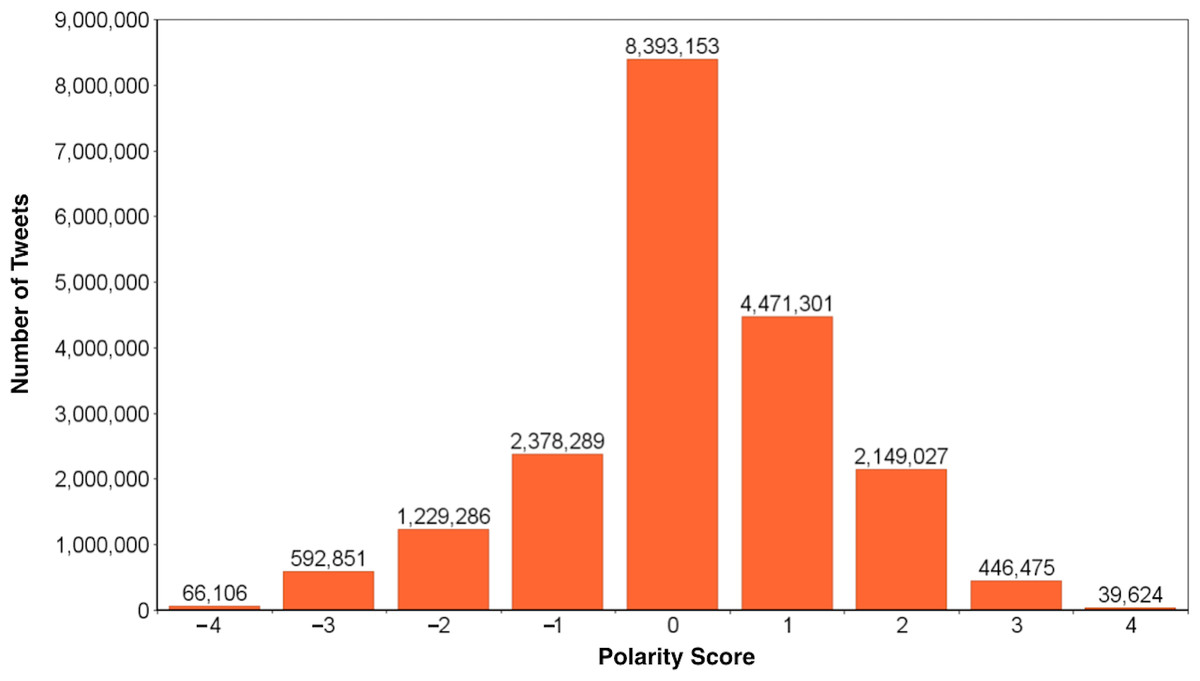
Ferrara and Yang conducted a study of 19 million tweets with the following distribution:

Distribution of polarity scores computed for our dataset.

Their findings indicated that positive tweets reach a larger audience and are shared more often. As tweet score becomes more positive, the number of retweets, favorites and seconds to first retweet increases at an accelerated rate.

Just how much of a difference does positivity make:

  • Positive tweets are favorited 5 times the rate of negative tweets.
  • Positive tweets are retweeted 2.5 time faster than neutral or negative tweets.

So What? – Words Make a Difference

These are the key findings on sentiment content:

  • Sentiment content increases the quantity of social media traffic and its speed through social media channels
  • Sentiment contentm, used in addition to environmental factors, improves the predictability of social media diffusion
  • Increased positive sentiment content increases social media acceptance and diffusion (spread and shares)

At Yalo, we feel that your words really make a difference. There are many environmental factors that also need to be considered. With these environmental factors we have varied levels of control; however it comes to how we share content we have complete control. Control of what we share and also how we share it! Sentiment analysis from Yalo is the tool to tune content delivery for influencing followers and customers, as well as for analyzing social media traffic that reflects and responds to brand image.

Interested in this fascinating new Yalo marketing-communications and analytics service? Curious how it could be applied towards your business goals? Let’s have a conversation for nuanced understanding.

Insights & News
Insights & News 
Insights & News 
Insights & News 

Insight | 05.04.21

Sentiment Analysis Tools and AI

Natural Language Processing and text analysis are AI techniques for isolating, selecting and measuring the effective nature of unstructured information. With these techniques, sentiment analysis is applied for understanding customer feedback (reviews, surveys), analyzing social media traffic, creating website content and shaping marketing campaign messaging

Sentiment Analysis Techniques

A scored word list is a supervised learning technique for completing sentiment analysis. The scored list or lexicon contains words with scores from most negative to most positive. Numbers assigned depend on the lexicon being used, for example AFINN scores range from -4 to +4. Text is decomposed into its individual words. The individual words are matched against the lexicon, summed and divided by the number of words to get an average score. Lexicons can be developed using surveys and adjusted to address specific domains. This approach can be enhanced with a rules base to address other language features, such as context, multipolarity and negation resulting in a compound calculated score for a piece of text.  The power of this approach is in understanding the effect of each word and then being able to adjust the rules.

Using clustering, unsupervised learning can also be used for sentiment analysis. Like any unsupervised technique data is fed into the model, in this case, text – and in real time the model returns the overall results of positive, neutral or negative. To build the module, representative embeddings must be isolated and scored. Clustering is then completed on the data. The relative location of words in a cluster determines their positive or negative value. Then each word is considered for how unique it is in each sentence. This along with the sentiment scores are used to complete sentence scoring.

Application of Sentiment Analysis Tools

Some applications of sentiment analysis tools include:

Content Creation – confirming intended sentiment for social media and website content

Customer Feedback – analyzing market sentiment towards products and/or services

Product Review – capturing the most valued product features

Brand Image – monitoring social media by segment for sentiments on brand

Stock Market – real time assessment of investor sentiment on stocks, influencing long/short positions

Regulatory Compliance – identify, extract and understand regulatory, legal and medical documents that traditional data analytics techniques can’t handle

Competitor Intelligence – comparing sentiment on social media against competitors

Yalo offers sentiment analysis tools to help our clients understand their digital brand

Sentimental Analysis Tools Value

Sentiment analysis confirms the intent of communications: emails, website content and social media postings. This contributes to the reach, impressions and engagement of these communications. With studies indicating positive emotions increase the speed and reach of social messages, sentiment analysis has significant value. In addition to social media applications, sentiment analysis tools also provide value in tracking customer service feedback and product reviews.

Learn about Yalo’s own Sentiment Analysis services for our clients. Contact us please for any general inquiries, here.

Insights & News
Insights & News 
Insights & News 
Insights & News 

Insight | 04.27.21

NLP Roots

Many historical perspectives identify the genesis of Natural Language Processing with Alan Turing’s efforts during World War II cracking the Nazi’s Enigma code machine. By any measure, his Ultra intelligence and Turing machine saved millions of lives and shortened the war by multiple years.

NLP Evolution

After World War II, Turing’s direction involved establishing the foundation of NLP in his article, “Computing Machinery and Intelligence.”  This ground-breaking article is viewed as the first treatise on artificial intelligence. He proposed the “Turing test,” (see below) for addressing the question,” can machines think?” He supported his position by rebutting nine arguments against intelligent machines. The nutshell result -thinking machines do not just isolate the words; they identify what the words mean in context.  

A computer would deserve to be called intelligent if it could deceive a human into believing that it was human.”  – Alan Turing

NLP Components

Building on this foundation, language translation, language theory, probabilistic and data driven models have yielded what we know of as NLP today. Using NLP, computers dissect, absorb and draw meaning from language in context by:

  • Decomposing posts, text, paragraphs and sentences into meaningful words
  • Applying a lexicon containing words, expressions and symbols
  • Transforming words into a grammatical structure which shows how the words are related
  • Defining word structures and their meaning from their context
  • Abstracting language meaning for social situations by applying rules

NLP Applications

It is surprising how many everyday situations benefit from the application of NLP. Some of them include:

  • Web search – allowing algorithms to read text on a page and translate to another language
  • Word processing – supporting grammar and spelling checks
  • Translation – computer applications to translate speech or text into another natural language
  • Speech recognition – decoding the human voice for mobile telephony, virtual assistance
  • Summarization – condensing a text source into a shorter version
  • Sentiment analysis – analyzing text before distribution, analyzing customer/product feedback

NLP and Sentiment Analysis

Natural Language Processing as part of the artificial intelligence discipline is the foundation for sentiment analysis. Both supervised and unsupervised learning techniques can be applied to complete sentiment analysis. The approach being used relies on the input word, sentiment values definition, and the level of control desired in understanding, modifying and acting on the results.

NLP Strengths 

Natural Language Processing’s power is derived by its ability to understand and manipulate the human language. This ability delivers exact answers to questions without extraneous information. In addition, NLP can provide structure and sequence to ambiguous information. Yalo utilizes these functions as part of our new Sentiment Analysis services for expanded social media success for our clients.

Insights & News

Insights & News 
Insights & News 
Insights & News 

Insight | 04.20.21

AI Destruction or Disruption

AI is here and in the words of PF Sloane, many think we are on the “the eve of destruction.” But it is not that dire, it always feels this way when we are on “the eve of disruption.” For example:

  • 100 years ago, Kodak “fiends” were roaming the country taking pictures without permission, considered an invasion of privacy by many and legal actions were even pursued to prevent this activity.
  • “Where a calculator on the ENIAC is equipped with 18,000 vacuum tubes and weighs 30 tons, computers in the future may have only 1,000 vacuum tubes and weigh only 1.5 tons.” Popular Mechanics, 1946.
  • Twenty years after television’s invention, in 1946 Darryl Zanuck stated, ”people will soon get tired of staring at a plywood box every night.”
  • The cell phone was viewed as having no viable future. Marty Cooper, known as the father of the cell phone, was quoted as saying, “cellular phones will absolutely not replace local wire systems,” “Even if you project it beyond our lifetimes, it won’t be cheap enough.”

Challenges of AI

The artificial intelligence disruption is rolling in and protesting or lamenting the risks will not hold it back. In these situations, big opportunities come commensurate with risks and responsibilities. Minimizing the challenges confronting this generation presents significant leadership moments. So, we have been here before, the next wave is approaching, and “disaster” is just around the corner. What is different this time is the reach of artificial intelligence in a Now-Digital, Now-IT based world.

The artificial intelligence wave is here, perhaps not cresting yet and what are some of the most frequently presented concerns?

  • It’s The Wild West Out There – As invasive as artificial intelligence can be, standards (pgs. 18 & 19) for testing and ethics are at best just emerging.
  • Man + Machine – Trusting the outputs is an increasing concern considering all of the artificial intelligence applications and this further-complicates the increasing machine-and-software addiction possibilities.
  • Judgment – Intelligent machines require context from humans to complete tasks. This results in a single-mindedness in completing the task. If there is a conflict or roadblocks in completing the tasks, will AI make the right call or violate Issac Assimov’s laws?
  • Control – Humans, who are limited by slow biological evolution, couldn’t compete and would be superseded,” according to Prof Stephen Hawking. How do humans guide artificial intelligence innovation without losing control?
  • We Don’t Have All The Answers – As machine intelligence grows, what are the plans to monitor the algorithms and learning abilities of AI and to have standards, ethics and tracking in-place to control, isolate and fix issues?

These are some of the challenges with artificial intelligence, but not a complete list.

Opportunities for AI

The challenges are plentiful but the opportunities are significant. They include:

  • Predictive maintenance for automobiles and capital equipment (glass furnaces, paint systems)
  • Packaging recommendations for eCommerce deliveries- thereby reducing transportation cost and waste
  • Fraud prevention for credit card usage and online recommendations
  • Logistics support in assessing traffic flows and optimizing transportation routes
  • New drug creation leveraging historical data and medical intelligence

It is hard to imagine a discipline where artificial analysis has greater impact than marketing. Areas affected include:

  • Personalization of the customer experience: social media, email, eCommerce, and notifications
  • Monitoring and enhancing delivery of paid ad campaigns
  • Improving the content and context of content creation using natural language processing and sentiment analysis tools
  • Intelligent chatbots delivering human-like performance during online customer interactions
  • Anticipating churn and focusing content and notifications to re-engage customers
  • Showcasing products and/or services based on customer interactions with enterprise

With all the avenues for delivery business value, it is little wonder that artificial intelligence is projected to deliver additional global output of $13 trillion dollars.

Where We Go From Here

The value proposition is extensive, while at the same time the risk profile can be viewed as daunting. Where do we go from here?

Managing the introduction of artificial intelligence must address risk areas mentioned earlier. The risk/reward relationship has all of the elements associated with introducing any new technology. Artificial intelligence intensifies the risk/rewards because we are replacing routine human tasks and/or introducing data relationships and business tasks not easily grasped or described. 

Not understanding all the outcomes after AI implementation impacts the ability to have a sense of risk profiles for each potential application. Prevention and second order thinking becomes critical in assessing unintended consequences. This starts with the technology used to implement solutions powered by artificial intelligence. Isolating, cleansing and using appropriate unstructured data from a variety of sources is an emerging challenge. This must be accomplished in a secure manner, without revealing sensitive and personal information, and still achieve the business value of the algorithm/model. The delivery of the right data at the right time along with the uptime of the infrastructure of the solution is also key when artificial intelligence is applied to a mission-critical function, like customer service. Additionally, when utilizing what appears like non-sensitive information in building the artificial intelligence solution, the appropriate security levels must be established so that bad actors are prevented from building false identities for hacking and data-theft activities.

If an artificial intelligence solution could be compared to an automobile, the above elements would be similar to the frame, body, and tires/brakes. The real “engine” is the algorithm. In building and maintaining the algorithm, constant vigilance is required to ensure that recommended outcomes are consistent with regulations, social norms, and brand image. Managing the supplied data and supervising the algorithm includes addressing concerns over bias, underrepresented populations, and outcomes where there is no recourse (outcomes where it is unknown how to change the recommendation). Outcomes and response also require consideration on how the AI solution interacts with humans. When and how do humans interact with solutions when the solutions are slow to react to or are generating safety issues. This is not straightforward because they must also address situations where human judgment may be incorrect. 

When implementing artificial intelligence, the following quote comes to mind:

“Where there is great power there is great responsibility,” Winston Churchill 1906

In meeting the challenges that artificial intelligence presents, a structured enterprise approach that isolates the most critical risks, controls for the development/implementation of solutions, and strategizes to prioritize risks based on model transparency, complexity, and the nature of the human interface, is whole-heartedly advised in order to achieve success.

Yalo has begun our journey with artificial intelligence by offering our Sentiment Analysis services for AI for social media. Please learn more here about this exciting service.

Insights & News
Insights & News 
Insights & News 
Insights & News 

Insight | 03.24.21

Supervised/Unsupervised Learning Defined

AI has two approaches in programming intelligent machines: supervised learning and unsupervised learning. Supervised learning requires data with defined input/output relationships (labeled data). The comparison being taught by a supervisor or teacher. The resulting supervised learning algorithm uses the learning to predict outcomes from new input data. Over time the model must be maintained to ensure that the labeled data is both current and complete.

Unsupervised machine learning requires no supervision. Using this approach, the model works on its own to infer information from unlabeled data. There is no information on the outputs, the model identifies patterns from the data. This approach supports more complex processing tasks when compared to supervised learning. Unsupervised learning can be more unpredictable when compared to other learning methods.

A picture containing text, person, indoor, computer

Description automatically generated

Supervised Learning Advantages

Supervised learning takes advantage of collecting/developing data from existing experiences. This provides an approach for optimizing a model’s performance.  Supervised learning is valuable in addressing computational problems.

Unsupervised Learning Advantages

Unsupervised learning is adept at discovering unknown patterns in data. The identification of the patterns occurs in real-time and labeling is completed in the presence of the learners. Using unlabeled data, unsupervised learning does not require the data labeling effort. 

Supervised Learning in Action

Supervised learning trains the machine to complete a task. Suppose you wanted to predict how many games a pitcher will win in an upcoming season using prior year performance. The process requires the collection of a data set of pitching performance by pitcher. Example data could be:

  • Games won
  • Games lost
  • Strike outs
  • Walks
  • Ground balls
  • Fly balls
  • Home runs
  • Runs allowed

These inputs for a particular pitcher would be collected and the model determine the output, number of games won.

The labeled data defines a training data set used as an input for training the model. The model may conclude that more strikes and less walks are desirable. Similarly, more ground balls and fewer flyballs. The learning process takes this training data, isolates attributes and develops an algorithm(s) which become the model. 

Unsupervised Learning in Action

Unsupervised learning uses data with no labels. An example for unsupervised learning would be if you went to a baseball game and had no idea how the game is played, you would watch and make observations to develop an understanding of how the game is played. You would notice

  • There are 9 players on the field
  • Each team puts 9 players on the field while the other team’s players take turns hitting the ball
  • If the batter misses hitting the ball three times the next batter comes up
  • When the batting team has three players who swung and missed three times the team in the field gets to bat.
  • And so forth

You would be learning baseball without any assistance. The learning would have occurred by identifying patterns that were not previously known.

Summary – Supervised vs. Unsupervised Learning

The learning methods differ on how data is used. Input data is labeled for supervised learning and unlabeled for unsupervised learning. Supervised learning uses the output data to learn and outputs to new inputs. Unsupervised learning does not use output data. Supervised learning is a simpler method with learning performed offline versus unsupervised learning being computationally more complex and occurring in real time.

The major unsupervised learning drawback is that without labels, complete information on data grouping and output data is not available. Supervised learning requires the classification of the data. Supervised learning is considered a trusted process with accurate results, whereas, unsupervised learning in more unpredictable.

Both of these processes and more contribute to the fascinating power of artificial intelligence. In the workplace, Yalo is using our new sentiment analysis services to leverage AI for social media monitoring and actionable insights for our clients. Request a demo in order to understand how these amazing tools can help to build and boost your brand.

Insights & News
Insights & News 
Insights & News 
Insights & News 

Insight | 03.17.21

March Madness Done Differently The Rules & Regs Breakdown

March Madness is making a return! According to the NCAA, fans will be present for every round of the men’s tournament. Though, only later rounds of the women’s tournament will have spectators, starting with the Sweet 16

Teams and fans usually travel around the country. Yet, for the first time, all games will be held primarily in one city.  The men’s tournament will take place in Indiana and the women will play in San Antonio.  Arenas will be at as much as 25 percent capacity for the men’s games and 17 percent for the women’s, with masks, social distancing and testing in place for entry.

When the announcement was made that the men’s tournament would take place in Indiana, a poll was done by a local Indiana outlet, IndyStar. IndyStar sports ran a 24-hour Twitter poll asking: “If the NCAA were to allow fans for the tournament, would you feel comfortable — COVID-19-wise — going?”

Nearly half of more than 500 respondents, 48%, answered “absolutely.” Another 29% said it “depends on the rules/capacity.” And 23% replied “no way.”  In a similar Facebook poll, 54.3% said “absolutely,” 38.2% answered “no way,” and 7.5% said it depends on rules and capacity.

Capacity will include all participants, essential staff, up to six family members of each participating team’s athletes and coaches. The number of fans will also be reduced. All fans must wear face coverings and physically distance during the event. Thorough cleaning, disinfecting and safety measures will be a priority in all venues.

For players, before arriving in Indianapolis, everyone must have seven consecutive negative COVID-19 tests. If any of the tests yield a positive result, the person will not be allowed to attend the tournament until he has completed a period of self-isolation.

Although the setup and precautions look promising, only time will tell if this ends up being a successful strategy. This is a good but bold move by the NCAA.  Coming off the cancellation of the tournament in 2020, the NCAA had to adjust their approach to regain the excitement for its biggest event.  With the tournament rapidly approaching, we recently completed a website to help a client drive brand awareness during the tournament. Need help with your brand awareness? Pass us the ball and we’ll take a shot!

Insights & News
Insights & News 
Insights & News 
Insights & News 

Insight | 08.17.20

Lies, Damned Lies, and Statistics

“There are three kinds of lies: lies, damned lies, and statistics.” This quote of indeterminate origin and incorrectly attributed to but made famous by Mark Twain, came to mind when I received questions from friends and associates about an opinion piece recently published in the New York Times.  The questions raised from Just Because You Test Positive for Antibodies Doesn’t Mean You Have Them, included:

  • Does this mean that 70% of the people tested will test positive for COVID-19 antibodies?
  • Do you believe these numbers are correct?

My response was no and no.

Reporting just on a parameter estimate to an average audience can generate confusion. This is confirmed by the questions above. The article concept is correct that a base rate of a population will impact the outcome of a testing effort.  Applying a statistical tool (Bayes Theorem) and considering the base rate of the population of having COVID-19 antibodies, determines what the effect is. One of the testing results is a false positive, meaning of the people tested, who tested positive for Covid-19 antibodies, will not have COVID-19 antibodies. NOT, that 70% of the people tested will have Covid-19 antibodies.

With the information provided, I cannot reproduce the numbers indicated in the article, specifically –

“An antibody test with 90 percent accuracy could be as low as 32 percent if the base rate of infection in the population is 5 percent. Put another way, there is an almost 70 percent probability in that case that the test will falsely indicate a person has antibodies.”

Taking the high ground, I will assume Hanlon’s razor, or that adjustments to the numbers were made for journalistic effect. Applying Bayes’ Theorem, below I share my calculations. I do this only to show my approach if this makes your head hurt, jump down to the next paragraph.

Population1.000
Base Rate0.050
Population does not have COVID-19 antibodies0.950
Test Accuracy0.900
1-Test Accuracy0.100
(Test shows COVID 19|Has COVID-19 antibodies =  1 X.050.050
Test shows COVID-19 = (1 X .05) + (.95 X .10) 0.145
(Has COVID-19 Antibodies|Tested positive for COVID-19 antibodies)=(Test shows COVID-19|Has COVID-19 antibodiesXHas COVID-19 antibodies)
Test shows COVID-19 antibodies
1 X .05X0.05
0.145
=0.655
66% Rounded

This means of the people who test positive for having COVID-19 antibodies 34% (rounded) tested will have COVID-19 antibodies and about 66% (rounded) will not have COVID-19 antibodies. Few people, except practitioners of data analytics, will go through this effort to complete this analysis and understand what the statistic (false positive) and the formula calculation mean.

Rather than just communicating 34% or 66% a thought experiment resulting in an example is more effective in conveying the testing outcome of a 90% accurate test with 5% of the population having COVID-19 antibodies.  What would happen if 1,000 people were tested in this situation? Applying the same approach, we get the following results:

 Have COVID-19 AntibodiesDo Not Have COVID-19 Antibodies  
Test Positive for COVID-19 Antibodies509595/145~ 66%
Test Negative for COVID-19 Antibodies0855  

This is example allows a clearer explanation:

  • 855 tested having no COVID-19 antibodies
  • 145 tested positive for having COVID-19 antibodies
  • 95 of the 145 who tested positive for COVID-19 antibodies, DO NOT HAVE THEM
  • Not possible to know of those who tested testing positive for COVID-19 antibodies (95 out of the 145) do not have COVID-19 antibodies.

What is the advantage? Simply reporting a statistical parameter runs the risk of generating responses spanning from confusion to panic. Except for the data analytic practitioners, formulas and parameters are not good input for what relevant action should be taken. What could be actions that could be taken from the table above?

  • 855 tested should be notified that they do not have COVID-19 antibodies and should continue safe practices and be candidates for a vaccine when it becomes available.
  • 145 should be notified that they tested positive for COVID-19 antibodies but should be retested to confirm the findings.

The key learnings here are to recognize as a data scientist: it is not about a parameter that many will not understand or a calculation that they could care less about, it is about giving a business outcome that management can relate to and act on.

Insights & News
Insights & News 
Insights & News 
Insights & News 

Insight | 08.10.20

Opening Day

Go Braves!

Yes, there will be a baseball Opening Day, we just do not know when it will be! But when it happens it will be like any other Opening Day; the Braves will have new life and hope springs eternal for post season play.

With a full season, Fangraphs.com projects the Braves will win 87 games, with the Nationals, Mets, Phillies and Marlins projected to win: 88, 88, 81, and 69, respectively. How did we get to this point that we dare to predict something that will happen 7-8 months in the future?

First off, you can dispute the numbers using other sources, such as: ESPN, Sports Illustrated, Baseball Prospectus and Yahoo! Sports.

How this is determined starts with collecting key data for each player and applying proven tools to project individual player performance. Using those player performance projections and combining them into an Opening Day roster, the team’s schedule is simulated enough times to achieve projected season performance with the desired level of confidence.

Building a team based on statistical analysis was introduced to the public in Michael Lewis’ book, Money Ball and reached a far wider audience via the movie of the same name. It was about using a large sample of data to take advantage of a systemic flaw in player valuation in the game.

Considering the projected runs identified above, it looks like it is “too close to call.” That happened because other teams starting using the same data analytics and the flaw in evaluation disappeared. Makes one wonder how effectively your competition is using data analytics. Compared to your competition, does your data analytics make you look like the Braves or the Marlins?

These analytics give a view on potential full season performance. Adjustments will be necessary through the season as injuries, trades and other factors change the original assumptions. In the post season, the sample size becomes too small. Hot pitching, hot hitting, untimely errors, and managerial decision making are why we watch the post season.

And as a result, in the post season, all bets are off.   Just ask the Dodgers!

Insights & News
Insights & News 
Insights & News 
Insights & News 

Insight | 07.07.20

Max Out Your Social Media Investment: 6 Key Takeaways from a Recent CMO Poll

Marketing Budgets & Social Media  

Anticipation is high for the payback of social media marketing investments. The verdict is out for capturing any quantifiable results. A recent CMO poll completed cosponsored by Duke Business School and Deloitte Touche indicated the following:  

  • 86% of the executives surveyed have social media marketing in the budget 
  • Average percentage of marketing budget spent on social marketing – 13% 
  • Increased spending has only resulted in moderate perceived value (3.4 on a 7-point scale) 
  • Percentage having a good idea of the qualitative and not the quantitative impact – 37.6% 
  • Percentage not having shown any impact to date – 32.4% 

Isolating Social Media’s Value 

With only 30% being able to show demonstrated quantifiable value, it is a bit surprising that a five-year growth projection of social media becoming 21.5% of the marketing budget. These views are held with a social media ecosystem that is in a constant state of flux. Simplifying the challenge, social media is an ecosystem where there are 3 broad forces in play: two which must be sensed and adapted to for survival and one with mindful choices it is possible to influence. First, at any given moment, it is impossible to anticipate what is happening on the internet in general or specifically with social media. Second, we are victims of “original sin,” what has been posted in the past and what followers have grown to expect. But it possible to influence the third force by what is actually introduced and how it is shared. How it is constructed and shared influences how it will be received.  

“It’s in the way that you use it.” (thank you Eric Clapton). 

Value Tracking with Lagging Indicators 

To achieve a quantifiable benefit, social media must drive to outcomes with business value. Driving users, clients, or customers through the marketing funnel. For eCommerce, the outcome is getting a loaded shopping cart and committing to buy. For concerns offering services and/or building a brand image, it is attracting eyeballs “from the wild,’ and migrating from reach/impressions to followers. Followers that value the trust relationship and are willing to repurpose posts and keep the migration process going. The most frequent approach tracks progress by using standard analytics based on lagging indicators. The intent to determine what was an effective post, but resorts instead, to just comparing summary statistics for a given time period. This can show that the process is directionally correct but: 

  • There is no detailed data on how the present position was attained. 
  • No clear direction on how to maintain or change course for the future. 

Sentiment Analysis Influences Desired Outcomes 

So, for a particular campaign or post, what is the “right” post content, word choice, and composition for influencing the desired outcome. This can be accomplished using a two-pronged approach. First, is the evaluate the overall context and sentiment of each sentence. Then the contribution of each word of the sentence needs to be determined. The goal is to determine the predilection, sentiment, required to influence the desired outcome. Word level lexicons exist indicating the sentiment that a word can generate. Due to the “beauty” of the English language, some words can generate multiple sentiments. The bottom line, the words matter. 

Sentiment Tools Focus Intent 

The process for addressing these challenges starts with screening the post using AI natural language tools. This identifies the sentence level sentiment (degrees of positive or negative). Select tools also define the words from within the sentence with their respective sentiment and how they contribute to the overall sentence sentiment. After the screen, there may be an opportunity to replace negative words or replace less positive words with appropriate synonyms. The sentiment of synonyms can be assessed through the use of open-source lexicons (nrc, bin, afinn) which can be customized for specific business use. After changes to the post, resubmission to the AI tool will assess the impact of the changes. When satisfied the reviewed text can be posted. 

Analytics are then used to track the posts’ performance. Post analysis establishes a valence score by combining the values of all the sentiments of the words used, and word usage at the post level. This approach is not intended to be prescriptive, like taking a pill and always getting the desired outcome. The creative resources building the content must consider followers, trending topics, and branding guiding principles in developing posts and campaigns. 

Focusing Sentiments for Value  

This approach and set of tools assist in building a set of leading indicators to be proactive in the social media ecosystem. It is important to remember, that there are two forces that we cannot control and need to understand the associated indicators to monitor so that it is possible to adapt as the ecosystem changes. It is the variability of all three forces that should keep us grounded by George E. P. Box’s counsel, “All models are wrong, some are useful.” Assessing and maintaining usability is a constant task given the nature of the social media ecosystem. 

Value Guiding Correlating & Searching for Causation 

Before the days of satellites, there was celestial navigation, where three heavenly bodies were used to determine a fix or location on the ocean as an input on any required course corrections. At Yalo, we use a combination of pre-post screening, analytics, and sentiment word analysis to asses our ability to influence funnel efficiency. These three techniques determine where we are in the social media ecosystem and how we plot our course going forward.   

Insights & News
Insights & News 
Insights & News 
Insights & News 

Insight | 06.16.20

How to Navigate Google Analytics Like A Pro

Few things are harder to follow than a presentation with too many numbers on slide after slide…after slide. My Data Analytics Professor, Brian Berger stressed, “you have to be able to tell a story.” The goal is to turn data into information, and information into insight.  Being able to influence and “sell” decisions created from the data is everything.

From asking someone out on a date to applying for a job, or making a pitch to a potential client, each situation requires you to influence others to make a particular decision.

At Yalo, we are constantly tracking, tweaking and sharing data. Finding ways to fine tune our own marketing strategies enables us to sharpen the toolbox for our clients. We develop content, test campaigns, and create data reports to monitor engagement. What we share with our team must be easy to collect and decipher.

Using Google Analytics and Google’s Data Studio, we leverage the platform to include reports and analysis for:

  • Realtime Data
  • Audience Data
  • Acquisition Data
  • Behavior Data 
  • Conversions Data

With these tools you are able to segment data and analyze each point on its own. Here are Yalo’s seven key takeaways and tips to help you navigate Google Analytics like a pro.

Realtime Data from Google Analytics involves the location of your traffic, the source, the content being viewed, event action, and conversions. For example, one-day promotions for e-commerce sites can be followed to track real-time reports. This helps you understand how people are finding those promotions, where they are coming from, what items interest consumers, and where they get lost in the funnel.

Audience Overview allows you to analyze age and gender, the technology being used, and their behavior and engagement on a website. Utilizing this tool is crucial in understanding reactions from consumers to your marketing strategies. The web traffic showcases engagement from various locations throughout the country that can assist larger retailers in analyzing reasons for expansion.

Acquisition Overview breaks down how your traffic is reaching a website. There are six channels that enable consumers to find a site:

  • Direct traffic. When someone types in your site address or if they’ve bookmarked your site/clicked on a link from an email.
  • Organic Search. Refers to visits stemming from search results.
  • Social. Links shared on social channels that direct visitors to your site.
  • Retargeting. Cookie-based technology that retargets your ads on other sites your visitors view.
  • Referral. When another site has a link that sends people to your site when they click on it.
  • Paid Search. When someone gets to your site by clicking on a paid search result.
What is driving visitors to your website? Are they viewing your website on their laptop or while on the go on their phone?

Multi-Channel Marketing focuses on utilizing the channels to extend your reach cost effectively and efficiently. For a company such as Birdogs that has a younger demographic, focusing efforts toward their social channels is important. Their desire is to continue to gain popularity throughout high school and college campuses as well as 20-somethings throughout the country. Multi-Channel Funnels show how marketing channels work together to spread awareness of a brand with the hope of increasing sales and conversions. 

Behavior Overview showcases how consumers view a website, including how they shift throughout the website or drop off entirely. These factors play a huge role in our work for Hissho Sushi. The behavior overview focuses on page views, unique page views, average time on a page, bounce rate, and exit rate. Pinpointing what page drives engagement versus those that hold little interest, and what users search for on the site ranging from information to products offered. From this you are able to enhance a visitor’s experience by streamlining information, showcasing your company, and integrating platforms such as google maps to assist your customers in finding where to shop for your products.

A close up of a map

Description automatically generated

Conversions Data focuses more on a company’s e-commerce and multi-channel funnel goals. Are site objectives being met? What is the relationship between marketing campaigns, user engagement, and transactions? Have expectations been met? This data is vital in testing and measuring how close you are to your target objectives.

These are just the first steps in improving websites built by Yalo for clients from Back To Nature to Primrose Schools and M&T Bank. Analyzing these points of data help us deliver the best user experience for their prospects and existing customers.

Google Data Studio

This enables you to share reports from any date range with your colleagues and clients in real-time, despite your industry, including:

  • Behavior
  • Audience 
  • Acquisition

Overviews should be analyzed to determine what aspects of strategies are successful and where those strategies fall short. Google Data Studio includes a wide range of charts such as:

  • Regular & Pivot Tables
  • Scorecards
  • Time Series
  • Bar Graphs
  • Pie Charts
  • Geo & Google Maps
  • Line Graphs
  • Area & Scatter Graphs
  • Tree-maps

These charts can be utilized to show a month-long view of page views or a break down of traffic by its Source/Medium over the course of a few weeks. Scorecards can quickly highlight metrics such as average session duration, bounce rate, and unique page views so that everyone can understand and recognize performance metrics. 

Google Analytics also offers a feature to help filter data segments in several ways. Want to only see how a website performs in a certain region? Create a segment where data comes from a specific segment by excluding all other traffic in that view. Need to understand where people are dropping off from Memorial Day sale promotions? Create a segment only showing traffic from a multi-channel marketing strategy that drove consumers to your site. 

Segmenting data into digestible information is exactly what Google Data Studio offers. From capturing real-time data, to comparing current results to the previous year, or reviewing improvements made over several months. Are the majority of consumers viewing a website on their laptop or mobile device, are they Edge or Chrome users, is the money you’re using for paid search increasing leads or going down the drain? It even determines if outlier traffic is a success or a bot traffic invasion. 

Data tells a story. Numbers on their own can be overwhelming to any audience. But you can use the right tools to build and shape your story. Let us help you create a dialogue that keeps your visitors turning the pages.

Insights & News
Insights & News 
Insights & News 
Insights & News 

Insight | 04.15.20

Made up stats that feel real!

Hey all you cool cats and kittens, it’s time to take a break from the empty shelves, homeschooling, and social distancing to appreciate some of the positive effects from our newly discovered habits. Here are some stats that feel pretty darn real. After all, we’re all in this together so let’s enjoy the positive benefits of staying at home!

Let us know your favorite stats! #AtHomeTogether

Insights & News
Insights & News 
Insights & News 
Insights & News 

Insight | 04.15.20

What’s in a title?

After joining the Yalo tribe, the Ratu (chief/CEO) asked what I would like my title to be? My choice of “data scientist” seemed a bit dated to him, so I began to wonder if it was. And as wonderers do, I wandered onto the Interweb for some data on the name I selected. 

In an environment where assets and ideas are readily sharable, being thoughtful and intentional with the digital data we share is often overlooked. That’s where I come in. Deciphering all the data my new tribe captures on the regular and challenging them to think through it a little differently. 

“Data engineer” was the leading alternative title with “machine learning engineer” worthy of consideration, given the AI craze currently gripping the business world. At the same time, the definition of the work being like a three-legged stool has not changed. It requires skills in mathematics/statistics, computer science and business acumen. I needed a title that balanced the importance of business acumen with an emphasis on the tools and computer science. 

Data analytics is about the data. But it is more than cleansing and isolating what’s relevant. Many can be trained to make the tools deliver an answer. But deciphering the answer is entirely different. Filtering through the sea of data to determine the answer is a business solution that delivers value to our clients. 

Alas, I found an article that confirmed that Data Scientist continues to have some cache. I considered the derivation of this choice. “Data” comes from the Latin word dare, meaning give. “Scientist,” or science, comes from the Latin word scire, meaning knowledge. Data Scientist gives knowledge. 

That works for me and my tribe.

Insights & News

Insights & News 
Insights & News 

Insights & News