Insight | 09.23.24

Breaking the Mold: How AI Helped Us Create Wild Cars for Precision Tune Auto Care
AI is a lot like a teenager learning to drive. It’s got potential, but it still needs guidance to get where you want it to go. And when we were tasked with bringing Precision Tune Auto Care’s “Any Make, Any Break, Fixed” campaign to life, we knew AI could help us generate some truly out-there vehicle concepts. But AI alone wasn’t enough. We had to steer it, gearshift it, and a bunch of other car metaphors, ultimately using our creative expertise to refine its output into something that truly hit the mark. Or like, the parking spot. 

The Concept: Any Car, Any Problem, Fixed

Precision Tune Auto Care owns a network of automotive shops throughout Atlanta, and they wanted to emphasize their ability to fix anything. Not just your standard sedans and SUVs, but anything—no matter how strange, old, futuristic, or broken it might be. We needed imagery that wasn’t just cars, but wild, eccentric, AI-dreamed vehicles that captured the essence of the campaign.

Step 1: Letting AI Go Off the Rails…or Road? 

The first step was strategic prompting. We weren’t just telling AI to generate “a weird car.” We crafted specific prompts to create vehicles that were futuristic, absurd, unconventional, and unlike anything on the road.

Some of our initial prompt variations included:

  • “A vehicle that looks like it was designed in the year 2099 but only had 1950s car parts to work with.”
  • “A car that’s a mashup of a monster truck, a motorcycle, and a space shuttle.”
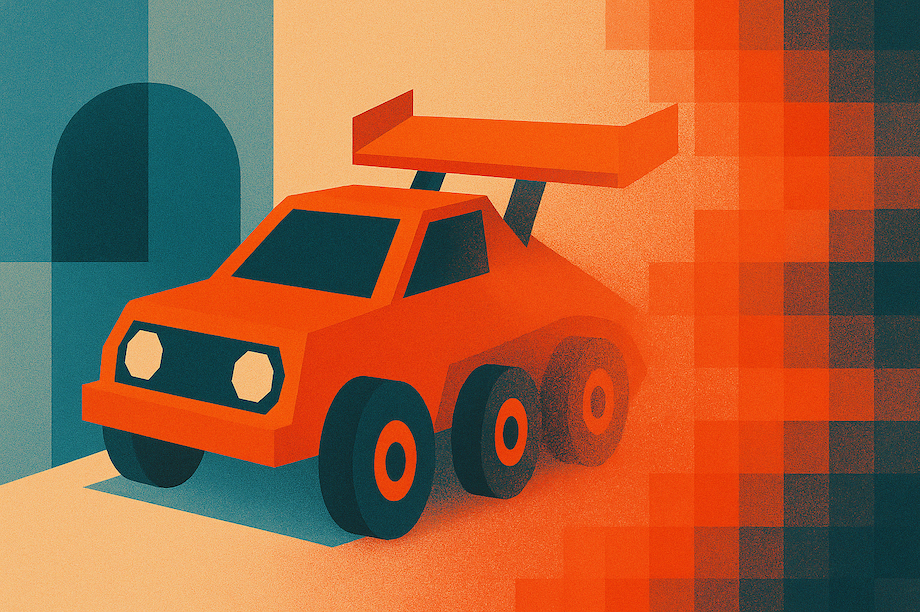
  • “A tiny European city car that somehow has six wheels, two steering wheels, and a spoiler the size of a dining table.”

AI happily obliged, and delivered some of the most bizarre, delightfully wrong car designs we’d ever seen. The results were wild, unpredictable, and often completely impractical… but that was exactly what we wanted.

Step 2: Embracing Imperfection (and Fixing It Ourselves)

Here’s the thing about AI-generated art: it’s not final art. AI doesn’t understand engineering or design principles; it doesn’t know why a wheel shouldn’t be inside the car instead of underneath it. The beauty of AI is that it gets you a starting point, not a finished piece.

That’s where human expertise comes in. The art director took the best of the AI-generated images and pulled them into Adobe Photoshop and Illustrator to refine them. That meant:

  • Adjusting proportions so the vehicles looked surreal but still functional
  • Fixing AI-generated distortions (like cars with 12 headlights but no tires)
  • Enhancing textures, lighting, and details to make them campaign-ready

The result? A set of visually striking, one-of-a-kind vehicles that perfectly communicated the idea: No matter how weird, wild, or worn-down your car is, Precision Tune can fix it.

The Takeaway: AI is a Tool, Not a Replacement

The big lesson here? AI is great at generating ideas, but it takes real creative expertise to shape those ideas into something usable. AI gave us the raw material, but it took a human touch to refine, manipulate, and make it truly work for the campaign.

Could AI replace artists and designers? No. But can it act as an accelerator for creativity, giving us unexpected ideas and a head start? Absolutely. And in this case, it helped us take a fun, conceptual idea and turn it into a visual campaign that was as inventive as the message itself.

Final Thoughts

At the end of the day, “Any Make, Any Break, Fixed” wasn’t just a tagline, it was our approach to creative problem-solving. AI gave us something weird, we broke it apart, and then we fixed it into something truly impactful.

Because just like Precision Tune Auto Care, we believe that with the right expertise, anything can be made to run smoothly—even AI-generated mayhem.

Insight | 05.12.24

Smart Tires for Stupid Roads: Using AI to Drive Industry Analysis for Apollo’s North American Expansion

In today’s hypercompetitive market, breaking into a new region isn’t just about having a great product, it’s about knowing exactly how to position it. The right insights can be the difference between a brand that eats, like, Wagyu beef versus a bowl of cold gristle. 

When tasked with developing a go-to-market strategy for Apollo, a commercial tire brand entering the North American market, Yalo turned to AI to help synthesize massive amounts of data and translate it into actionable marketing intelligence. AI wasn’t just a research tool; it was the foundation of a smarter, more strategic approach to brand positioning. 

Using AI to Define the Competitive Set

Step one in any strategic contest is understanding the battlefield. Who are the key players? What are their strengths, weaknesses, and differentiators? Leveraging the artificial intelligence tools at our disposal helped us analyze the competitive landscape at scale. Rather than sifting through whitepapers, industry overviews, competitive positioning and anecdotal insights, we used AI to process everything from customer sentiment analysis and industry trends to competitor marketing messages. We were even privy to some designated fiscal media buys.

What we uncovered was a landscape dominated by a handful of legacy brands, each staking its claim with a “unique” (these are air quotes, FYI) value proposition. Many highlighted their durability, emphasizing their ability to withstand brutal mileage. Others touted affordability, positioning themselves as the best “value” (though value seems to be a dirty word). In looking at larger brands in the space, many emphasized brand trust, leveraging decades of experience to reassure buyers. Through AI-driven sentiment tracking, we could see how these narratives played out in real-world conversations, allowing us to pinpoint white space where Apollo could step in and own a distinct position. Ideally one that appeals to the motivations and needs of our North American audience…

Cracking the Code on North American Fleet Owners & Distributors

The next challenge? You guessed it: understanding our target audience. Not just who they are, but what makes them tick. Fleet owners and distributors are the gatekeepers of the commercial tire industry, and if you don’t speak their language, you’re not getting through the door.

AI-powered audience analysis allowed us to segment North American fleet owners and distributors based on their key motivators, purchasing behaviors, and industry pain points. The data painted a clear picture: these buyers aren’t just looking for tires—they’re looking for reliability, efficiency, and solutions that address the specific challenges of North American roads.

And those roads? They’re a damn mess. From the snow-packed highways of the Northeast to the blistering heat of the Southwest, truckers face a gauntlet of conditions that demand more from their tires. AI helped us quantify these challenges, analyzing regional weather patterns, accident reports, and fleet maintenance logs to validate a crucial insight: North American truckers don’t just need tough tires; they need intelligent tires engineered to anticipate and overcome the unpredictable nature of the road.

From Insight to Impact: Crafting the Right Message

With a clear understanding of the competitive landscape and our audience’s needs, we built a strategic brief that cut right to the core of Apollo’s differentiation. Unlike competitors who leaned on vague promises of durability or affordability, Apollo had something unique: engineering intelligence. Their approach to tire manufacturing wasn’t just about toughness; it was about smart, calculated performance backed by data, research, and world-class engineering.

That insight led us to a creative platform that not only set Apollo apart but also resonated deeply with our audience: Smart Tires for Stupid Roads.

This wasn’t just a tagline; it was a rallying cry. It acknowledged the reality that truckers face every day—roads riddled with potholes, black ice, and extreme conditions—and positioned Apollo as the solution that could take on those challenges with intelligence and precision. The best part? Despite the high-quality, Apollo is a more affordable tire, backed by a road-hazard guarantee. That’s tier one performance at a tier two price. That way, we wouldn’t have to lean on value as a motivator, but rather let it be the closer when it’s time to make a sale. 

The Takeaway

AI isn’t just a tool for efficiency, it’s a weapon for marketers who want to outthink the competition and a megaphone for us to amplify our message. By leveraging AI-driven industry analysis, audience segmentation, and competitive intelligence, we were able to craft a positioning strategy for Apollo that was both authentic and compelling. Hell, I feel like I am getting nostalgic about the future.

The result? A market entry strategy that didn’t just introduce a new brand but made a bold statement: when the roads are unpredictable, your tires shouldn’t be.

Insight | 08.23.23

My Ode to Hip Hop – 50 Fabulous Years

If you were an 80’s kid, you may have missed the birth of Hip Hop in the 70’s because you were too young, but you didn’t miss out on the RISE of Hip Hop, and its Golden Era of the 80’s. The world was exposed to a mind-bending, rapidly-expanding genre of music and culture emerging from the urban core of New York City.  New York City was already the mecca for basketball (Madison Square Garden and Rucker Park). But now there was a new soundtrack accompanying the sport of basketball and its athletes. Hip Hop was an amazing confluence of style, art, dance, music, storytelling, and lyricism. Put it in the blender and out came this vivid, vibrant, and powerful new culture. It was exciting. It was fresh (and yes it was ‘fresh’). It was ‘off-the-grid’, especially for the rest of America, especially suburban and rural America. The beats and scratching, the stories, the sneakers and track suites, the graffiti, and breakdancing gave kids like me in suburban Ohio a new canvas to imagine the world upon.

I remember hearing Hip Hop for the first time. It was 1984 and rap was exploding, I just didn’t know it yet. My friend and neighbor from across the street ran over to my house on a Saturday night and dragged me to his house. His stereo was on, and he had somehow picked up an FM station from Detroit that night. It was the Saturday Night Mix Party. They were playing a mash up of rap tunes from NYC. The sounds and voices we heard blew our minds, literally. This new fantastic thing was so far off the grid of what we usually heard and what we knew. We started recording it every Saturday night on his double tape deck, with 2 double-sided Maxell 90-minute tapes (that is 6 hours of music!), front to back, the entire show. We would listen to those tapes all week, wearing them out. We couldn’t get enough. We loved every beat, rap, rhyme, story we heard. It became a weekly ritual for a long time. We got indoctrinated to Kurtis Blow, Whodini, The Fat Boys, Whistle, The Sugarhill Gang, Grandmaster Flash and the Furious Five, and of course Run DMC that year in 1984. Somehow, I was able to convince my parents (I was 14 at the time) to let my buddy (he was 16) drive us to Cleveland for the Fresh Fest II. It was the congregation of the biggest rap acts at the time. It was to be my first concert ever. That night we witnessed Matronix, Kurtis Blow, The Fat Boys, Whodini, and Run DMC. I smelled weed for the first time. I had my first ever concert tee snatched right out of my hand. And I loved every second of it. I am sure we looked like 2 fish out of water (2 ‘burb kids – 1 white, 1 Asian) in a sea of black folks, but we rapped and danced right along with everyone else because we knew every lyric. 

I jumped in with both feet into the Hip Hop culture. Boom box, check. Adidas sneakers, check. Track suits (and eventually Starter jackets), check. Gold chain, check (still wear it every day). Turntable, check. Stacks of 12 inch vinyl singles, check. Heavy bass, check. The only thing I didn’t buy was the Kangol hat because I couldn’t pull it off. We took weekly trips to the local record shop to get the latest records, hot off the streets of NYC. More records, more tapes. I am proud to say that I still have all of my original rap vinyls from the 80’s. Public Enemy’s eponymous first album, literally one of the greatest recordings of all time. Run DMC’s first 3 albums. Multiple Fat Boys’ 12 inches. The Beastie Boys first album. N.W.A’s first EP (before they even had a full album). To name a few, and keepers for sure. 

Since the 70’s, Hip Hop has exploded. The music, the art, the fashion, and the culture; Hip Hop is now global. Over the 50 years of Hip Hop, the new artists have continued to push the boundaries every year, continuing to tell their stories, expanding the art form. We have many Hip Hop fans in our Yalo Tribe. One is even a lyricist himself (in his spare time).  Here are a few of the Tribe’s favorites in no particular order:

Arrested Development, LL Cool J, Beastie Boys, 3rd Bass, Drake, Bone Thugs-N-Harmony (shout out to the 216!), Wu-Tang Clan, Fugees, Dr Dre, Lil Wayne, 2Chainz, Pharcyde, Ice-T, Ice Cube, Aesop Rock, Jurassic 5, Kendrick Lamar, Timbaland, Killer Mike, Childish Gambino, Royce da 5’9”, J Cole, TI, Mos Def, Planet Asia, Nipsy Hustle, 50 Cent, Snoop, Biggie, Tupac, EPMD, Jay-Z, OutKast, Eminem, Ludacris (the 404!), Missy Elliott, Eric B & Rakim, De La Soul and of course A Tribe Called Quest

My musical tastes have expanded over the years, but Hip Hop will always be my first true music love. Hip Hop launched me on a lifelong journey with music. It ignited a passion within me for music and for culture, of all genres. My playlists now include reggae, classic rock, punk, grunge, R&B, Prince (yes Prince is his own genre – that’s whole other blog to be written), Delta blues, alternative, metal, oldies, Americana, Yacht rock, and even certain types of country (think more Wilco). Hip Hop did that for me. 

Most importantly, Hip Hop taught me to be my own person, to be an individual, to be myself, during the coming-of-age point in my life, in a town that only listed to Led Zeppelin. And for that, I owe a huge debt of gratitude to Hip Hip. If DJ Kool Herc and his sister didn’t throw that party on August 11th in 1973 (known as the official birthdate of Hip Hop), who knows how I would have turned out or what I would be? I thank you, DJ Kool Herc, for putting me on this path. Thank you for creating a whole new culture with just a couple of speakers, a turntable and some records.

What did Hip Hop teach you? We’re all ears and would love to hear. Drop us a line and let us know. While we’re at it, we’d love to help you with your brand as well. That’s what we do as our day job. See our creative services here.