
Insight | 10.28.26
ChatGPT Ads Infancy:
They Exist & That’s Most of What There is To Say

Let’s start with the basics: ChatGPT Ads are real, they’re growing quickly, and they have a self-serve platform for everyday users, major brands and agencies alike.
But they’re not worth a damn of your hard-earned ad dollars, not yet, at least.
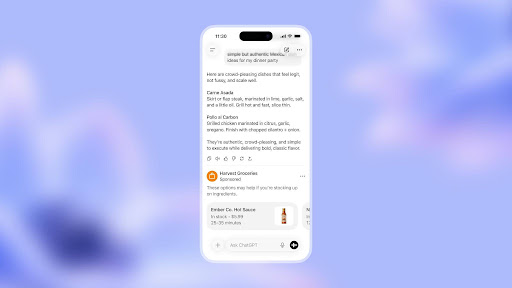
What are they, exactly? In simple terms, and in reality, they’re sponsored cards that appear beneath in-stream answers when interacting with ChatGPT, and they’re eligible to be seen by logged-in adults on the Free and Go tiers (if you pay for Plus, Pro, Business, Enterprise or Education, you won’t see ads, though every platform we’ve ever seen eventually found a way to monetize everything aside from their computer desks, so we’re willing to be that will change at some point). One other caveat, and it’s this — ChatGPT ads don’t run near health, mental health or political topics.
Here are the details on that one, sponsored card format: it includes your logo, a short headline (reviews suggest roughly 16 characters), a line of copy (about 32 characters), an image and a link. No video, no carousel, no lead forms, no shopping units with prices and ratings.
According to OpenAI, “people are often learning about a category, comparing options, or deciding what to do next,” and that encapsulates the purpose and value they see in ChatGPT ads. And every other digital ad platform, for that matter.
What Digital Yalo finds most interesting about ChatGPT’s situation is two-fold:
- It’s still early; the ad platform is just four months old, and it’ll only get better
- The platform has grown rapidly, and it’s not impossible to imagine a near-future scenario where the volume of users and time on site for ChatGPT rivals or exceeds entrenched rivals, perhaps even Google
But that doesn’t mean it’s where you should deploy your ad dollars today. The one big caveat is if you have dollars to test and learn, and incubate new paid opportunities for your organization. On the flip side, if you reside in the ‘average business’ — think one Google Ads account, one Meta Ads account, one very tired person running both — the answer for you is likely ‘not yet.’
The reason is simple: ChatGPT gives you none of the tools that the Meta and Google platforms rely on to make a dollar multiply its impact: no control over the intent you buy, no way to exclude what you don’t want, no lookalike audiences, no visibility into what triggered your spend, and only one creative format.
In short, the shiny new toy looks a lot like one you’d buy at a yard sale.
Specifically, there are a few examples we’ve landed on:
- Ad targeting utilizes “context hints,” which are plain-language descriptions of the conversations you’d like your ad to appear in. If you were counting on keyword bidding (this writer was), well, it’s not there. And thus, no negative keywords either (words that tell the platform what you don’t want your ad to show up next to).
- ChatGPT utilizes custom audiences (lists of identifiable first party data that help you pinpoint a known cohort of customers or users), but unlike other platforms, where you can utilize and deploy an ad against a list of a few hundred people, ChatGPT needs roughly 25,000 matched users, which rules out most of those ‘average businesses’ we talked about earlier.
- And perhaps most surprising is that there is no interest targeting, and no lookalike audiences even if you meet the above-mentioned 25,000 matched user threshold.
Which leaves what, exactly? A lot of trust in ChatGPT, for better or worse. In literal terms, it means describing what kind of intent you’d pay for, and which kind you wouldn’t. From there, you cross your fingers and hope ChatGPT figures it out.
Another important consideration, of course, is cost, but in ChatGPT’s case, those costs are scarcely reported and unverified: TheeDigital cites CPMs of roughly $12–$18 in lifestyle categories and $25–$40 in finance and B2B software; WebFX reports a recommended starting CPC of $3–$5 and no minimum spend.
So, not that far off from what some brands pay today to Meta (on the low end) or LinkedIn (on the higher end).
So, when is a good time to test the waters? If you’ve got the reserve budget to test it out now, you should; you can’t put a price on generating early learnings. But if that doesn’t describe your situation, we’d recommend waiting for stronger audience controls, expanded creative formats, stronger contextual relevance and control, and detailed reporting to show where exactly you had success — or didn’t.
Until then, we’re watching. But we’re not buying.
Insights & News
Insights & News
Insights & News
Insights & News
Insights And News