
Insight | 10.28.26

ChatGPT Ads Infancy: They Exist & That’s Most of What There is To Say

Let’s start with the basics: ChatGPT Ads are real, they’re growing quickly, and they have a self-serve platform for everyday users, major brands and agencies alike.

But they’re not worth a damn of your hard-earned ad dollars, not yet, at least.

What are they, exactly? In simple terms, and in reality, they’re sponsored cards that appear beneath in-stream answers when interacting with ChatGPT, and they’re eligible to be seen by logged-in adults on the Free and Go tiers (if you pay for Plus, Pro, Business, Enterprise or Education, you won’t see ads, though every platform we’ve ever seen eventually found a way to monetize everything aside from their computer desks, so we’re willing to be that will change at some point). One other caveat, and it’s this — ChatGPT ads don’t run near health, mental health or political topics.

Here are the details on that one, sponsored card format: it includes your logo, a short headline (reviews suggest roughly 16 characters), a line of copy (about 32 characters), an image and a link. No video, no carousel, no lead forms, no shopping units with prices and ratings.
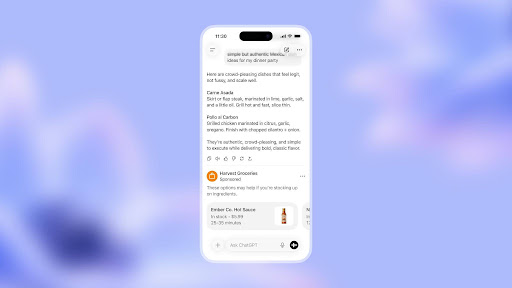
According to OpenAI, “people are often learning about a category, comparing options, or deciding what to do next,” and that encapsulates the purpose and value they see in ChatGPT ads. And every other digital ad platform, for that matter.

What Digital Yalo finds most interesting about ChatGPT’s situation is two-fold:

  1. It’s still early; the ad platform is just four months old, and it’ll only get better
  2. The platform has grown rapidly, and it’s not impossible to imagine a near-future scenario where the volume of users and time on site for ChatGPT rivals or exceeds entrenched rivals, perhaps even Google

But that doesn’t mean it’s where you should deploy your ad dollars today. The one big caveat is if you have dollars to test and learn, and incubate new paid opportunities for your organization. On the flip side, if you reside in the ‘average business’ — think one Google Ads account, one Meta Ads account, one very tired person running both — the answer for you is likely ‘not yet.’ 

The reason is simple: ChatGPT gives you none of the tools that the Meta and Google platforms rely on to make a dollar multiply its impact: no control over the intent you buy, no way to exclude what you don’t want, no lookalike audiences, no visibility into what triggered your spend, and only one creative format. 

In short, the shiny new toy looks a lot like one you’d buy at a yard sale.

Specifically, there are a few examples we’ve landed on:

  • Ad targeting utilizes “context hints,” which are plain-language descriptions of the conversations you’d like your ad to appear in. If you were counting on keyword bidding (this writer was), well, it’s not there. And thus, no negative keywords either (words that tell the platform what you don’t want your ad to show up next to).
  • ChatGPT utilizes custom audiences (lists of identifiable first party data that help you pinpoint a known cohort of customers or users), but unlike other platforms, where you can utilize and deploy an ad against a list of a few hundred people, ChatGPT needs roughly 25,000 matched users, which rules out most of those ‘average businesses’ we talked about earlier.
  • And perhaps most surprising is that there is no interest targeting, and no lookalike audiences even if you meet the above-mentioned 25,000 matched user threshold.


Which leaves what, exactly? A lot of trust in ChatGPT, for better or worse. In literal terms, it means describing what kind of intent you’d pay for, and which kind you wouldn’t. From there, you cross your fingers and hope ChatGPT figures it out.

Another important consideration, of course, is cost, but in ChatGPT’s case, those costs are scarcely reported and unverified: TheeDigital cites CPMs of roughly $12–$18 in lifestyle categories and $25–$40 in finance and B2B software; WebFX reports a recommended starting CPC of $3–$5 and no minimum spend. 

So, not that far off from what some brands pay today to Meta (on the low end) or LinkedIn (on the higher end).

So, when is a good time to test the waters? If you’ve got the reserve budget to test it out now, you should; you can’t put a price on generating early learnings. But if that doesn’t describe your situation, we’d recommend waiting for stronger audience controls, expanded creative formats, stronger contextual relevance and control, and detailed reporting to show where exactly you had success — or didn’t.

Until then, we’re watching. But we’re not buying.

Insight | 09.14.26

Don’t Get Sloppy: How to Use AI Without Losing Your Humanity

Artificial intelligence has become marketing’s favorite subject. Every week brings another platform promising to automate creativity, generate campaigns in seconds, or replace entire workflows. On the flip side, every new advancement sparks another wave of think pieces debating how to use AI, how much to use it, and whether we should be using it at all. While the technology is undoubtedly polarizing, we believe there’s a way to embrace it without replacing the very things that make great work human.

At its core, AI is a tool. We know, you’ve heard that a hundred times already. Like every transformative technology before it, its value depends entirely on how it’s used. The calculator didn’t eliminate mathematicians. Photoshop didn’t replace designers. Search engines didn’t make expertise obsolete. They simply gave talented people better tools. AI can  be viewed the same way. The problem is, it’s increasingly being used for anything and everything. And when that happens, the results become obvious. And messy. (Think: eating cereal with a hammer.) (Maybe not that exactly but tool metaphors are really hard to nail and who has the time, right?) 

You Can’t Build a Brand on Blog Posts Alone 

For marketers, that means letting AI handle the repetitive work that slows creativity down. It can summarize research, organize data, identify trends, draft initial concepts, and automate tedious tasks that once consumed valuable hours. Though SEO folk might argue otherwise, marketing has never been about producing the most content. It’s about messaging that resonates because it understands people. Great brands are built on insight, empathy, emotion, and originality; qualities that come from experience, curiosity, and human perspective.

AI can certainly generate words. It can imitate styles, recognize patterns, and predict what has worked before. What it can’t do is understand why a founder tears up while telling their company’s story. It can’t read the room during a strategy session or recognize the subtle tension behind a client’s hesitation. It can’t instinctively know when a campaign should challenge convention instead of following it. Those moments require emotional intelligence, and that’s something technology still can’t replicate.

What Do We Want? Strategy! When Do We Want It? ASAP! Or maybe EOD? Can We Make this a Priority, Please? 

Ironically, one of AI’s biggest risks isn’t that it will create bad marketing. It’s that it will create average marketing. As more organizations rely on the same models, prompts, and workflows, we’re already seeing content begin to blend together. It sounds polished, checks all the boxes and is instantly forgettable, labeled “AI Slop,”  or both. 

Memorable brands have distinct points of view, bold ideas, and the confidence to say something unexpected. AI can help get those ideas to market faster, but it can’t create an authentic brand voice from scratch. That voice comes from understanding your audience, knowing your values, and having the courage to communicate both consistently.

This is why strategy matters more than ever. AI can’t execute against a direction that has no direction. (And it’s no picnic for humans, either.) Businesses with a weak brand strategy won’t solve that problem by adding AI. They’ll simply create more content that lacks clarity. Organizations with a strong strategic foundation, however, can use AI to scale their thinking without sacrificing quality or consistency. The companies getting the most from AI are removing friction from the creative process so teams can spend less time formatting presentations and more time asking better questions. In other words, less time creating volume and more time creating value.

Don’t Strip the Art from Artificial

Oh, and one more thing. Like your teachers always said: check your work. AI can misinterpret context, invent facts, cite outdated information, or confidently present incorrect conclusions. That’s why every AI-generated draft should be treated as a starting point, and why the human review process remains essential for verifying accuracy, checking sources, refining tone, and ensuring the final work truly reflects the brand’s voice and objectives. 

Marketing has always been about understanding people before persuading them. No technology changes that. If anything, AI makes it even more important. As automated content floods every channel, authentic ideas, genuine storytelling, and strategic thinking become increasingly valuable. The future doesn’t belong to brands that choose between artificial intelligence and human creativity. It belongs to those that understand the two are strongest together. 

Insight | 07.02.25

Beyond the Click: Why Media Strategy Needs More Than Just a Magic Button

When a client asks, “What’s the ROI of [insert ad channel here]?” what they’re really asking is, “Which magic button can I press to make results appear?”

We get it. Attribution is intoxicating. ROAS feels like truth. And with the rise of AI-powered buying tools, real-time dashboards, and third-party data integrations, it’s never been easier to see results. 

But here’s the kicker: the numbers you can track are only part of the story. The rest? That’s where we come in.

Our Approach

At Yalo, our media team is built differently, with the knowledge that data is a critical tool, but it’s not the whole tool belt. 

We’re full-funnel, full-service, and fully fluent in the nuances of both digital and traditional channels. And yes, when to trust ROAS metrics, and when to be a healthy skeptic. From CTV and podcasts to SEM, print, programmatic, and beyond—we’re not here to rack up views, we’re here to make them count.

How? We use in-platform and third-party AI tools not just to chase efficiency, but to ensure impact. 

Whether it’s uploading a CRM list through LiveRamp, creating historical geotargeting audiences via third-party partners, or running brand lift studies across healthcare or general market categories, we’re not guessing—we’re pinpointing.

The Planning Process

Our planning process is powered by research partners like MRI Simmons and Comscore. 

Our buying is enriched with purchase-level data from credit bureaus and intent signals. And our reporting? Custom dashboards that are live, accessible, and actually usable, so clients aren’t stuck staring at a spreadsheet asking ‘so what?’

Get Creative

But tech alone won’t win the war.

You still need great creative. An integrated media mix. A message that lands. And yes, that includes a team that understands your business well enough to challenge your assumptions.

While it’s tempting to chase short-term wins with last-click logic, the truth is: 91% of people who buy your product saw your ads and didn’t click them (Nielsen). 80% bounce between devices before purchase. And 40% use more than one screen to complete a transaction (eMarketer).

So, what’s the ROI of that?

Truth is, the most impactful plans don’t just ask, “What channel will convert?” They ask:

  • Where does your audience live, scroll, shop, or tune out?
  • What will they remember tomorrow?
  • What combination of message, medium, and moment creates action?

That’s what we do.

The Yalo Difference

Our tribe connects the dots between strategy, storytelling, and sales. Between the art and the algorithm. Between “what you’re doing” and “why it’s working.”

There’s no magic button. Just media done right. And that’s the Yalo way.

Insight | 01.17.25

Encore! How AI Helped The Strand Theatre Steal the Show in Media Performance

They say all the world’s a stage, but when you’re running media for a historic theatre like The Strand, the real performance happens behind the scenes—in dashboards, data, and media spend optimizations. Our task? Drive ticket sales for a lineup of wildly different shows, from classic films to live concerts, all while ensuring our client got the best bang for their advertising buck. Enter AI, the ultimate understudy that helped us steal the show in media performance.

Act One: Understanding Our Audience with AI

The first challenge was figuring out exactly who we needed to have sitting in the proverbial front row: our target customer. But with such a diverse lineup of performances, that audience was a varied one. AI helped us break it down by analyzing Meta’s audience data at scale and identifying patterns in who was engaging, who was buying tickets to which types of shows, and (more importantly) who wasn’t.

  • For classic movie nights, we saw higher engagement from an older demographic that responded well to nostalgic content.
  • For concerts, AI pinpointed younger audiences that skewed towards certain music genres based on their social interactions.
  • Theatre performances? A mix of local patrons and die-hard fans, depending on the production.

Engaging them on their terms added another layer to our efforts. Rather than relying on assumptions, AI helped us tailor our messaging and audience targeting to match the unique vibe of each show.

Act Two: Optimizing Spend Like a Broadway Producer

Once we had our audiences locked in, we made sure our ad dollars were putting on a Tony-winning performance. We wielded AI by continuously analyzing which channels and creative assets were hitting the right notes at the moment of transaction.

  • If carousel ads were outperforming static images, AI flagged it.
  • If video ads were getting stronger engagement, AI shifted more budget their way.
  • If a particular behavioral subset was buying more tickets, AI made sure we prioritized their feeds (and in the process, we learned that behaviors trumped demographics when it came to driving sales).

This real-time, data-driven decision-making kept us from wasting budget on underperforming tactics and ensured we doubled down on what worked. Think of it as a media strategy that constantly fine-tuned itself, like a sound engineer tweaking the mix to get the perfect balance.

Act Three: ROI That Kept Getting Better

A great show builds momentum; our campaigns did too. Thanks to our team’s prowess in deploying AI to parse analytics at scale, we didn’t just see good performance, we saw better performance month over month.

  • We refined audience segments based on actual purchase behavior, not just interest-based assumptions.
  • We kept shifting budget dynamically to high-performing content types.
  • We analyzed ad fatigue in real time, swapping out creative before engagement dipped.

By the time the final curtain fell, The Strand Theatre had maximized its media spend while continuously improving ROI. The result? More ticket sales, smarter budget allocation, and a digital media strategy that played to a standing ovation.

The Takeaway: AI is the Ultimate Tech Crew

We didn’t use AI to replace our expertise, we used it to enhance it. It helped us make smarter, faster, and more data-driven decisions, allowing us to move budget with precision and drive higher returns. In the world of media strategy, it was a box-office smash.

And with AI in the mix? Let’s just say we’re already looking forward to several encores. 

Insight | 05.11.21

Social Media Diffusion


Is Your Social Media Messaging Good Enough?

Does it make a difference what and how you post on social media? Don’t you just need to maintain a presence? Or if you do not have a presence, then how do you know the right message is getting out there to your target audience? In reality, it’s all about emotion, quantity and speed. Your company’s social messages Do make a difference, because business social media is exploding.

The Social Media Explosion

How fast are social networks growing?

  • Percentage of users ages 16-64 who are increasing social media use – 43%
  • Annual growth in total number of social media users – 10.5% =376 million

Across age groups, where are the commercial uses for social networks:

  • Discovering brands/products via ads on social – 27%
  • Discovering brands/products via recommendations on social – 24%
  • Researching products online via social – 43%

Simultaneous to audience growth, information being added to the Internet will grow from 4.4 billion GB per day in 2016 to 463 billion GB per day in 2025 (IDC estimate). With exploding users and content projected to grow a 100-fold per day, how do you differentiate your messaging to gain, maintain and grow followers, engagement and sales? How do you make sure your content influences and accelerates through the Internet, so you get your “share of eyeballs?”

Social Media Diffusion

Information diffusion is how fast data is moving through a network. It has been studied extensively in social, physical and computational sciences. Research in word of mouth and viral marketing has been documented in business literature. With the emergence of social media, new communication techniques have been explored such as: SMS, weblogs, picture-sharing portals and online communities. The following research considers the variables that effect the diffusion on information on social networks.

Sentiment and Social Media Quantity and Speed

Steiglitz and Xuan conducted research on the effect of emotion on political tweets. This research analyzed 64,432 tweets posted one week before two German state parliament elections. They proved the following hypotheses:

  • The larger the total amount of sentiment (positive or negative) a political Twitter message exhibits, the more often it is retweeted.
  • The larger the total amount of sentiment (positive or negative) a political Twitter message exhibits, the shorter is the time lag to the first retweet.

Using supervised learning (regression) the study considered: 

Dependent variables

  • Number of times the tweet has been retweeted
  •  Time lag between the tweet and the first retweet

Independent variables

  • Total amount of sentiment
  • Number of hashtags
  • URL inclusion
  • # of user’s followers
  • Number of tweets posted during the sample period activity.

The regression models’ coefficients indicated that for every unit increase in negative words there was a 6% increase in retweets(pg. 238). Likewise, for every unit increase in positive words there was a 4% increase in retweets. An important hypothesis they were not able to prove:

  • The association between sentiment and retweet time lag is stronger for tweets with negative sentiment than those with positive sentiment.

Sentiment and Social Media Predictability

Ashan and Kumari researched 20,000 tweets on the 2016 U.S. presidential election. The analysis considered the impact of sentiment along with the following environmental factors in predicting information diffusion:

  • URL’s
  • Hashtags
  • Number of followers
  • Account age
  • Tweet age
  • # User created tweets

Using two different regression approaches, analysis was completed determining the independent variables that provided the best model predictability. As seen below, in each model sentiment content was included and provided a significant increase in predictability.

Graphical user interface, chart

Description automatically generated with medium confidence

Including the sentiment content significantly improves the predictability of social media performance and is enhanced with the ability to consider hashtags.

Sentiment and Positivity

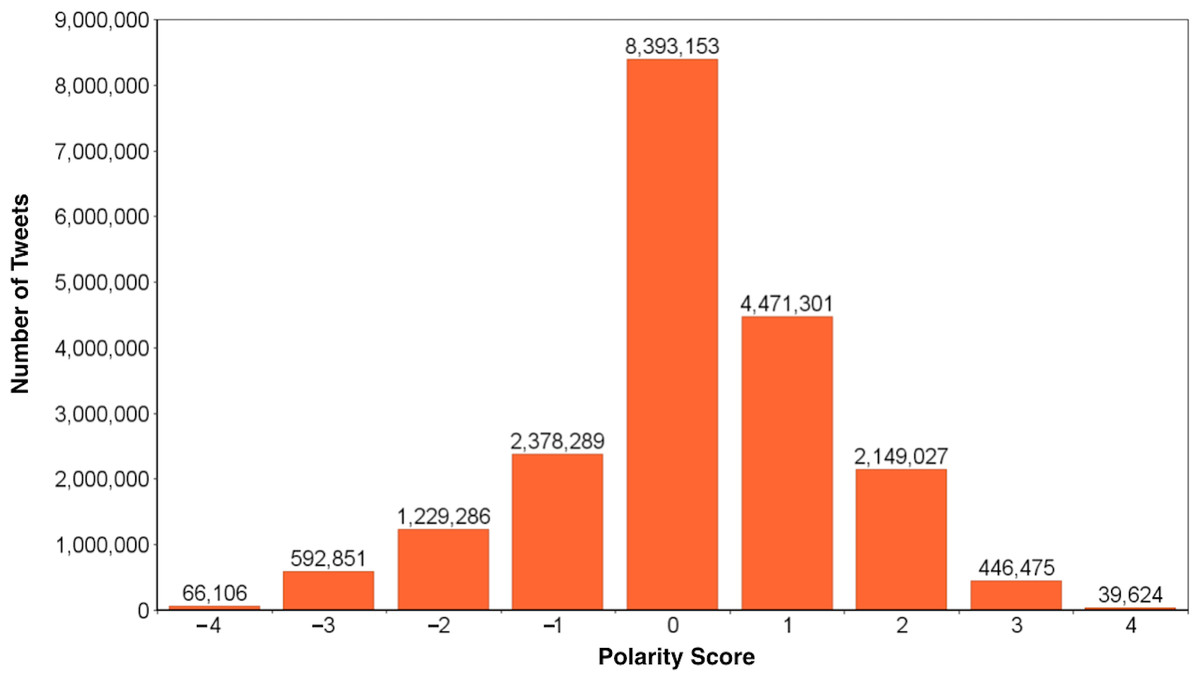
Ferrara and Yang conducted a study of 19 million tweets with the following distribution:

Distribution of polarity scores computed for our dataset.

Their findings indicated that positive tweets reach a larger audience and are shared more often. As tweet score becomes more positive, the number of retweets, favorites and seconds to first retweet increases at an accelerated rate.

Just how much of a difference does positivity make:

  • Positive tweets are favorited 5 times the rate of negative tweets.
  • Positive tweets are retweeted 2.5 time faster than neutral or negative tweets.

So What? – Words Make a Difference

These are the key findings on sentiment content:

  • Sentiment content increases the quantity of social media traffic and its speed through social media channels
  • Sentiment contentm, used in addition to environmental factors, improves the predictability of social media diffusion
  • Increased positive sentiment content increases social media acceptance and diffusion (spread and shares)

At Yalo, we feel that your words really make a difference. There are many environmental factors that also need to be considered. With these environmental factors we have varied levels of control; however it comes to how we share content we have complete control. Control of what we share and also how we share it! Sentiment analysis from Yalo is the tool to tune content delivery for influencing followers and customers, as well as for analyzing social media traffic that reflects and responds to brand image.

Interested in this fascinating new Yalo marketing-communications and analytics service? Curious how it could be applied towards your business goals? Let’s have a conversation for nuanced understanding.