

Insight | 10.28.26

ChatGPT Ads Infancy: They Exist & That’s Most of What There is To Say

Let’s start with the basics: ChatGPT Ads are real, they’re growing quickly, and they have a self-serve platform for everyday users, major brands and agencies alike.

But they’re not worth a damn of your hard-earned ad dollars, not yet, at least.

What are they, exactly? In simple terms, and in reality, they’re sponsored cards that appear beneath in-stream answers when interacting with ChatGPT, and they’re eligible to be seen by logged-in adults on the Free and Go tiers (if you pay for Plus, Pro, Business, Enterprise or Education, you won’t see ads, though every platform we’ve ever seen eventually found a way to monetize everything aside from their computer desks, so we’re willing to be that will change at some point). One other caveat, and it’s this — ChatGPT ads don’t run near health, mental health or political topics.

Here are the details on that one, sponsored card format: it includes your logo, a short headline (reviews suggest roughly 16 characters), a line of copy (about 32 characters), an image and a link. No video, no carousel, no lead forms, no shopping units with prices and ratings.
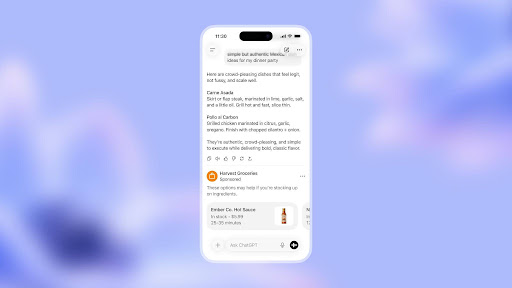
According to OpenAI, “people are often learning about a category, comparing options, or deciding what to do next,” and that encapsulates the purpose and value they see in ChatGPT ads. And every other digital ad platform, for that matter.

What Digital Yalo finds most interesting about ChatGPT’s situation is two-fold:

  1. It’s still early; the ad platform is just four months old, and it’ll only get better
  2. The platform has grown rapidly, and it’s not impossible to imagine a near-future scenario where the volume of users and time on site for ChatGPT rivals or exceeds entrenched rivals, perhaps even Google

But that doesn’t mean it’s where you should deploy your ad dollars today. The one big caveat is if you have dollars to test and learn, and incubate new paid opportunities for your organization. On the flip side, if you reside in the ‘average business’ — think one Google Ads account, one Meta Ads account, one very tired person running both — the answer for you is likely ‘not yet.’ 

The reason is simple: ChatGPT gives you none of the tools that the Meta and Google platforms rely on to make a dollar multiply its impact: no control over the intent you buy, no way to exclude what you don’t want, no lookalike audiences, no visibility into what triggered your spend, and only one creative format. 

In short, the shiny new toy looks a lot like one you’d buy at a yard sale.

Specifically, there are a few examples we’ve landed on:

  • Ad targeting utilizes “context hints,” which are plain-language descriptions of the conversations you’d like your ad to appear in. If you were counting on keyword bidding (this writer was), well, it’s not there. And thus, no negative keywords either (words that tell the platform what you don’t want your ad to show up next to).
  • ChatGPT utilizes custom audiences (lists of identifiable first party data that help you pinpoint a known cohort of customers or users), but unlike other platforms, where you can utilize and deploy an ad against a list of a few hundred people, ChatGPT needs roughly 25,000 matched users, which rules out most of those ‘average businesses’ we talked about earlier.
  • And perhaps most surprising is that there is no interest targeting, and no lookalike audiences even if you meet the above-mentioned 25,000 matched user threshold.


Which leaves what, exactly? A lot of trust in ChatGPT, for better or worse. In literal terms, it means describing what kind of intent you’d pay for, and which kind you wouldn’t. From there, you cross your fingers and hope ChatGPT figures it out.

Another important consideration, of course, is cost, but in ChatGPT’s case, those costs are scarcely reported and unverified: TheeDigital cites CPMs of roughly $12–$18 in lifestyle categories and $25–$40 in finance and B2B software; WebFX reports a recommended starting CPC of $3–$5 and no minimum spend. 

So, not that far off from what some brands pay today to Meta (on the low end) or LinkedIn (on the higher end).

So, when is a good time to test the waters? If you’ve got the reserve budget to test it out now, you should; you can’t put a price on generating early learnings. But if that doesn’t describe your situation, we’d recommend waiting for stronger audience controls, expanded creative formats, stronger contextual relevance and control, and detailed reporting to show where exactly you had success — or didn’t.

Until then, we’re watching. But we’re not buying.

Insight | 05.08.26

How We Build Media Plans That Can Flex and Scale

By David Berry

Marketers humans love certainty. But reality rarely cooperates.

And that’s true in business. Markets change. Platforms change. Costs change. Sometimes the strategy you believed in on Monday looks shaky by Thursday.

That’s why our best media plans aren’t rigid documents. They’re a guide, but a guide that always ties directly to business outcomes, adapts as data rolls in, and scales when the proof is present.

Here’s how we build them.

1. A Goal Without a Measure Is Just a Wish

Every media plan starts with a simple question: what outcome actually matters to the business?

Sometimes that’s straightforward. Leads. Sales. Bookings. App installs. Revenue.

Other times the answer sits higher in the funnel. Brand awareness. Consideration. Maybe education. In those situations, the role of media isn’t to close the sale directly, but to create the conditions that make the sale possible later.

Either way, the principle is the same. Every objective needs a measurable signal attached to it.

If the goal is awareness, we define the signals that prove awareness is growing.

If the goal is consideration, we define the signals that prove it’s deepening.

If the goal is conversion, we track the metrics that track to revenue.

A media plan without defined success metrics isn’t a strategy, it’s a guess.

2. We Start With People, Not Platforms

One of the quiet traps in our work is platform bias.

Many agencies default to the same playbook every time: Meta and Google for digital.

Programmatic display for reach. TV for awareness.

But media channels are tools, not strategies.

The real starting point is understanding the audience: who they are, what they care about, how they spend their time, and where messages might have disproportionate impact.

A homeowner considering a major renovation behaves differently than a college student choosing a food delivery app. A grocery category manager evaluating new suppliers lives in a completely different information ecosystem than a consumer shopping for patio furniture.

Different behaviors create different media opportunities.

Sometimes the answer really is Meta or Google (there’s a reason they’re so massive; their platforms work). But, other times the highest-impact placements live somewhere less obvious: a niche publication, creator partnerships, or situational moments where the message carries more weight. Or Facebook mom groups (seriously, they’re incredible).

It’s simple thinking. But it requires discipline.

The platform should serve the audience strategy. Not the other way around.

3. Flexibility Isn’t a Backup Plan. It’s the Plan.

No matter how thoughtful the strategy is, the first version of a media plan is a hypothesis.

We have research. We have benchmarks. We have experience. But until campaigns are live and real data starts coming in, every assumption still needs to prove its worth.

That’s why flexibility is built into the structure from the beginning.

Budgets can shift between audiences.

Creative approaches can evolve.

Channels can scale up or scale down depending on performance.

If the data confirms the strategy, we lean in and expand the investment.

If the data tells us something different, we pivot. 

The goal isn’t to defend the original plan. The goal is to produce the best possible business outcome.

Being wrong is okay — as long as you pivot quickly.

The Real Advantage of Flexible Media Planning

When a media plan is tied to real outcomes, grounded in audience behavior, and designed to adapt to live performance data, it becomes more than a repeatable process.

It becomes a growth engine.

Good signals get amplified.

Weak signals get corrected.

And the strategy improves with every cycle of learning.

That’s how media our plans flex.

And that’s how we scale.

Insight | 11.13.25

Reach Your Online Potential with a Digital Advertising Audit

Struggling to make the most of your digital advertising? You’re not alone. Between shifting algorithms, rising ad costs, and endless options for where to spend, it’s easy to wonder whether your efforts are really paying off.

Whatever your motivations may be, we’re here to help you achieve them.

A digital advertising audit isn’t about pointing fingers or ripping apart your strategy. It’s about taking a clear, honest look at what’s working, what’s not, and where there’s room to grow. We don’t believe in a one-size-fits-all approach, so we’ll tailor our recommendations to fit your specific needs.

For some brands, the goal might be more leads or higher sales. For others, it’s building awareness, connecting with the right audience, or even carving out a stronger role in their industry. No matter the endgame, an audit offers the kind of insight that helps you align your advertising with your bigger picture.

Here’s how we tackle digital advertising audits:

  1. Define objectives: Before we begin the audit, we clearly define objectives. What is our client hoping to achieve with their digital advertising? Are they looking to increase website traffic, generate more leads, or improve ROI? Having a clear set of objectives helps focus the audit and ensure that we are measuring the right metrics.
  2. Gather data: We collect all the relevant data from their website, email, and social and digital ad channels. This should include metrics such as website traffic, click-through rates, conversion rates, engagement rates, and cost-per-acquisition. We use tools like Google Analytics, social media analytics, and email marketing software to gather this data.
  3. Evaluate website: We start by evaluating the website, checking for any technical issues that may be impacting SEO or user experience. We also look for broken links, slow loading times, or any other issues that may be negatively impacting the website’s performance.
  4. Evaluate email marketing: Review email marketing campaigns to determine if they are achieving the client’s goals. Evaluate open and click-through rates, as well as conversion rates. Make sure that their email campaigns are optimized for mobile devices and that they are using best practices to avoid ending up in spam folders.
  5. Evaluate social media channels: Evaluate social media channels to determine if they are reaching the target audience(s) and generating engagement. Look for opportunities to improve content and engagement strategies. Determine which social media channels are providing the most ROI.
  6. Evaluate digital advertising campaigns: Evaluate digital advertising campaigns to determine if they are delivering results. Look at cost-per-click, cost-per-acquisition, and return on ad spend. Identify any areas for optimization, such as targeting or creative.
  7. Identify strengths and weaknesses: After evaluating each channel, identify the strengths and weaknesses of the digital advertising strategy. Determine what is working well and what needs improvement.
  8. Develop an action plan: Based on our findings, we develop an action plan to improve the client’s digital advertising strategy. We prioritize the changes that will have the biggest impact on their objectives. Set measurable goals and track progress over time.
  9. Implement action plan: Implement the changes identified in our action plan. Monitor progress and make adjustments as needed.
  10. Review and refine: Conduct regular reviews of the digital advertising strategy to ensure that we are staying on track and achieving the client’s objectives. Refine the strategy as needed to keep pace with changes in the market and new opportunities.

A fresh look at your digital advertising can uncover opportunities you didn’t even realize were on the table. If you’re ready to see where your campaigns stand and how they could work harder for you, reach out. We’ll dig into the details, cut through the noise, and help you build a strategy that actually delivers.